
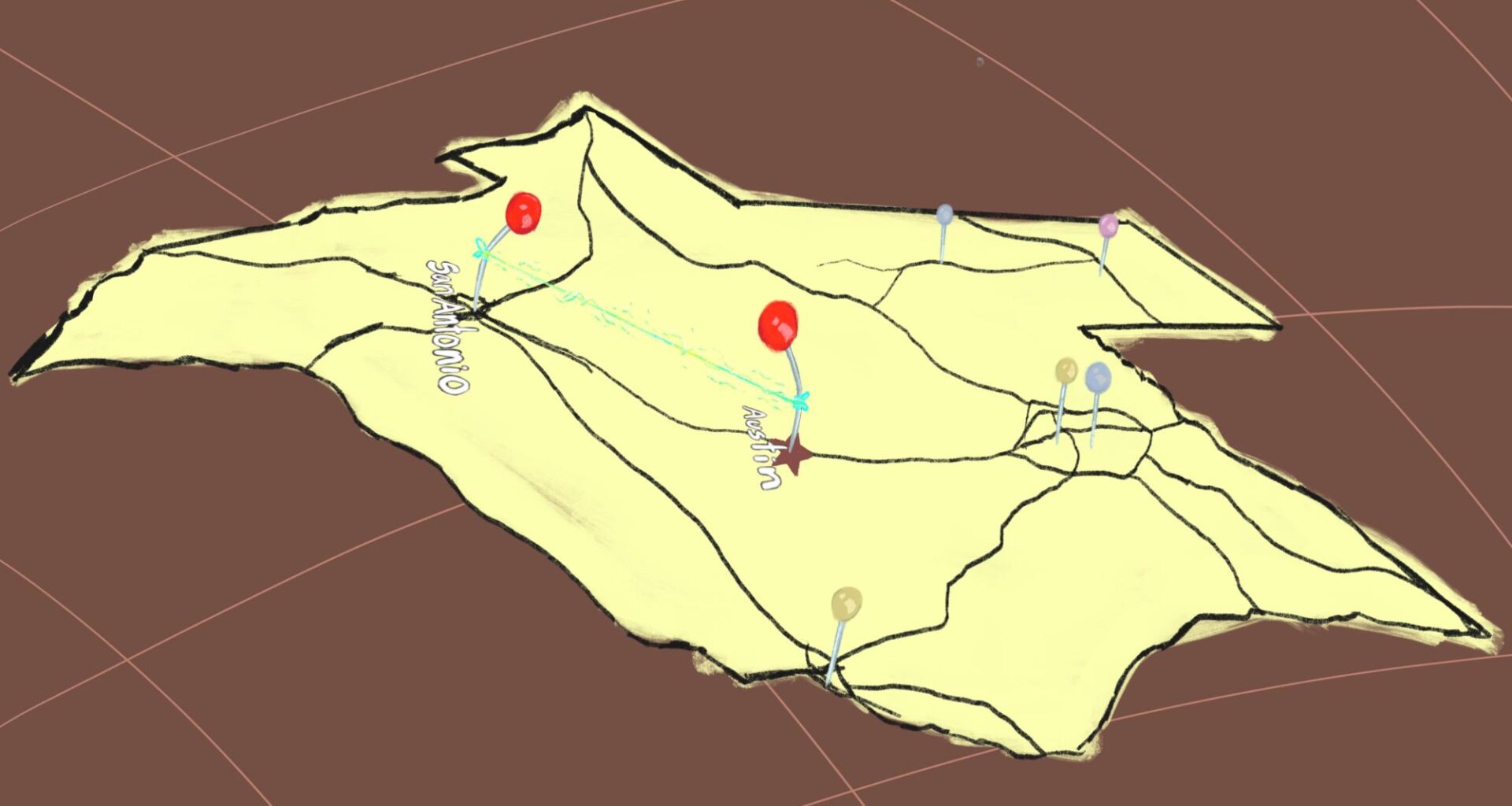
Billionaire entrepreneur Elon Musk announced that his transportation company, the Boring Company, plans on constructing a Hyperloop tunnel between Austin and San Antonio in a Sept. 20 X post.
In the post, Musk wrote the trip from San Antonio to Austin takes about 2.5 hours one way, depending on traffic, but under this new plan, this time could be cut down to under 30 minutes.
James Bass, the executive director of the Central Texas Regional Mobility Authority, said he was not aware of any plans to make a tunnel before Musk posted. The CTRMA is a government agency that operates and maintains toll roads and other transportation projects in Travis and Williamson counties.
“It remains unclear whether the ‘precursor’ system would rely on conventional electric vehicles, such as the Teslas … or whether it would incorporate true Hyperloop architecture, with passenger pods traveling through low-pressure vacuum tubes,” Bass wrote in a statement.
Christian Claudel, associate professor at the Cockrell School of Engineering whose research specializes in transport engineering, has concerns about the feasibility of Musk’s Hyperloop.
Typically, Claudel said, the term “hyperloop” refers to a train in a vacuum-like environment such as an airtight tunnel, where the lack of air drag can enable speeds as fast as 600 miles an hour. Producing such conditions would require the Boring Company to fund what he said would be an incredibly expensive project, and overcome significant technical hurdles, like finding ways to avoid air leaks and building emergency and maintenance access points.
Druhinh Roy, an electrical and computer engineering junior, is the president of Texas Guadaloop, an engineering organization on campus that researches prototype hyperloop technology. A different, and slower, model for the hyperloop may be more likely to be implemented, he said.
“(Musk) did say something around 200 miles per hour, which is a bit slower than I was expecting for a hyperloop,” Roy said.
The Boring Company has built similar transit systems in the past. The “Vegas Loop,” located in Las Vegas, is a service that uses one-lane tunnels to shuttle users in Tesla vehicles from one part of the city to another, according to the Boring Company website.
Anara Getter, a textiles and apparel freshman from San Antonio, said that for people from her area who go home often from college, some sort of hyperloop could be useful.
“I think there are people that could use it,” Getter said. “But for me personally, I really like the route that I’m on and I will stick to that.”
Bass wrote building a 80-mile tunnel will present logistical challenges, such as managing environmental concerns and receiving regulatory approvals.
“At the same time, Mr. Musk has achieved notable successes in several ventures by pursuing approaches that departed from conventional industry practices,” Bass said.