
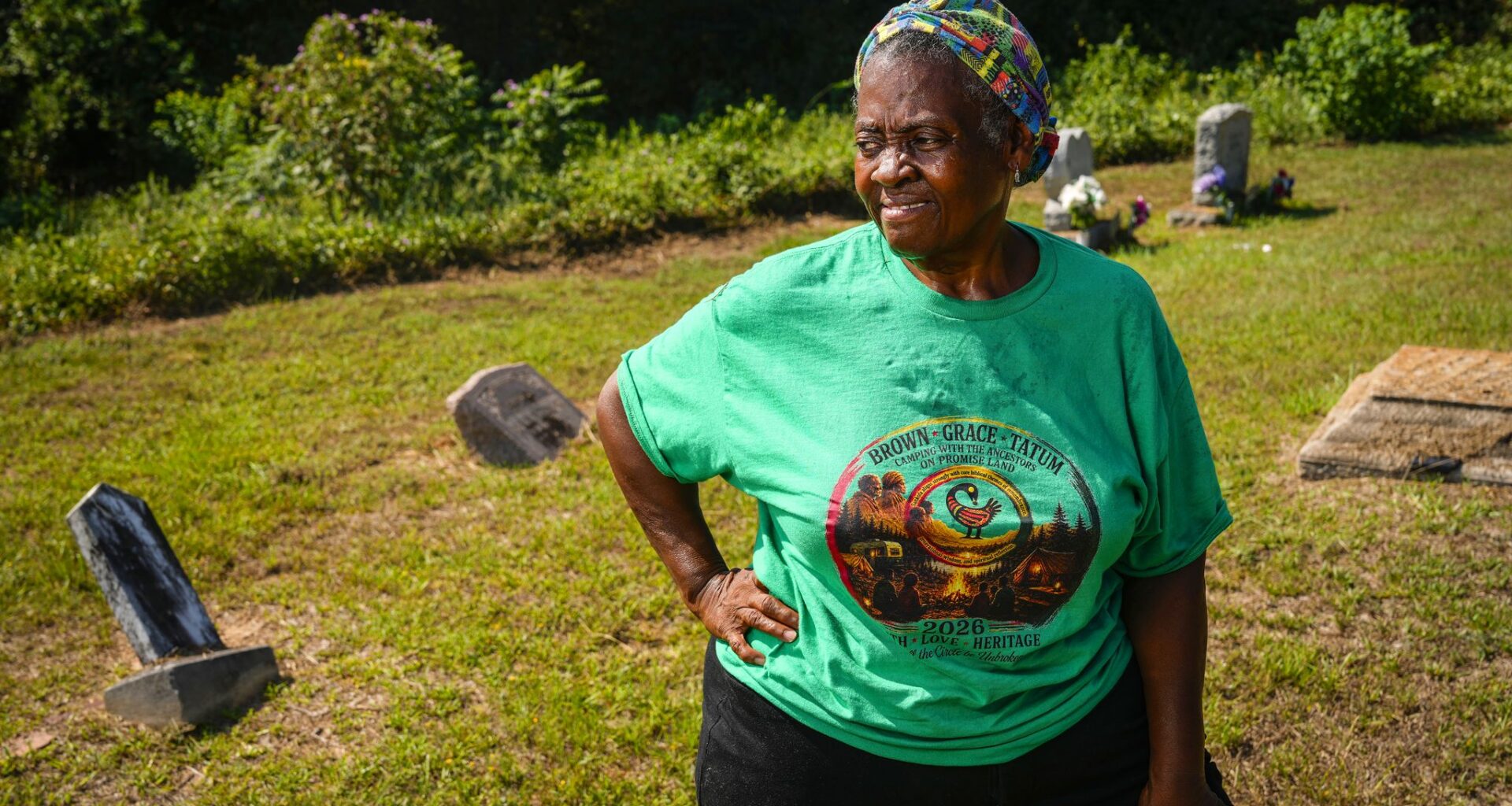
Jacque Tatum walks through the Mount Gillion Cemetery where much of her family is buried near Center, Wednesday, Sept. 16, 2026. In East Texas, many families have passed down large tracts of land generation to generation without wills, meaning that today, dozens of heirs may own shares in a property. A group is forming to help them keep their land by connecting them to legal services and ways to use the land.
Brett Coomer/Houston Chronicle
Jacque Tatum, who is one of 95 heirs to 80 acres near the Louisiana border, walks through the Mount Gillion Cemetery where much of her family is buried in Center, Wednesday, Sept. 16, 2026.
Brett Coomer/Houston Chronicle
Jacque Tatum, who is one of 95 heirs to 80 acres near the Louisiana border, stands near a home that several members of her family grew up in near Center, Wednesday, Sept. 16, 2026.
Brett Coomer/Houston Chronicle
Autry Tatum checks the mailbox next to a tract of land that several members of his family are heir to in Center, Wednesday, Sept. 16, 2026.
Brett Coomer/Houston Chronicle
Debbie Bates Turner, niece of Jacque Tatum, who is one of 95 heirs to 80 acres near the Louisiana border, wipes the gravestone of family patriarch Robert W. Tatum, at the Mount Gillion Cemetery in Center, Wednesday, Sept. 16, 2026.
Brett Coomer/Houston Chronicle
Jacque Tatum, who is one of 95 heirs to 80 acres near the Louisiana border, walks through the Mount Gillion Cemetery with her niece Debbie Bates Turner in Center, Wednesday, Sept. 16, 2026.
Brett Coomer/Houston Chronicle
Jacque Tatum, who is one of 95 heirs to 80 acres near the Louisiana border, checks on a fallen gravestone of a family member at the Mount Gillion Cemetery where much of her family is buried in Center, Wednesday, Sept. 16, 2026.
Brett Coomer/Houston Chronicle
In the decades after slavery was abolished, Robert Tatum became one of an untold number of Black Texans who bought their portion of the American dream.
His 300 acres in East Texas were fertile, providing corn, peas, okra, watermelon, cantaloupes, apples. He and his neighbors, many of them freedmen or their children, would take turns hunting wild boar and sharing the meat. There were cows and chickens, butter and eggs.
“No one ever came to our house and left hungry,” his grandson, Autry Tatum, 76, reminisced.
Article continues below this ad
Autry Tatum stands near his childhood home near Center, Wednesday, Sept. 16, 2026. “I loved it,” he said of his rural childhood on the land.
Brett Coomer/Houston Chronicle
This summer, a network of lawyers and advocates, known as the East Texas Heirs’ Property Initiative, launched to help families hold onto such properties.
A fault line ran through the Tatums’ self-sufficiency, and through that of other families throughout the region and the South. In 1900, 99% of Texas attorneys were white men. Many families lacked access to a lawyer, and they wouldn’t necessarily trust one. So after Robert Tatum’s death, his land, like the land of many others in the region and throughout the South, didn’t go through probate court to change the name on the deed or officially split the property between heirs. In such cases, the heirs inherit a share of the property. Tatum had 12 children — each inherited an 8% share.
As baby boomers pass away in the coming years, a big part of their legacy will be the property they leave their children, which has become more valuable as real estate prices have risen far faster than wages. But the Great Wealth Transfer, as it has been called, won’t be equal. Land jointly owned by heirs whose names aren’t on the deed, like Robert Tatum’s remaining 80 acres, is vulnerable to loss or forced sale at far below market value.
Article continues below this ad
KNOCKING ON DOORS: Meet the team trying to save Houston family homes
Enter the East Texas Heirs’ Property Initiative. Many members have their own stories about family land in East Texas. A lawyer, paralegal and forester are dedicated to educating heirs on the law, providing free legal aid and finding ways to generate income from the land to make it easier to keep in the family.
While they focus on land in East Texas, much of their outreach is in Houston, based on the hunch that many seniors living there now come from families in rural East Texas.
“That hunch has proven to be true,” said John Cooper, the initiative’s consulting project director.
Growing family trees
Jacque Tatum, 73, grew up in Houston’s Fifth Ward. One of Robert Tatum’s granddaughters, she would take a more than three-hour drive to Shelbyville with her dad three or four times a year. He would help clean the cemetery, pay dues to the church and visit his brothers. When she played hopscotch with the other children after service, it was different than in the city; they skipped on grass instead of concrete and marked the course with branches instead of chalk.
Article continues below this ad
In the ’70s, her dad and two of her uncles asked her to make sure the family didn’t sell the land. In the early 2000s, she began researching how to protect heirs’ property. It began, she learned, with mapping out all the heirs associated with the property and finding a way to make decisions together, a process that would require a lawyer.
The grave of family patriarch Robert W. Tatum is shown at Mount Gillion Cemetery in Center, Wednesday, Sept. 16, 2026.
Brett Coomer/Houston Chronicle
She began investigating the family tree. It turned out most of Robert Tatum’s 12 children had children of their own.
Article continues below this ad
Growing loblolly pines
Meanwhile, Gregory L. Phillips’ phone rang with calls from heirs seeking help keeping or reclaiming their family land.
Like Jacque Tatum, Phillips lives in Houston, where he works as a corporate securities lawyer. His day-to-day involves ironing out the complicated details of company mergers and acquisitions.
It’s a high-powered, big-city job. “My whole life, I’ve tried to run from my country roots,” he said.
But both his parents are from a part of East Texas about an hour and a half west of the Tatum land, and 30 years ago, his father and uncles asked for his help keeping a 220-acre tract of land that has now been in the family for over 120 years.
Article continues below this ad
Families often lose land when one heir wants to cash out their share, which can trigger a court-ordered sale of the whole property. (A recent change in state law aims to make this less common by first allowing the family to buy out the heir, but advocates say many are unfamiliar with the process.)
HEIRSHIP STUDY: Families live in inherited homes. Trouble proving ownership can keep families from repairs and help.
Phillips’ family wanted to get ahead of the possibility by buying out the cousins who didn’t have a strong emotional connection to the land where Phillips had spent his childhood picking berries and gathering pecans and hunting raccoons among the tall, resinous, sweet pines.
Luckily for their family, acquiring interests was literally Phillips’ bread and butter. He created a corporate structure for the land with clear buy-and-sell language.
Problem solved. Well, not quite. At the time, the land was used for cattle. Phillips would get calls in the middle of the night — a storm had rolled through, a fence was down, the cows were out. He was 140 miles away. Again, the thought of selling the land crossed his mind.
But a cousin encouraged him to consider other land uses, which led him to network with several organizations that worked with landowners. He ended up selling the cattle and planting 40,000 loblolly pines through a government program meant to protect rural land from development.
A tract of Jacque Tatum’s family’s land in East Texas. A new nonprofit, the East Texas Heirs’ Property Initiative, is helping heirs look into ways to make their land profitable without selling it. A common use is forestry through a government program meant to protect rural land from development.
Brett Coomer/Houston Chronicle
It also led him to a relationship with Prairie View A&M University, which asked him to share his experience by educating Black rural landowners about sustainable forestry. He led dozens of legal workshops on the subject, most of them virtual because of the pandemic that was unfolding at the time.
Which led to the phone calls asking for help.
He searched for organizations to refer them to — somewhere that specialized in heirship property and could help sort out the legal issues and guide them on how to use the land.
And he found a place that did just that, but in South Carolina: the Center for Heirs’ Property.
He convinced the nonprofit to help launch a sister organization in East Texas, and together they won a five-year grant to do so.
Growing a nonprofit for East Texas heirs
The Center for Heirs’ Property was founded in 2005, after a foundation held community focus groups and was struck by how many people had a story that started the same way: “I own land, but…”
Today, the center organizes its work around five pillars. It offers education to help families draft simple wills. It provides the legal services needed to hold onto a property, such as resolving title issues, updating deeds and going through probate. It helps families with acreage turn their land into an income-producing timber farm, often partnering with the same U.S. Department of Agriculture program Phillips worked with. It dedicates resources and staff to building trust with communities — because heirs’ issues involve family dynamics and because most heirs know of examples when misplaced trust cost a family their property.
And, now, it consults with people interested in doing similar work in other states.
In other places, it has advised existing nonprofits. But in East Texas, no existing nonprofit wanted to take on the work. So instead, the Center helped support a new nonprofit as it put together an advisory board, made its first hires and found board members. As the East Texas Heirs’ Property Initiative spins off, it will aim to become self-supporting through grants and donors.
Jacque Tatum, who is one of 95 heirs to 80 acres near the Louisiana border, stands near a home that several members of her family grew up in near Center, Wednesday, Sept. 16, 2026.
Brett Coomer/Houston Chronicle
The initiative is starting “small,” focusing only on 12 counties in East Texas — but even that geographic area is larger than all of South Carolina, Cooper said.
At one event in Houston’s South Union neighborhood, over 300 people attended. As the initiative’s attorney, Jennifer Robinson, spoke about heirship issues, a line began to form in the back of the room.
Phillips is serving the East Texas Heirs’ Property Initiative as an advisor and has been thinking about ways to expand the program’s land uses beyond forestry.
He’s hoping to create legal structures so that if an investor is interested in a certain venture — for example, solar farming or battery storage — a family could lease them land and get a share of the profits.
“Very similar to what oil and gas developers do, right?” he explained. “‘We’ll write you a check to lease land from you, and we’ll give you a cut if we find oil.’”
His goal is to help landowners build wealth from their land without having to sell it.
Growing consensus
Jacque Tatum contacted a lawyer that both Prairie View A&M University and the Center for Heirs’ Property had listed as someone familiar with inheritance issues. One reason heirs’ property is often lost is that it’s hard to make decisions about repairs, investments or even a sale when so many people are involved. The lawyer recommended she reach out to all of the heirs to see whether they would give her the right to make decisions on their behalf.
“I assumed it would take me a week and a half to send the letters out and get the letters back,” Jacque Tatum said. “But in reality it took almost two years.”
Many family members wanted to talk — some on the phone, some in person, sometimes more than once. She drove across the state and even to Oklahoma. When Jacque Tatum retired from nursing in 2013, she made sorting out the property for the next generation her full-time job.
Ultimately, of the 95 heirs, 77 signed paperwork granting her power of attorney. Since she had tracked down the heirs and had the conversations herself, instead of an attorney billing those hours, the legal work cost $987, Jacque Tatum said.
Now, the heirs meet monthly over Zoom to discuss plans for the land, and they get together every year for a family reunion. This year, about 60 people came in from Texas, California, Nevada, South Carolina.
“There were so many people that were so happy to walk on the land,” she said. One cousin hadn’t even known her father had relatives until Jacque Tatum reached out while researching her family. She had cried when she learned how many relatives she had still alive.
A map of family land was made by Jacque Tatum, who is one of 95 heirs to 80 acres near the Louisiana border in Center, Wednesday, Sept. 16, 2026. The family holds monthly Zoom meetings to discuss plans for the land.
Brett Coomer/Houston Chronicle
And the heirs are working with the East Texas Heirs’ Property Initiative to make the land generate the income needed for maintenance, taxes and, one day, profit. Currently, the plan is for a forester to survey the existing timber and determine what is marketable. Acreage without valuable trees will likely follow the path of Phillips’ land, planted with southern yellow pine. The family also wants to build an event center that could be rented out for weddings and family reunions.
Every month, Jacque Tatum makes the three-hour drive from Houston to spend time on the property. “Because I need to show presence. I need to go out there to sit on the land to get acclimated to the land or get the land acclimated to me. Because absenteeism does not help.”
Things can happen. Once, a sign went up advertising the 80 acres for sale. Someone living nearby called her, and she called the real estate agent to explain that, as an heir, she was one of the dozens of landowners and had not given permission to sell the property. The agent dropped the listing.
In September, Jacque Tatum visited with her brother, sister, three cousins, including Autry Tatum, and a niece.
They walked the land and visited the house where Autry Tatum grew up, remembering the sweet red dirt and sand that never turned muddy; the delicious brown seeds of stinging nettles in fall; the oak his brother planted, now too big to wrap your arms around; the creek full of perch his mother fried; her handmade quilts, knitted toy dogs, muscadine jelly and fig preserves; and the community school built with help from Booker T. Washington and the president of Sears, Roebuck and Co.
“I loved it,” said Autry Tatum. “I loved it.”
Growing a legacy
Afterward, they visited a relative, Irene, 86, who still lived in town. When asked about heirs’ property, she told the story of her father selling off most of his 200 acres during segregation to a white man starting a sawmill.
“Daddy was afraid of white people,” she said. He hadn’t wanted to sell the land, she remembered, but he felt he had no choice.
“They could do a lot of destruction,” Autry Tatum murmured.
Autry Tatum walks near the Mt.Gillion Baptist Church, a church that stands across the road of a tract of land that several members of his family is heir to in Center, Wednesday, Sept. 16, 2026. The church holds a homecoming every August.
Brett Coomer/Houston Chronicle
Irene told a story of her father once looking over at a white woman sitting in a car. Her husband slapped him down to the ground and spat on him. Her father could do nothing. He focused on taking care of his family, farming and pulping wood until he was 102.
But Jacque Tatum was not willing to let the story end there. She asked her what her plans were for her family land.
“What land?” Irene asked. “I don’t have any land.”
Irene, who had asked her not to use her last name because she was discussing a family matter, scrunched up her face as though she had tasted something sour. She didn’t even know how much land was left. And there were so many heirs on it. “It would be a thousand of them.”
Not quite a thousand, Jacque Tatum said, smiling. But they needed to sort things out. Because when she and her brother passed away, who among the dozens of heirs would feel invested enough to step up and pay the taxes?
“That’s how it ends up on the courthouse steps,” she said.
Plus, Autry Tatum pointed out, they could fix it up for timber, which could reduce taxes and provide a way to pay them.
“Ain’t enough people going to come to agreement,” Irene said.
“It won’t happen if you don’t try,” Jacque Tatum said.
Just tell Jacque she was free to try if she wanted, Autry Tatum urged.
A POWERFUL PROMISE: 25 years ago, a string of hate crimes rocked Texans. The relationships formed after hold a lesson for us all.
Irene thought about when she was younger, begging her father to put all the land in her brother’s name. That would’ve saved the family from this mess. Whatever her brother wanted, she wanted.
“And that’s the beginning of an agreement,” Autry Tatum said.