
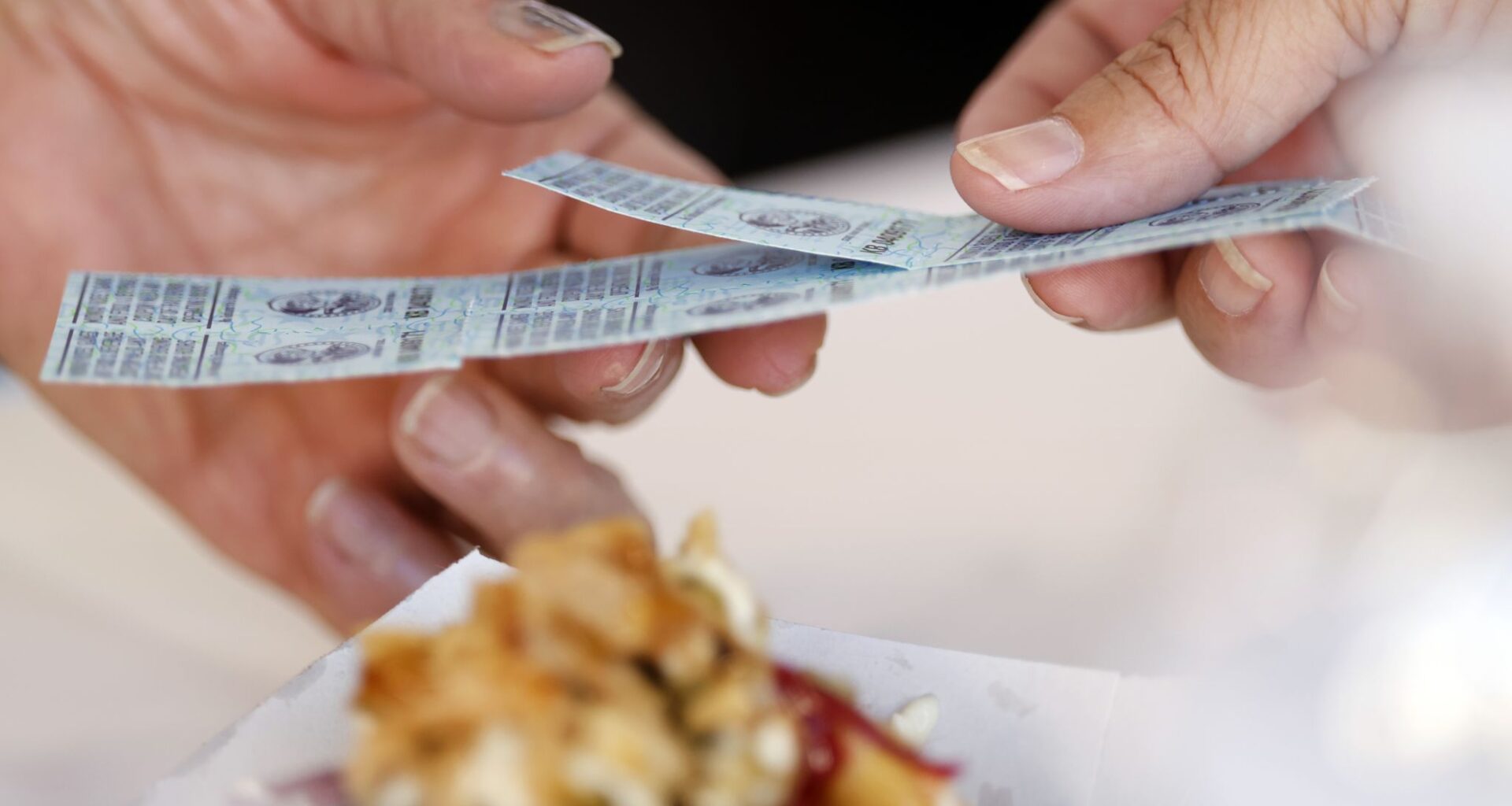
Coupons exchange hands at Pierogizilla, a State Fair of Texas food stand, in Dallas’ Fair Park, October 5, 2026.
Tom Fox/The Dallas Morning News
It may seem silly to think about what happens to the thousands of tickets exchanged at the State Fair of Texas, but using those paper coupons for a corny dog or ride on the Ferris wheel is just step one during the 24-hour day of a ticket at Fair Park.

And for vendors, the wait – well, weight – is worth it.
Why does the State Fair use coupons instead of cash?
Coupons reign as the “currency of the land,” said Lindsay Clark, the fair’s chief financial officer. The system began in 1975 as a universal way for vendors to accept payment.
Article continues below this ad
“It’s really part of the legacy and the tradition of the State Fair; so here we are, our 51st year,” said Jaime Navarro, chief operating officer. “It’s a unique system. It’s worked well for us, and we love it.”
One monetary system with a single set of rules decreases vendor wait time and provides ease for fairgoers, Navarro said. “When you find something that can work like that, especially on a monetary side, you just keep doing it.”
Related: 3 meal combinations at the State Fair of Texas for $25 and under
The process
Once fairgoers spend their $1 coupons, vendors place the collected tickets into a fair-provided metal container with a business-specific barcode. At closing time, vendors bring their collected coupons to fair officials, which will be cleaned – yes, physically cleaned – counted and weighed the next day.
Article continues below this ad
That weight equals the vendor’s profit, minus the fair’s percentage (based on each business’ contract).
A coupon lock box is pictured behind the Stifflers Moms Cookie Factory counter at the State Fair of Texas in Dallas’ Fair Park, October 5, 2026. Coupons are locked up so they can be weighed for cash returns to vendors.
Tom Fox/The Dallas Morning News
A small team of 10 to 12 meticulous people clean the coupons, and a “very, very, very precise scale” is used for weighing, Clark said.
First, the clean team dumps their designated bag onto a table, checking for any invalid, illegitimate State Fair tickets. Then, pieces of trash and specks of cotton candy sugar get wiped off before weigh-in.
Stiffler’s Concessions manager Ashley Mayshaw is working her 15th seasonal year at the fair. She said the company uses a Toast system to track what they sell and how many coupons they receive each day. Toast is a food industry-specific point-of-sales system.
Article continues below this ad
“It’s not perfect, but it gives you an idea of how much product [you’re] sending out,” Mayshaw said. “Before, all we did was take tickets and throw them in the box.”
After storing the coupons overnight, the fair counts them the next morning and brings a receipt to vendors, similar to a Chuck E. Cheese ticket machine, Mayshaw said.
Mitigating counterfeits, coupon security
Clark said the fair uses several built-in production and counting safeguards to keep operations transparent with vendors.
“That is the vendor’s paycheck, right? It’s their till,” Clark said. “It’s as important to us as it is to them.”
Article continues below this ad
When new vendors onboard, Clark said they receive a tour of the facility and a behind-the-scenes look at the coupon weighing process. Vendors are encouraged to ask questions and have the option to request an independent reweigh and hand count, if needed.
“The joke out here is typically a vendor will request a hand count once,” Clark said. “It’s usually their first year, and they come out and count their coupons and realize maybe there’s a difference of a coupon or two … and that we’re counting it right, and maybe it’s not worth the time to do the hand count.”
Related: State Fair of Texas expands access to student ticketholders after bad weather
Because coupons carry the same value as a dollar bill at the fair, there are some protected “trade secrets” within the manufacturing and storage process, Navarro said.
“We wouldn’t want to peel back the curtain to the same degree we wouldn’t want to peel back the curtain on our bank operations,” Clark said. “It’s for the safety of our team.”
Article continues below this ad
Clark said counterfeit coupons have been a problem at the State Fair but volume has decreased in recent years.
“There has to be some type of integrity built into the system for counterfeiting or anything like that,” Navarro said.
Mayshaw said she remembers seeing counterfeit coupons while working at the fair, specifically in 2024. In response, some vendors implemented security measures like installing lights that turn counterfeit coupons a different color, she said.
“I’ve been here so long I can feel them,” Mayshaw said. “They’re real thick … The tickets now, they’re real thin.”
A State Fair of Texas employee doles out coupons at a booth in Dallas’ Fair Park, October 5, 2026.
Tom Fox/The Dallas Morning News
Related: With a new affordability push at the State Fair of Texas, are the good vibes back?
Article continues below this ad
Other challenges include “sticky fingers,” Mayshaw said, from people not putting tickets in the metal boxes, forcing vendors to install cameras.
Alec Aleman, general manager of first-year vendor Pierogizilla, said his family installed cameras to track missing coupons after speaking with other vendors about their systems.
Fans and critics
Clark and Navarro said feedback on the coupon system from fairgoers and vendors remains largely positive. Navarro said the fair has made purchasing coupons accessible for all generations through several methods: in-person booths, ATM-style kiosks and online through the fair’s website.
A State Fair coupon booth is pictured on the Midway at the State Fair of Texas in Dallas’ Fair Park, October 5, 2026.
Tom Fox/The Dallas Morning News
Any coupons bought at the State Fair can be reused without an expiration date, even original coupons from the 1970s, Clark said.
Fair attendee Lukeh Daniel said he likes the fair’s coupon system because he “doesn’t think about it as much” like when dealing with cash or card. Fellow fairgoer Mayra Serna said using coupons “makes it more fun” instead of paying with plain money.
However, Mayshaw and Aleman both said some customers still attempt, unsuccessfully, to use straight cash.
Mayshaw also noted some vendors don’t want to shift to a digital system due to technology challenges, such as credit card fraud or extra card processing fees.
“They’ve just been here for years, and they’re stuck on doing things the old and simple way,” Mayshaw said.
Related: What’s your favorite thing to do at the State Fair and why?
Could a digital system be possible in the future?
Navarro said the fair has evolved as technology has changed, but any potential changes to the coupon system have not been reliable enough to shift away from tradition.
“If we’re going to deploy something like that, we have to ensure infrastructure is in place,” Navarro said.
Clark said similar organizations have moved toward tap-and-go or wristband systems, but those options are not yet feasible for Fair Park because of the current internet and technology set up.
“That sort of a system remains on the wish list, but it is something that we’re evaluating constantly,” Clark said.
Yet, nothing beats the nostalgia.
“Coupons have always been part of the tradition,” Navarro said. “As we evaluate technology, I think it’s one of those things about our State Fair [that’s] worth appreciating now.”
Short-form video producer Annika Sunkara contributed to this report.