
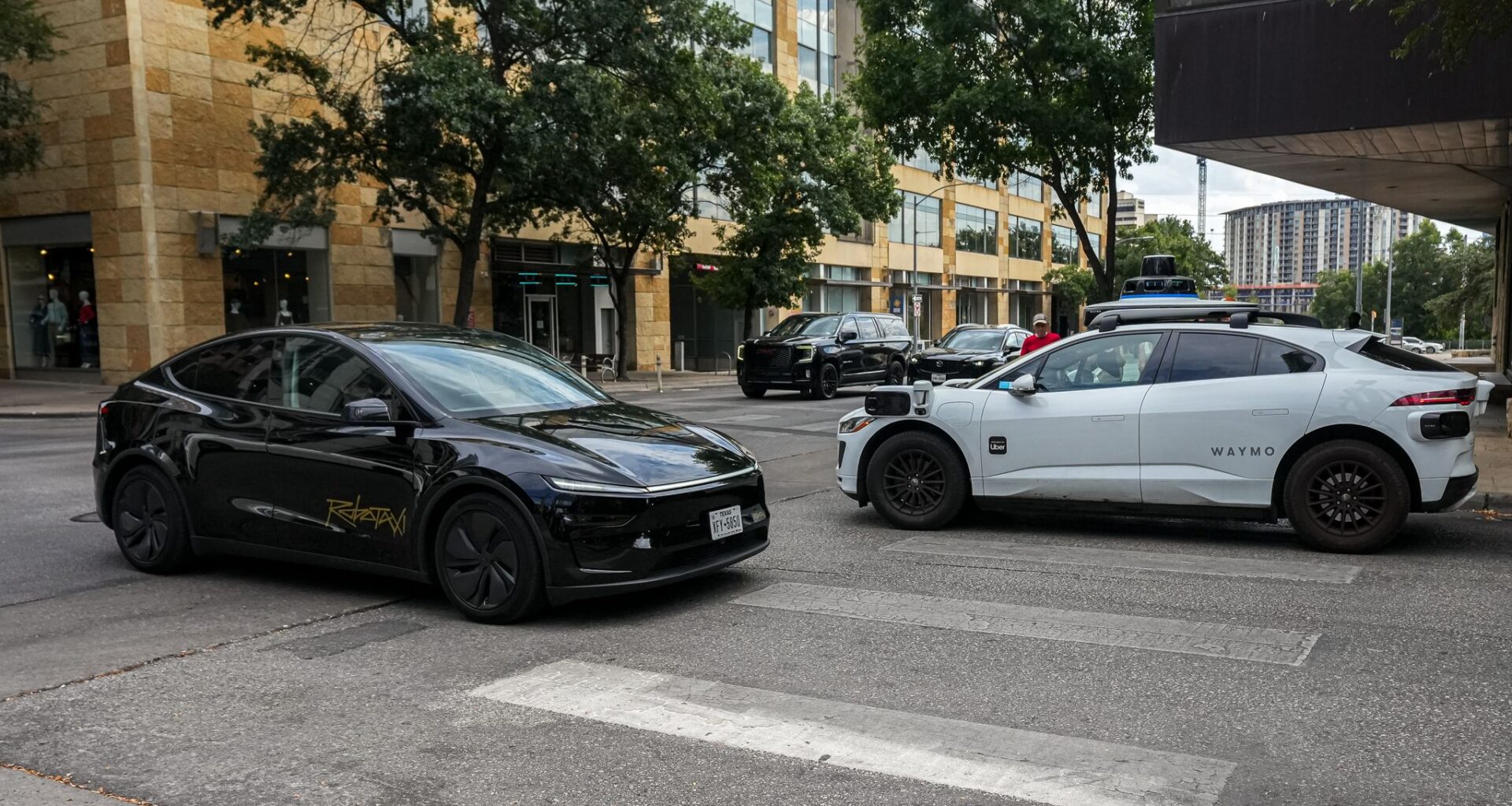
A Tesla RoboTaxi passes a Waymo autonomous vehicle on Thursday, Sep. 3, 2026 in Austin.
Aaron E. Martinez/Austin American-Statesman
Companies and recruiters behind the autonomous vehicle industry are touting a slate of new jobs to help power the vehicles, even if the end goal is operating without anyone behind the wheel.

In fact, the industry says it is so eager to fill jobs that demand for autonomous vehicle-related roles in Texas has grown sixfold year over year, Morgan El-Zeinab with NGV Talent said during a gathering of industry leaders at Capital Factory in downtown Austin.
Article continues below this ad
“They’re largely operations based, which is fantastic because Texas is uniquely positioned with an already vast pool of people with operations, manufacturing and logistics experience,” El-Zeinab said. “So it’s being able to not only find that talent that understands the need in the AV space, but also sees that career path, which is something that I think, by and large, we have to do a better job of explaining to the public.”
Austin in particular stands to see job opportunities brought by driverless vehicles as Austin-based Avride, Tesla, Waymo and Amazon’s Zoox seek to scale their operations.
Sergei Kirillov, chief commercial officer at Avride, said the company is targeting a fleet of 350 cars by the end of the year and has a headcount of more than 800, and it’s “focusing more and more on growing here.” Some of those roles are involved in the hardware for its fleet of cars and final assembly, which is carried out in Austin.
“We’re like, we’re not surprised that Austin became almost like a capital of AVs,” Kirillov said. “We also made our choice to be based in Austin because of the regulatory environment, because of the access to the talent, because of the just general balance of the cost of living and comfort of living.”
Article continues below this ad
An Avride car drives in downtown Austin, Tuesday, May 19, 2026.
Jay Janner/Austin American-Statesman
For some, the transition feels familiar. After Uber and other ride-hailing companies disrupted the taxi industry in the 2010s, autonomous vehicles are now disrupting gig driving. A report from Gridwise, a business app for gig drivers, noted that drivers in markets with autonomous vehicles saw a steeper drop in rides in the fourth quarter of 2025. Trips per hour declined 5.3% in cities with autonomous vehicles compared with 2.6% nationwide, the report noted, and fleets have only grown since then.
Still, Austin largely bucked the broader trend. The report found hourly gross pay for gig drivers in the city rose 3.2% year over year during the quarter, even as earnings declined in more mature autonomous vehicle markets such as Los Angeles, Phoenix and San Francisco.
Commercial truck drivers are also preparing for greater adoption of autonomous driving. In 2023, Teamsters released a framework for autonomous vehicle policies, asking Congress to require that a human operator remain in all vehicles, regardless of the automation level and for the creation of a grant program for impacted workers, including training on new technologies and reskilling for workers who are displaced.
Article continues below this ad
The industry has responded with assurances that new jobs will be attainable. Talent in the AV industry, El-Zeinab said, is often grouped into two categories: the engineering and technical side, and operations and testing. While the former almost always requires college degrees, about 70% of the roles on the operations side do not require anything beyond a high school diploma.
“It’s open to an incredibly large amount of people, and I don’t think that we’ve seen that in a new space in quite a long time, where that volume is out there for opportunity,” El-Zeinab said.
Liz Fishback of Stack AV listed several roles the company requires for its fleet of autonomous trucks. There are obvious roles such as drivers with a commercial driver’s license and service tech operations. Fishback noted that the company also has a machine control section where employees are monitoring assets at all times, hotlines in the case of incidents, and a meteorologist on staff to keep the company aware of weather patterns across states that could affect the fleet.
“The truck is driverless, but the operation is not humanless,” Fishback said. “It has to be built and upfit and supported by folks who are putting those vehicles together. They need to be maintained across the country.”
Article continues below this ad
Aurora, which travels without drivers on a route between Dallas and Laredo that follows Interstate 35 through Austin and San Antonio, also acknowledged the transition won’t be immediate.
A Peterbilt 579 powered by the Aurora Driver.
Aurora/Courtesy of Aurora
“If you’re a truck driver today, you will be able to retire as a truck driver tomorrow,” said Gerardo Interiano, senior vice president of government relations at Aurora, who noted emerging jobs like lidar technicians weren’t thought of 10 years ago, but are now key to the industry. “The deployment of this technology is going to happen, but it doesn’t mean that all of these jobs will disappear tomorrow.”
Interiano also added that being a long-haul truck driver is a challenging role with skills that can transfer to other jobs.
Article continues below this ad
“It’s really hard on them as individuals. It’s really hard on families,” Interiano said. “And if we can find ways to upskill those jobs and to create new job opportunities for those individuals to enter a market and a job that maybe wasn’t on their radar before, that’s a really unique opportunity for us to be able to partner with academia and government to create those opportunities.
Gov. Greg Abbott’s Deputy Chief of Staff Toby Baker, meanwhile, criticized what he described as “doomsdayers.”
“I view autonomy as an additional tool to be helpful and not to replace,” Baker said.
Texas regulations brought interest from AV companies
The job demand for roles in the autonomous vehicle industry in Texas followed the state’s light regulatory approach. And some would like to see it across the nation.
Article continues below this ad
In Texas, operators are required to obtain Texas Department of Motor Vehicles authorization to operate commercially on Texas roads, which involves demonstrating that the vehicle can comply with traffic laws, poses minimal risk if the automated self-driving technology becomes inoperable, and that the company has submitted a first responder interaction plan.
“I look forward to a future where an AV law is established at the federal level that is more like Texas’s law and allows for innovation, but sets as we talked about, a common regulatory environment,” said Darran Anderson with the Texas Department of Transportation, adding that regulators “think that we hit the sweet spot on how to do it.”
Leaders at companies say they’ve scoped out states with similarly friendly laws. Interiano said Aurora is also operating in New Mexico, Arizona and Oklahoma but would like to see it nationwide. Zoox said the same.
“There’s still a lot of differences throughout the states, and so that does provide uncertainty. And we’re left with choices of where we want to go because of what will be favorable for the industry,” Chris Nalevanko with Zoox said. Currently, Zoox is testing its purpose-built robotaxis in Austin.
Article continues below this ad
Pedestrians watch a Zoox robotaxi in March on East Fifth Street in Austin.
Jay Janner/Austin American-Statesman
Still, under President Donald Trump, regulations for AVs have relaxed. In June, for example, regulators announced they would eliminate the mandate for manual brake pedals in vehicles designed to be driven exclusively by automated driving systems.
And on Wednesday, companies celebrated a win when Administrator of the Federal Motor Carrier Safety Administration Derek Barrs announced to summit attendees that regulators approved a five-year exemption for self-driving trucking companies from rules that require drivers to place warning devices around a stopped truck.
Article continues below this ad
Interiano said it helps remove some of the barriers to growth and improves safety now that autonomous trucking companies can use warning beacons on the truck cab instead of relying on people to place warning devices around the truck.
“The reality is, every single year there’s a truck driver that loses their life putting out a warning triangle in the back of their truck,” Interiano said. “This is the first step in being able to deploy that and to make the road safer for everybody.”