
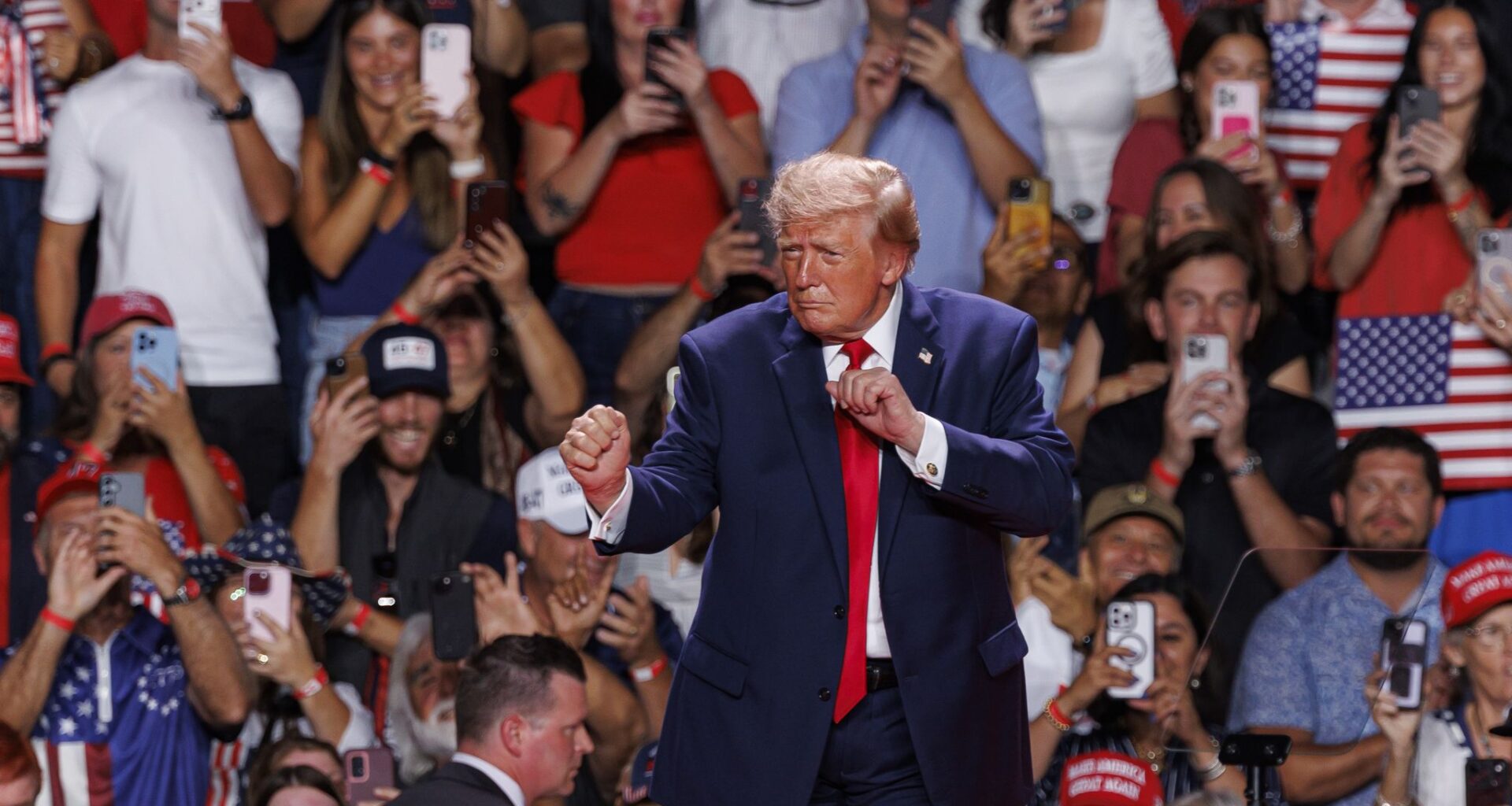
The crowd cheers as President Donald Trump dances to “Y.M.C.A.” before leaving the stage at the end of a political rally at Freeman Coliseum in San Antonio, Wednesday, Oct. 7, 2026.
Sam Owens/San Antonio Express-News
President Donald Trump is promising Americans a $5,000 payment if Republicans keep control of the House and Senate in November’s midterm elections. He repeated the pledge at Wednesday’s rally in San Antonio.

But political and economic experts say the proposal faces significant financial and legislative hurdles, making it uncertain whether the money will reach Americans. Here’s why.
Article continues below this ad
How much would Trump’s $5,000 checks cost?
Distributing $5,000 to roughly 240 million adult U.S. citizens would cost about $1.2 trillion in a single year — more than all three rounds of COVID-19 relief checks combined, PolitiFact reported.
Marc Goldwein, senior vice president of the Committee for a Responsible Federal Budget, warned that the expense would worsen the federal government’s fiscal outlook.
In a Sept. 10 social media post, he wrote,“the result would be a huge spike in the deficit, and almost certainly in the inflation rate.”
Article continues below this ad
ALSO READ: Meet the new TV reporter pulling double duty on Fox SA and News 4
The national debt topped $40 trillion in 2026, and economists have warned that $5,000 payments could worsen inflation and add to the deficit.
“If financial markets are already concerned about U.S. budget deficits, which are historically large and are projected to grow, and the message that you’re giving is, ‘We don’t really care. We’re almost going to double our deficits’ — that’s madness,” Erica York, senior economist with the Tax Foundation’s Center for Federal Tax Policy, told CBS News.
Where would the money come from?
Trump and Vice President JD Vance have pointed to using tariff revenue collected by the Trump administration as a potential funding source for the $5,000 payments. However, collections falls well below the estimated cost. Tariffs are generating about $125 billion in annual revenue — one-tenth of the $1.25 trillion needed to pay $5,000 to roughly 245 million U.S. adults, according to York.
Article continues below this ad
Additionally, some of the tariff revenue may have to be refunded.In a 6-3 decision, the court ruled that the 1977 International Emergency Economic Powers Act did not give Trump the power to impose sweeping tariffs worldwide, saying only Congress has the authority to set and collect tariffs.
ALSO READ: Cowboys Dance Hall landlord sues venue operator after bankruptcy
“The Framers (of the Constitution) recognized the unique importance of this taxing power — a power which ‘very clear(ly)’ includes the power to impose tariffs,” the ruling says. The ruling applied to tariffs imposed under that 1977 law, and did not invalidate tariffs imposed under other authorities or explicitly order refunds.
The funding shortfall would likely require the government to borrow more, adding to the national debt. Steve Ellis, president of Taxpayers for Common Sense, said the proposal would “simply add to the debt and fuel inflation.”
Article continues below this ad
“The nation is staring down the barrel of a $40 trillion debt,” Ellis told PolitiFact. “This proposal is ridiculous and wasteful.”
Is Trump legally allowed to do this?
Trump can propose the payments, but Congress controls federal spending and would have to approve them.
Even if Republicans retain both chambers, passage is far from certain. PolitiFact reported that the proposal would face significant hurdles in the Senate, where most legislation needs a simple majority of 51 votes for a final passage and 60 votes to overcome a filibuster.
Article continues below this ad
“He doesn’t have the power to do this on his own,” Rick Hasen, UCLA School of Law professor and election law expert, told PBS News. “You have to get Congress to do it.”
ALSO READ: 18 protesters escorted out as Trump rally in San Antonio turns chaotic
Experts have questioned whether the payments could improperly influence voters. But legal experts cited by The New York Times said a challenge could be difficult because Trump’s proposal would cover all eligible adults, rather than tie payments to how individual voters cast their ballots.
Article continues below this ad
For now, the $5,000 checks remain a political promise, not an approved federal payment. Congress has not authorized the funding, and the administration has not outlined a concrete plan for distributing the money. There is no guarantee the checks will arrive.