
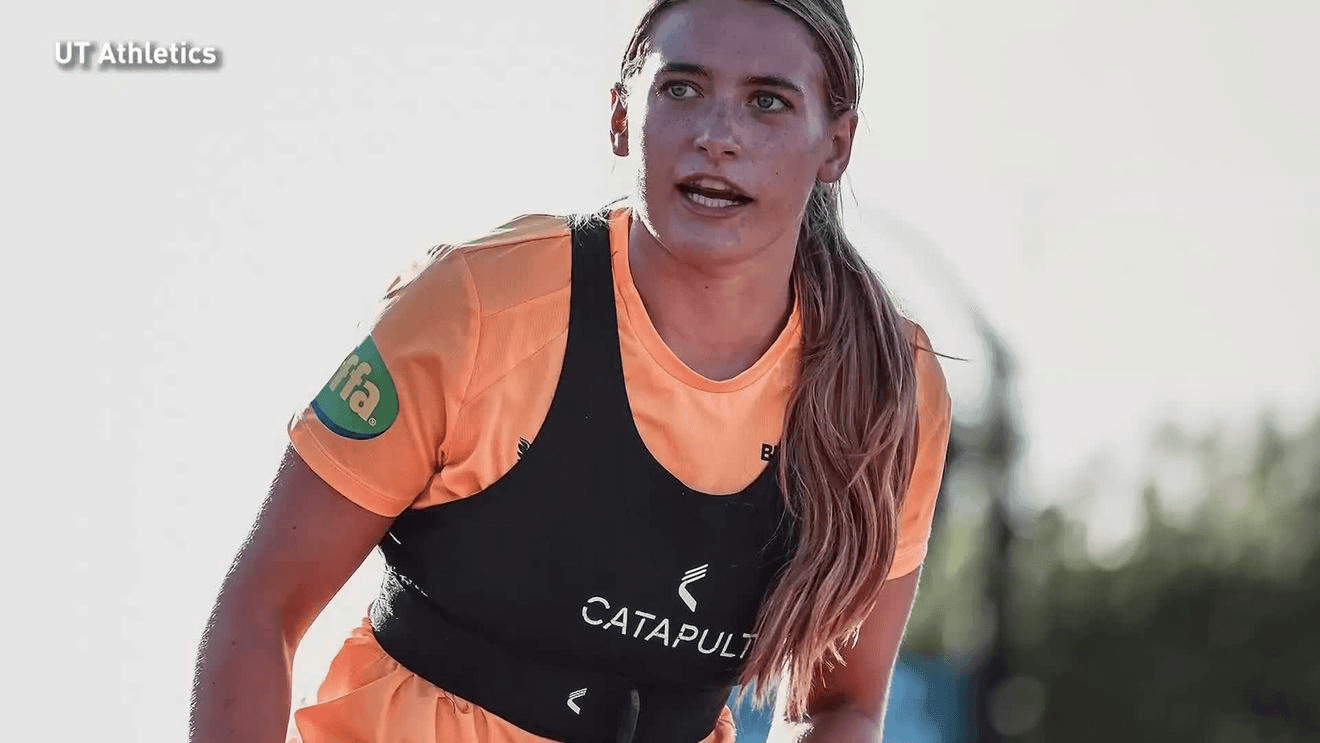
AUSTIN, Texas — Look closely at any Texas practice, and you’ll spot it. A black harness on every athlete, with a little bump on the back. It looks like a sports bra with a pouch.
It tracks every sprint, jump, and hit, and it started with an Australian experiment.
A fashion accessory with a job
The black vest is worn by everybody from Cristiano Ronaldo to the University of Texas football team. It looks like the hottest accessory in sports. It’s a piece of technology built to give athletes and coaches an edge.
It’s called the Catapult Vest.
“We’re trying to unleash the potential of the athlete,” said Kyle Voigt of Catapult. “We’re trying to help them play at their best while also reducing the risk of them getting hurt so that they can continue to play.”
From Athens to the NFL
Catapult’s origin story is a good one.
Just before the 2004 Olympics in Athens, Australia was looking for an edge against the world. The country bet on wearable technology and worked with the Australian Institute of Sport. The trackers went into vests around 2006.
By 2011 and 2012, Catapult says the idea had crossed the Pacific and landed in the NFL and pro soccer.
“Pretty much any professional sports team you’re watching is probably wearing something similar to this,” Voigt said.
ALSO| Cisco’s Jeetu Patel: AI Agents Are Coming, and Data Centers Are a National Security Issue
Watch for the bump
Voigt says you can spot the device on game day. “If you watch University of Texas football and you look at the back of their pads, basically between the numbers, you’ll see a little bump. That’s this device.”
Travis Vlantes, UT’s Director of Applied Sports Science, showed us how the Catapult Vector units work at Texas. They come out of a charging dock and turn on automatically, or on an alarm set for a specific time. Each unit gets tucked into a vest, and the athlete is ready to go.
What’s inside the pod
That small pod holds a lot of science:
GPS tracks distance and speed.
Accelerometer measures how forcefully a player moves. Catapult says it samples movement 1,000 times a second.
Gyroscope helps track direction and falls.
Magnetometer helps orient the device.
What gets measured depends on the sport. “In outdoor sports, we will track things like distance. We can track things like max speed. We can track things like how many times an athlete changed direction,” Vlantes said.
For indoor sports, the system can measure the overall volume and intensity of a workout: how much an athlete did, and how hard they went.
The data can get even more specific. Vlantes says the system can pull out a baseball player’s swings and throws, a volleyball player’s jumps and attacks, or whether a tennis player hit a backhand, a serve, or a forehand.
Ten-plus years of baselines
At Texas, the technology measures more than practice and game output. Those numbers are compared against more than a decade of team data. That gives trainers a baseline for what normal, great, or concerning can look like.
“Historical data is one of the biggest areas that give us an advantage,” Vlantes said. “We’ve had the applied sports science department here at Texas for about 11 years, which means we have a robust historical data set to be able to look back on and say, okay, here’s been the standard for the last 10 or 11 years.”
Data in coaches’ hands almost immediately
After practice or a game, the pods are docked and downloaded, and the information turns into usable data for coaches almost right away.
“And that’s really where the magic happens,” Vlantes said.
That’s when the staff can see if a group is putting up numbers they haven’t seen before, or if output is lower than they want. Then they adjust to get the most out of that group.
The tiny data lab
So the next time you see that little bump between the numbers on a Texas player’s pads, remember what’s in there. It’s a tiny data lab, working to help make the next big play.