
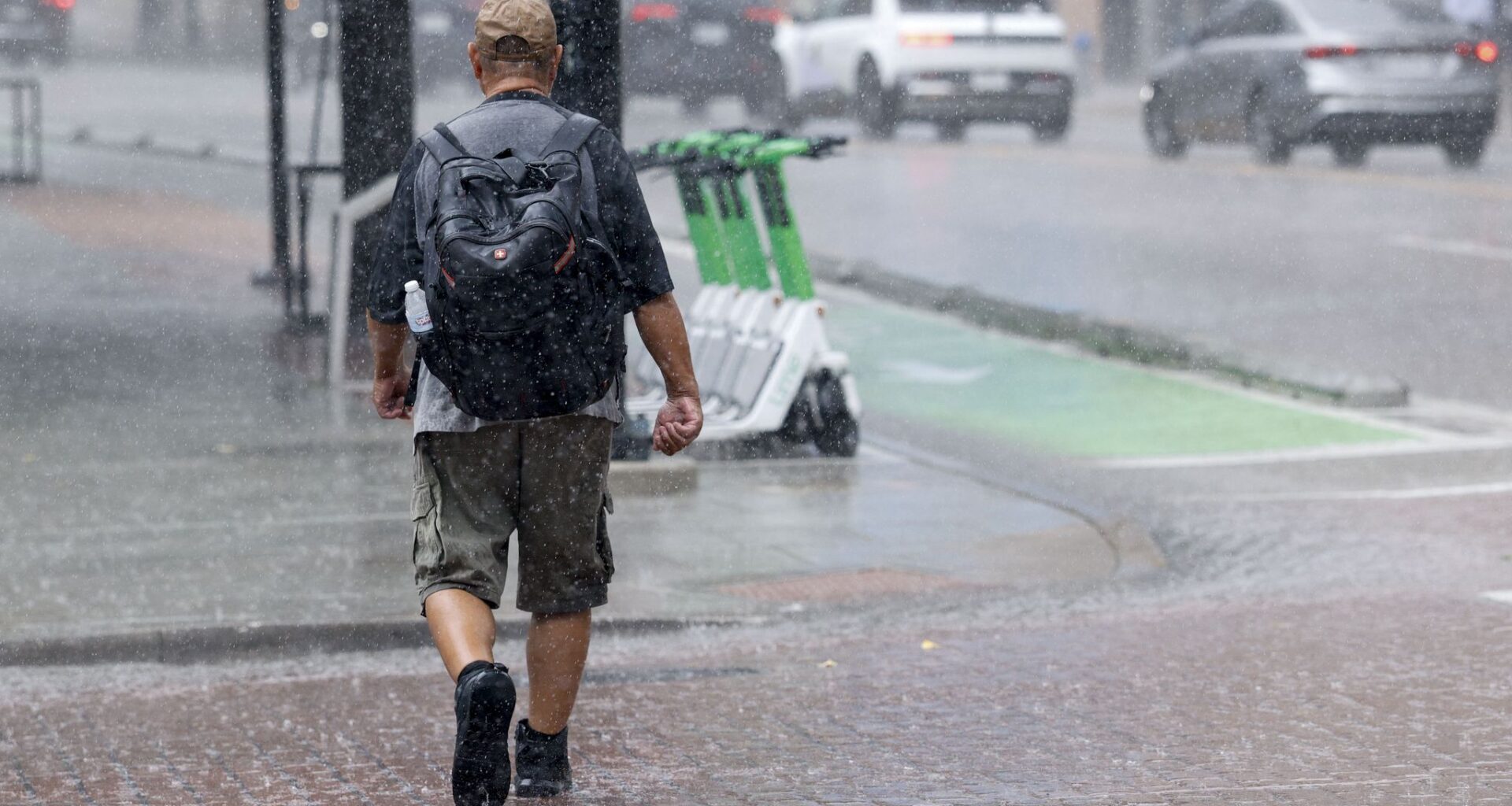
El Nino typically impacts Dallas-Fort Worth and the southern U.S. by causing wetter-than-normal conditions, meaning increased precipitation or rain, through roughly November to April.
Elías Valverde II/The Dallas Morning News
El Nino is continuing to strengthen in the Pacific, bringing increasing chances of a rainy winter to Dallas-Fort Worth.

According to an Oct. 8 advisory from the Climate Prediction Center, El Nino strengthened further in September and is expected to continue developing through the end of the year.
“Chances remain high for a historic event that would exceed the strength of previous El Nino events dating back to 1950,” the advisory states.
Article continues below this ad
Here’s what it means for Dallas-Fort Worth.
What’s the latest on the 2026 “Super” El Nino?
El Nino is a naturally occurring climate pattern that typically develops every two to seven years and can last nine to 12 months, according to the National Oceanic and Atmospheric Administration.
When sea surface temperatures become warmer than average in the Pacific, El Nino starts to develop gradually, which eventually affects local weather patterns around the world.
Related: What’s the difference between El Niño and La Niña again? A look at their impacts on Texas
Article continues below this ad
El Nino is expected to continue intensifying ahead of its forecasted peak this winter, according to the World Meteorological Organization, a specialized agency of the United Nations.
According to the Climate Prediction Center, this year’s El Nino event will likely exceed the strength of prior El Nino events dating back to 1950. That strength increase includes a 54% chance for September to November, an 83% chance for October to December and a 70% chance for November to January.
“With an event of this magnitude, the chances of experiencing impacts consistent with El Niño are larger, though not guaranteed,” the advisory states.
The organization forecasts El Nino will bring above-average temperatures to most of the world and shift rainfall patterns, increasing the risk of drought and floods in some areas.
What does the 2026 El Nino mean for Dallas-Fort Worth?
North Texas could see a “wetter-than-normal” season this winter, according to Tom Bradshaw, chief meteorologist at the National Weather Service’s Fort Worth office.
Article continues below this ad
El Nino typically impacts Dallas-Fort Worth and the southern U.S. by causing wetter-than-normal conditions, meaning increased precipitation or rain, through roughly November to April.
Related: Track Hurricane Isaias, first of the 2026 Atlantic season
While a rainy winter is generally expected, whether this winter will be colder than normal is still undetermined for the region.
“The big thing we get asked all the time is, ‘Well, is it going to be a cold winter or not?’” Bradshaw said. “And that’s the one where the jury is absolutely out.”
Bradshaw said there’s “nothing to really indicate” Dallas-Fort Worth will have a sharp departure from its typical winter temperatures in the 50s and 60s, with quick cold snaps.
Article continues below this ad
“It’s certainly possible we can get these brief, more amplified sharper outbreaks of cold air, but there’s nothing in the long-term guidance that’s yelling that,” Bradshaw said.
He said one question is whether these wetter-than-normal periods will line up with some of the intermittent cold stretches.
“That’s when we might get a little bit more snow and ice than we otherwise do,” Bradshaw said.
Related: Cooler temperatures arrived in Dallas-Fort Worth this week, but are they here to stay?
Conditions that could produce snow are typically predicted by forecasters two to three weeks in advance. Brashaw emphasized that forecasters will likely see a signal ahead of time for a freeze similar to what Dallas-Fort Worth experienced in February 2021.
Article continues below this ad
“If something like that was looming on the horizon, we would start to be able to see it at least two or three weeks out, just based on the state of the science now,” Bradshaw said.
Forecasting models are generally expecting El Nino’s effects to start to recede as Dallas-Fort Worth heads into the spring season, Bradshaw said.
Related: Five years on in Texas, Winter Storm Uri’s legal fallout has yet to be resolved