
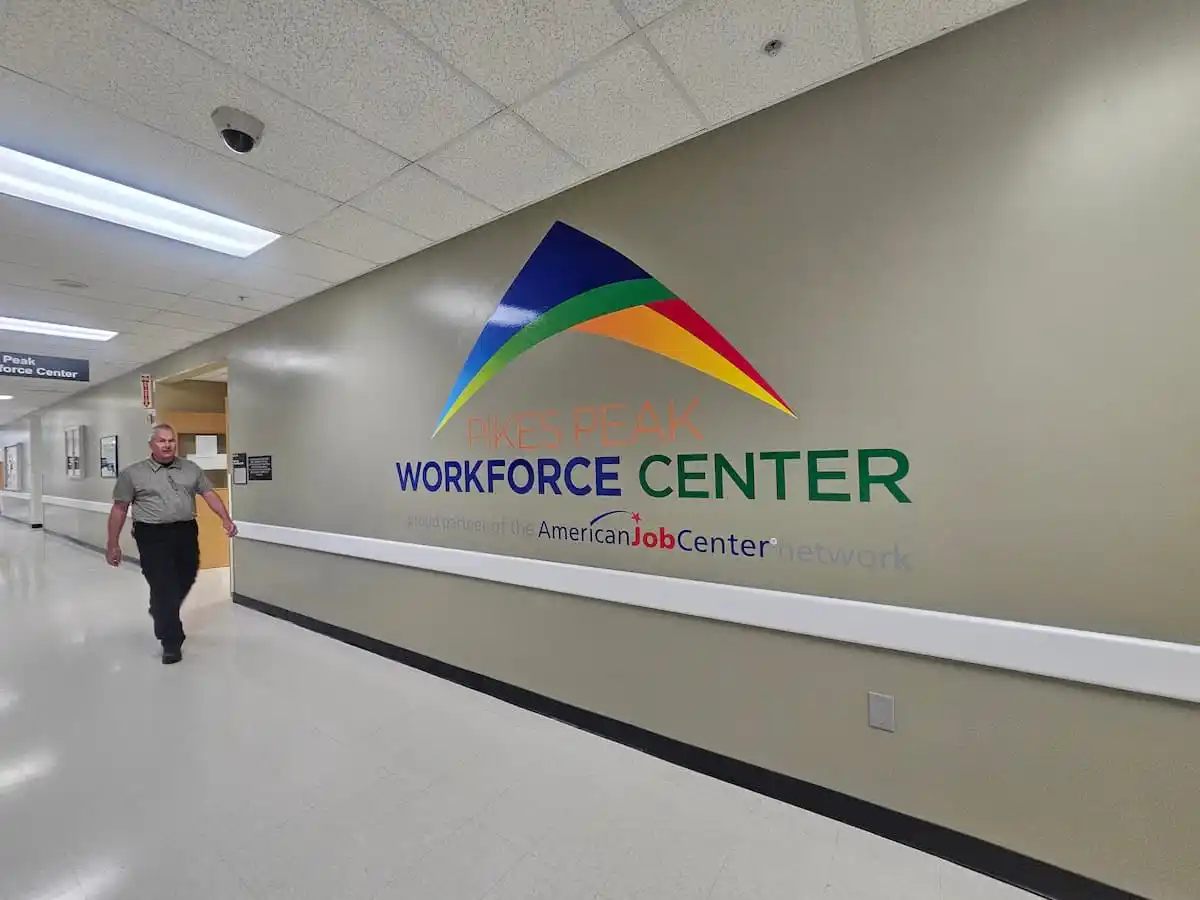
Two El Paso County departments began merging into one this past week, which involves an office relocation, a few layoffs and changes in the mechanics of how things are done at the Pikes Peak Workforce Center and the Economic Development Department.
At first glance it sounds like a typical internal reorganization intended to streamline operations and trim fat from the system.
Recommended Stories
▶
Behind the scenes, it’s the latest development in an unusual situation that produced a turf war in which one management team seemingly lost to the other.
There’s also:
Continued unease about a recent top-level decision to settle a lawsuit the workforce center filed against two state departments and pay back $1.24 million of already spent pandemic relief grant money;
Unanswered questions of whether the state had the legal authority to penalize other county departments by withholding funding; and
Adverse ramifications that include conditional recertification of the workforce board contingent on the workforce center making improvements in financial management and oversight, and providing conflict-of-interest training and certifications.
“I remain concerned how the county’s chosen outcome affects resources for local job seekers and businesses,” Traci Marques, president and CEO of the Pikes Peak Workforce Center for nearly 14 years, said in a statement to The Gazette.
Marques led the organization until an abrupt departure in mid-June, when she said her employment ended and she took early retirement.
Changes from consolidation
Employees of the Pikes Peak Workforce Center and the Economic Development Department will keep doing what they’ve been doing respectively in assisting employers and job seekers in El Paso and Teller counties, and work in business, affordable housing and community development realms, according to Crystal LaTier.
Last month, she was promoted to executive director of the new Economic and Workforce Development.
LaTier had been employed by the county’s Economic Development Department for 16 years, working her way up to executive director in 2019.
After Marques’ exit nearly four months ago, LaTier became interim director of the workforce center while still overseeing economic development.
With the new position, LaTier also will keep her title as executive director of the El Paso County Housing Authority, which gives her management of economic development, workforce services, community development and affordable housing.
That’s a big job for one person, since each area carries heavy-duty responsibilities, said Debbie Miller, president of the Greater Woodland Park Chamber of Commerce.
She’s been a workforce center board member for nearly two decades.
“When you have three organizations, the intricacies are great. They have specific, different missions. I think there’s enough difference that it will not serve us well,” Miller said. “How will Crystal find the time?”
According to the county’s job listings, applications for a deputy or assistant executive director for workforce development are being solicited through Tuesday.
The county’s communications staff, the gatekeeper for media to obtain interviews with county officials, has been reluctant to provide interviews about the topic.
A Gazette-requested interview with LaTier was denied in June, after she became the interim leader of the workforce center.
Communications staff said no one was available last week or part of the previous week to do an in-person or phone interview about the departmental integration and updating on related issues.
Instead, responses were provided via email to questions The Gazette submitted.
The most noticeable difference for the public is the Economic Development Department’s new location at the El Paso County Citizens Service Center, 1675 W. Garden of the Gods Road, Suite 1118.
The office will open there on Monday, LaTier said in an email routed through county communications.
Economic Development had been stationed at the county building at 9 E. Vermijo Ave., along with the El Paso County Housing Authority. The future use of the vacated space is unknown, LaTier said.
Pikes Peak Workforce Center will stay in its first-floor suite at the Citizens Service Center and for now will go by the same name, she said.
And, “We are not announcing changes to workforce center eligibility or services as part of this move,” LaTier said.
Among the changes, three jobs are being eliminated; one is a retiring employee’s position that is not being filled, according to LaTier.
Funding will be separately managed under each office, she said, and while county leaders expect cost savings, the amount is yet to be determined.
The departments will share resources and work together more closely to align efforts, improve efficiency and provide a better experience for residents and businesses, she said.
For example, a business discussing expansion with economic development staff could also need help recruiting or training workers, which workforce center staff could handle.
Concerns over dispute with state
Miller is convinced the workforce center was on track to win the lawsuit the agency filed against the Colorado Department of Labor and Employment and the Colorado Department of Personnel and Administration.
She and some others close to the matter think the state had no authority in trying to reclaim expended grant funding for the Colorado Springs Cultural Community Collective to train adults in culinary arts, media and early childhood development.
“The workforce center was in the process of being able to prove that we were not at fault with any of the allegations the Colorado Department of Labor and Employment brought against us,” Miller said.
“We believed we had a solid case, and that was the path we started taking until the Colorado Department of Labor and Employment began clawing back money.”
Marques agrees.
“I believed the evidence deserved a full and fair review before repayment,” she said in a statement to The Gazette.
When Marques left the workforce center in mid-June, an insurer-funded attorney “was still pursuing the challenge at no cost to taxpayers for that representation,” she said. “My understanding was that the insurer was continuing to move forward.”
But as the lawsuit progressed, the state enacted a “vendor offset” against El Paso County in early July, removing $44,961.20 from the accounts of the Department of Human Services, the Sheriff’s Office, the Facilities Department and the Clerk and Recorder’s Office, according to Sunny Bryant, deputy county administrator.
Bryant’s comments also were submitted to The Gazette via email, through the communications staff.
The county was never notified the state would begin withholding funds from county offices unrelated to the legal action, Miller said, adding that doing so has never been confirmed as being legal.
A 2024 state audit to determine grant compliance determined that expenses that did not qualify under the grant had been spent — such as on paying taxes, payroll processing fees and insufficient documentation on staff time — which created grant-compliance deficiencies.
The Colorado Department of Labor and Employment and the state government are “ultimately responsible to the federal government for any disallowed costs identified during programmatic monitoring,” a spokesperson said in an emailed statement in response to a Gazette request for comments on the issue.
The labor and employment department spent nearly two years working with the Pikes Peak Workforce Center to either recoup the disallowed costs at the heart of this case or bring them into compliance, the spokesperson said.
The state began demanding repayment last year, when the workforce center filed a lawsuit.
“CDLE made the difficult decision to execute a vendor offset, which in this case was against El Paso County as the original recipient of these funds, starting on July 7,” the statement reads.
The process was conducted according to “state statute and rule designed to protect state funds by withholding disbursements to recipients who owe debts to the state,” the spokesperson said.
The department decided to “pause” the vendor offset on July 14, “to allow for the county and its staff time to decide on a resolution, which happened shortly thereafter.”
County commissioners voted unanimously on July 21 to repay $828,371.78 of initial disallowed costs and $412,722.01 in disallowed contracted services and disallowed administration that the state identified in — for a total of $1.24 million.
The money was part of nearly $1.9 million funneled for workforce training initiatives from the federal government to the state government to the Pikes Peak Workforce Center to a now-defunct nonprofit, the Colorado Springs Community Cultural Collective.
Some commissioners said at the time they felt they had no choice in agreeing to settle and have the lawsuit dismissed in Denver district court to fix the unexpected consequence of the state forcing recoupment.
The workforce center does not intend to take other legal action in the matter, Bryant said.
However, county commissioners directed staff to “investigate and pursue any legal remedy against insurance policies and/or agents or principals involved with Colorado Springs Community Cultural Collective and its job training program called Opus Creative.
“We are still exploring options, and it is unknown if we will receive any reimbursements at this time,” Bryant said.
Founder of collective: No fraudulent activity occurred
Linda Weise, founder and operator of the shuttered Colorado Springs Community Cultural Collective, said she has not been notified of any new developments in terms of repaying the county for its repayment to the state.
She maintains no fraudulent activity occurred.
“I stand by my position that neither Colorado Springs Community Cultural Collective nor Pikes Peak Workforce Center did anything wrong, and the county should not have paid the state’s demand,” Weise said in an email.
The federal pandemic-era funding was awarded in the form of a reimbursement grant, Weise noted.
“Opus never held any of these funds in advance — money was paid out only after each expense had been reviewed and approved by the workforce center and the county,” she said in an email.
“Throughout the grant, rigorous ongoing reporting between the workforce center and the Colorado Department of Labor and Employment was a core part of the process.”
Leslie Weise, Linda’s sister who is an attorney who has done research on the case but does not practice law in Colorado, said the state “never had authority to demand back federal funds that had already been expended and not one person at the county or state level has responded to the question of how did the state, and now the county, demand this repayment when they never had that authority to do so.”
The resolution commissioners approved on July 21 allowed temporary use of the county’s self-insurance fund to resolve the dispute.
The workforce center’s former insurer, Philadelphia Insurance Co., paid $100,000, officials said during a recent meeting of the Workforce Center’s El Paso/Teller Counties Consortium Executive Board.
That entity was formed in 2016 and in May expanded county administration’s authority over the workforce center to provide another level of oversight and accountability, county officials said.
At the time the audit problems emerged, the workforce center managed its own finances and grant compliance.
Philadelphia Insurance notified the workforce center that it was dropping the agency as a client as of July 1, leaving workforce leaders scrambling to obtain coverage under the countywide insurance policies, which they did.
The workforce center also must provide reimbursement from its own budget of $284,726.65 for December 2024 expenses being submitted twice and reimbursed, LaTier said at the Consortium Executive Board’s July 27 meeting. The workforce center is not disputing the state’s finding of that error during an audit as well.
“We are putting strategic items in place to ensure that doesn’t continue,” she said.
Several workforce board members have resigned in recent months, including Lisanne McNew, president and CEO of Safe Engineering, who said after 15 years of board involvement, including on its executive committee, she felt it was time to leave.
“It is time for new voices, new leadership and new perspectives,” she wrote in her resignation letter.
During public comment at the July 27 Consortium Executive Board meeting, McNew accused the three-member board of making decisions behind closed doors.
“Decisions have been made on what has been heard and told,” she said. “It seems like there’s a lot of authority without responsibility.”
Miller said it’s perplexing “why the state did what it did, as well as why the county did what it did.”
The state also conducted another routine audit of the workforce center, which concluded in mid-September. The state labor and employment department is scheduled to provide a report by the end of this month.
Marques now is senior adviser to the National Association of Workforce Boards and started a company, Reimagining Workforce Strategies, which helps businesses access workforce programs, network and hire skilled workers. She also advises workforce leaders and local governments on rules-based oversight.
“My role has changed, but my commitment to connecting people and businesses with opportunities remains,” she said.