
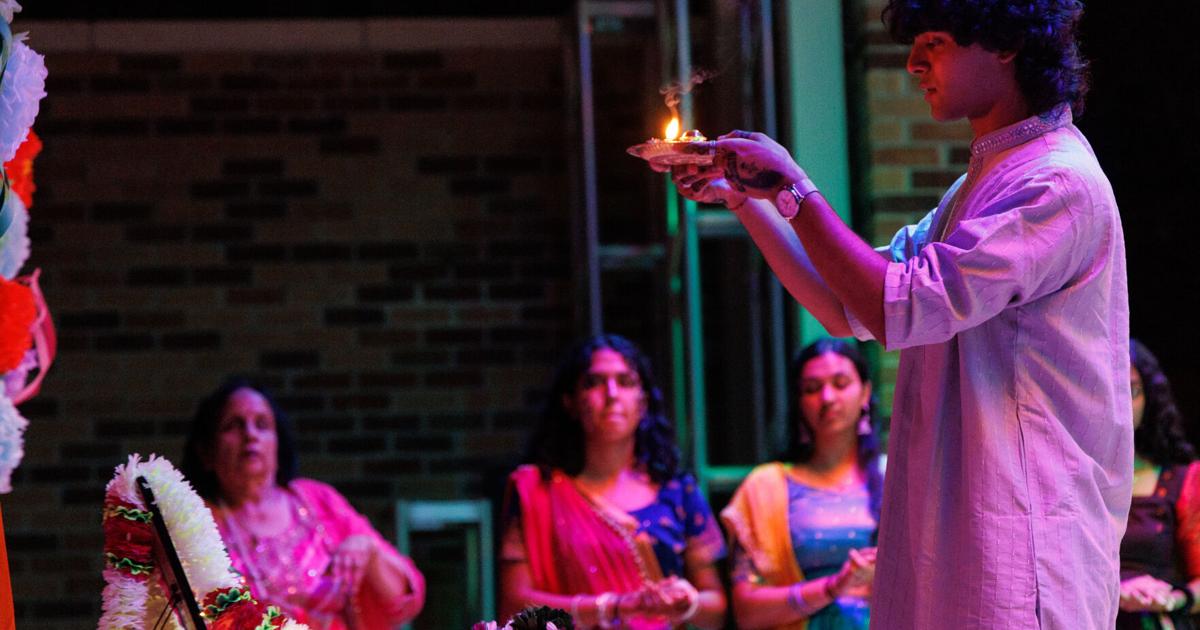

Finance freshman Aarush Behra celebrates Navratri with prayer during Garba Night on Oct. 9 at Brazos Park. Navratri is a celebration of good over evil that lasts for nine nights of dance and prayer.
Dressed in colorful lehengas, ghagra choli and other traditional South Asian attire, UTA students gathered for the Hindu YUVA UTA chapter’s Garba Night Friday at Brazos Park.
Rhythmic music, colorful traditional wear and spiritual practices transformed the venue.
For some students, celebrating Navaratri at home meant gathering with family for evening prayers, fasting and participating in traditions passed through generations. At college, miles away from their families, those familiar celebrations looked different.
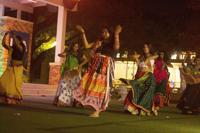
Students dance during Garba Night on Oct. 9 in Brazos Park. Garba is a traditional Indian folk dance.
Navaratri, a nine-night Hindu festival honoring the goddess Durga and her different forms, celebrates the triumph of good over evil. Garba, a folk dance originating in the state of Gujarat in India, is traditionally performed during the festival.
Sherley Sawant, Hindu YUVA UTA chapter president, said the organization spent more than four weeks preparing for the event, coordinating dance performances, decorations and lighting to transform the venue into a space for celebration.
Sawant said Garba Night welcomed everyone, regardless of religious background, giving students an opportunity to experience Hindu traditions and learn about the festival.

Nursing freshman Uttalika Dutta dances during Garba Night on Oct. 9 at Brazos Park. Dutta danced with others in celebration of Navratri.
“We know that many of the Indian people are immigrants who come thousands of miles away from their family, and it just gives them one night when they miss their festivals and traditions, just one night to come back to it,” she said.
Nursing freshman Suhani Sharma said celebrating Navaratri at home typically involves evening prayers and wearing a specific color associated with each day of the festival.
Celebrating at UTA was a different endeavor.
“I don’t think I really did anything this year because obviously, I’m away from home,” Suhani Sharma said. “It was mostly just getting ready for this event and performing here.”
Although celebrating at college differed from her experiences at home, Suhani Sharma said meeting new people and participating in cultural events helped her form connections during her first semester.
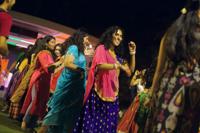
Students dance during Garba Night on Oct. 9 at Brazos Park. The Garba dance represents the cycle of life and time.
For biomedical sciences sophomore Pratikshya Sharma, who is from Nepal, the celebration offered an opportunity to experience how other South Asian communities observed similar religious traditions.
In Nepal, Pratikshya Sharma said the festival was closely associated with Dashain, one of the country’s largest celebrations. Her traditions included daily prayers, fasting, singing devotional songs and visiting the homes of family and friends.
During the event, Pratikshya Sharma participated in a choreographed Garba performance.
Beyond dancing, the event’s planned religious observances included arathi, a Hindu worship ritual involving the offering of light to a deity, allowing attendees to connect with the religious significance of the festival.
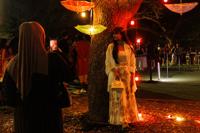
Finance freshman Hikmat Riyomi, left, takes a picture of biomedical engineering freshman Maryam Zafar during Garba Night on Oct. 9 at Brazos Park. Riyomi and Zafar said they admired peoples’ outfits during the event.
For Akhila Vegesna, biomedical engineering master’s student, Navaratri celebrations at home typically spanned 10 days and involved worshipping different forms of the goddess associated with blessings such as health, education and wealth.
In her final semester at UTA, Vegesna said attending the campus event for the second time gave her another opportunity to celebrate the holiday while living away from her family.
“When we see all the people who are actually missing their homes and coming together and celebrating these kind of festivals, it makes home feel a little closer than before,” she said.
@marupudisairam