
Members of St. David’s specialty transport team transfer a patient from the helicopter pad to the hospital. The team includes both a transport nurse for the baby and a transport nurse for the mother.
Provided by St. David’s HealthCare
Kayla Owen was in a state of shock after her water broke when she was 21 weeks pregnant with twins. It was the end of the school day and the kindergarten teacher knew it wasn’t good. “I was in a panic,” she said.

The mom, then in her third pregnancy, lives about a 20-minute drive outside of San Angelo, which had the nearest hospital with a maternity unit. But that hospital, Shannon Medical Center, is only a level 2 maternity care hospital with a level 2 neonatal intensive care unit. It can only handle babies who are born at 32 weeks of gestation or older.
Article continues below this ad
The Owen’s three daughters, Hallie-Jo. Averylynn and Linae have had three very different birth stories.
Provided by Kayla Owen
Owen needed the highest level of care — level 4 — to have any chance of extending her pregnancy and giving her babies the best chance at survival.
The team at Shannon called St. David’s HealthCare’s specialty transport team. The team transports hundreds of mothers and babies each year to St. David’s hospitals from sites within a one-helicopter-tank-of-gas radius: San Angelo in the west, Columbus in the east, almost to Waco in the north and Victoria in the south. For closer transport or in bad weather, St. David’s uses American Medical Response ambulances. The team is also looking into a fixed-wing plane to be able to go farther.
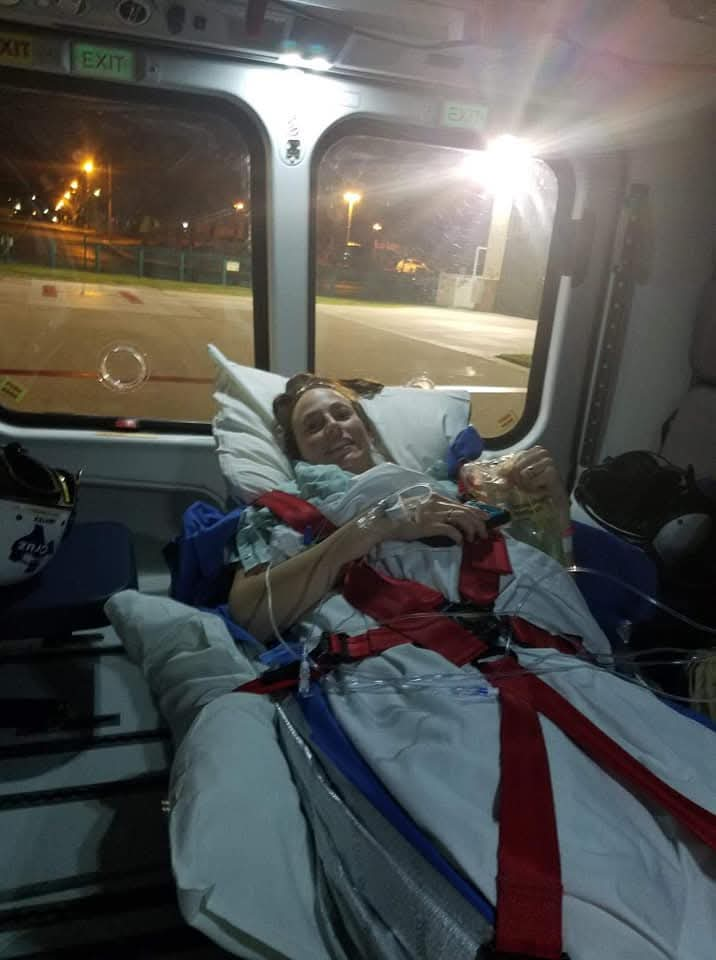
Kayla Owen is loaded into a helicopter with the St. David’s team in San Angelo to bring her to St. David’s Medical Center, where she gave birth to her twins a few days later. The transport team includes a maternal nurse and a neonatal nurse.
Provided by Kayla Owen
Owen illustrates a growing reality in Texas. Programs like St. David’s transport team and the maternal-fetal medicine telehealth program have been increasingly important as half of Texas counties are maternity care deserts where there are no hospitals with maternity care and no clinicians providing that care, according to the March of Dimes’ 2026 report. There are 272,000 women ages 15 to 44 who live in one of these deserts, and 18,000 babies born annually in Texas are from a care desert county.
Article continues below this ad
A 2022 report from UTHealth Houston School of Public Health found that only 40% of rural hospitals have a maternity unit. Since 2005, 14% of rural hospitals have closed, as well as 17 obstetrics units from 2011 to 2021.
The lack of access isn’t just about rural hospitals. This summer Baylor Scott & White closed its Lakeway maternity unit. Women in the Lakeway area now drive 29 to 42 minutes without any traffic to get to a hospital with a maternity unit.
Kayla Owen’s daughter Linae stayed at St. David’s NICU for 173 days, but today is 6 and thriving.
Provided by Kayla Owen
Each St. David’s transport team includes a NICU transport nurse and a maternal transport nurse, which is different from other hospital transport teams because it sends someone for the mother and someone for the baby, said Tim Farmer, the director of the team. The team started with just neonatal nurses in 1995 but added maternal nurses in 2008.
Article continues below this ad
Not sending both the maternal transport nurse and the NICU transport nurse adds “extra tension,” Farmer said. “It’s such a crystal ball. Is this mom going to progress? Is this mom going to stall out?”
Having both team members means that if a mom stays pregnant there is care; if she gives birth, there is care.
The hospital system also has maternal-fetal medicine doctors who do telehealth visits with mothers-to-be throughout Texas to try to anticipate problems and coordinate care before it becomes an emergency and the transport team is needed.
Kayla Owens has now had two different pregnancies monitored by the St. David’s team: one that resulted in a transfer by helicopter at 21 weeks and one that went full-term.
Provided by Kayla Owen
Bringing patients to sophisticated care
On Feb. 6, 2020, when St. David’s specialty care team arrived in San Angelo to transport Owen, “it was kind of surreal,” she said. “The moment those people walked in from the transport team, I knew I was going to be taken care of. I knew we were OK.”
Article continues below this ad
Owen remembers “they were calm; they had a presence about them.”
During the flight, the team monitored Owen to make sure her blood pressure was steady and that she wasn’t in active labor.
If Owen’s labor had progressed to a point where it was unsafe to fly or if there was a fear of giving birth in the helicopter, the team would have worked with the hospital staff to deliver the babies and then take both mom and babies to Austin.
Kayla and Ethan Owen leave St. David’s Medical Center with Linae after 173 days in the neonatal intensive care unit. Kayla was transported by helicopter after her water broke 21 weeks into the pregnancy.
Provided by Kayla Owen
Once Owen reached Austin, the team at St. David’s Medical Center took over. They were able to get Owen to 22 weeks and 2 days before needing to deliver the babies because of an infection.
Article continues below this ad
Linae Elise and Ryan Wade were born on Feb. 10.
Linae grew stronger every day, but had complications during her 173-day stay in the NICU such as infections and a blood clot. She also needed vision surgery to prevent blindness from retinopathy of prematurity.
Ryan had a bowel perforation on day 5, but didn’t fully recover. He lived 41 days.
The transport team gave him a chance that he would not have had in San Angelo, Owen said, and it gave her a healthy Linae, who today is a healthy 6-year-old who loves playing outside and with Barbies.
Article continues below this ad
“You would never know she was a micropreemie, other than she’s a little petite,” Owen said.
Owen daughters Averylynn, Linae and Hallie-Jo have very different birth stories. Linae was a twin and born at 22 weeks gestation.
Provided by Kayla Owen
Bringing higher-level care to patients
The Owen family’s relationship with St. David’s transport team and maternal-fetal telehealth program might have ended there. But last year, Owen began to feel funny. She was pregnant. “Oh, no, here we go,” Owen remembers thinking.
Article continues below this ad
She still had lingering trauma from previous pregnancies. Her first daughter, Averylynn, now 10, was a normal pregnancy, but then the next pregnancy in 2018 ended in a miscarriage. The twins in 2020 were born as micropreemies because of her cervix shortening prematurely, and Ryan didn’t make it. She worried about another premature pregnancy, another six months in the NICU or a poor outcome.
At 11 weeks, Owen received some relief that she was only having one baby. But at 14 weeks, an ultrasound revealed that her cervix was beginning to shorten just like it had with the last pregnancy. She began having telehealth appointments with Dr. Amy Bednar, a maternal-fetal medicine specialist at St. David’s. Bednar cares for women in San Angelo and Brownwood from her office in Austin.
Bednar’s patients go to the clinic in San Angelo and Brownwood and have their ultrasounds there. A nurse and medical assistant are on-site, but Bednar remains in Austin.
Owen initially was screened by Bednar when she was 16 weeks pregnant and everything looked fine, but by 18 weeks, Owen’s cervix was shortening again.
Article continues below this ad
Kayla Owen was able to have a full-term birth with Hallie-Jo because of the monitoring from St. David’s maternal fetal medicine specialists.
Provided by Kayla Owen
At 20 weeks, Owen traveled the four-hour drive to Austin to have Bednar put in a cerclage, a surgical stitch to close the cervix, and then Owen was able to return home.
“The nice thing about seeing her remotely is we get to see her weekly to make sure she is doing well and she doesn’t need to come to Austin,” Bednar said.
Article continues below this ad
At 37 weeks, the cerclage was removed to allow Owen to go into labor, but her daughter had other ideas. Hallie Jo arrived three days after her due date on April 10.
“She is such a healing for all of us,” Owen said. They got to again experience what it’s like to bring home a baby right away and without medical equipment and without grieving a loss at the same time.
New sister Hallie-Jo made it to full-term after Kayla Owen was monitored from Austin without leaving the San Angelo area.
Provided by Kayla Owen