
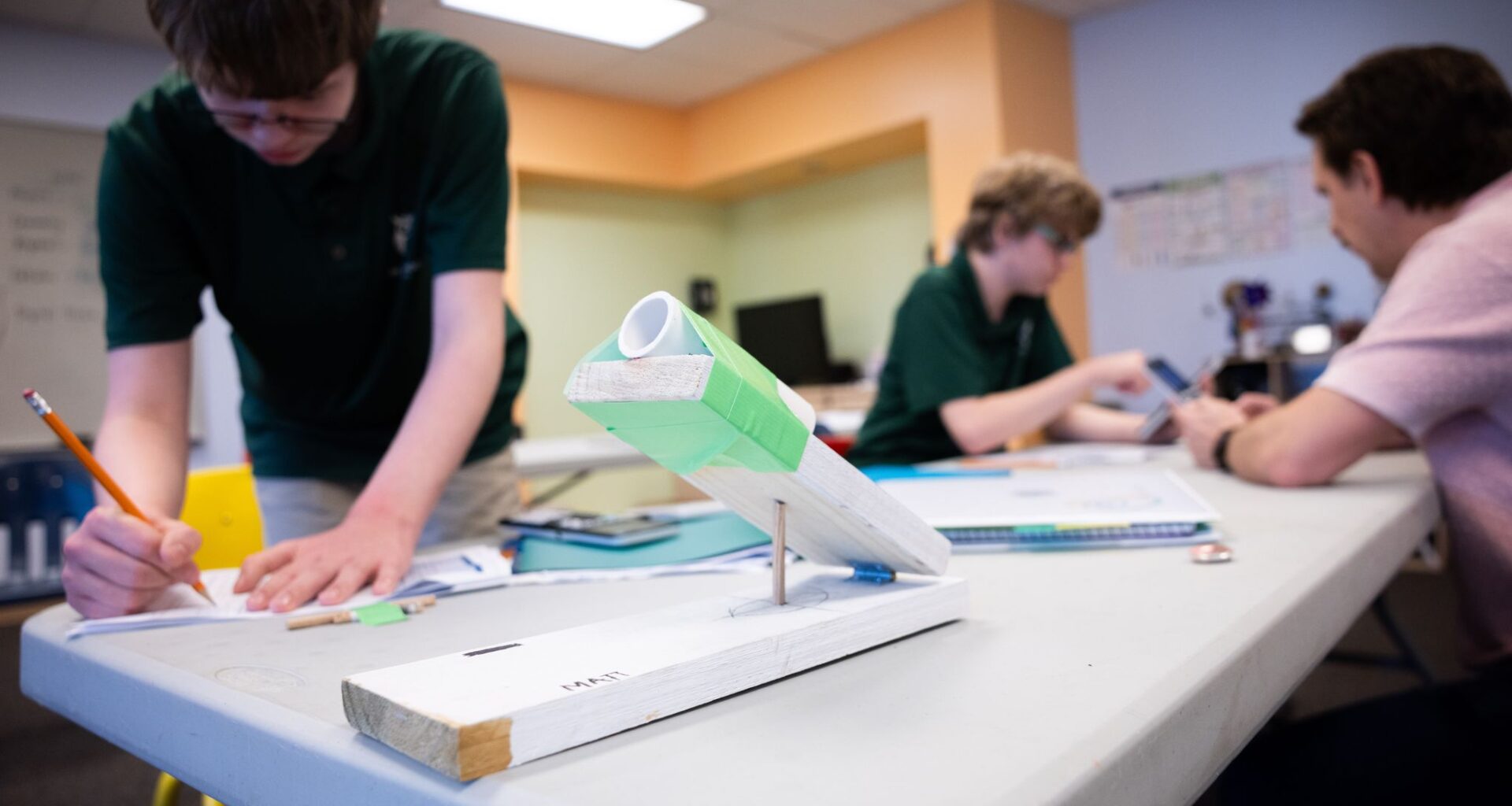
Students in David Mueller’s physics class complete predictions on their projectile launchers at the Sage School of Dallas in Dallas, Tuesday, Oct. 6, 2026.
Juan Figueroa/The Dallas Morning News
Megan Howard’s son is the kind of kid who studies trigonometry for fun. So why was he avoiding school?

He would get dressed, then refuse to leave the house. The car would pull up to his middle school, then he would hesitate to step out. His mom knew something had to change, so she pulled him out.
Her son, with autism and ADHD, has no trouble with homework. What was missing was a sense of belonging. Among the 1,000 students attending his public school, Howard said, he just needed one friend.
Article continues below this ad
Her two sons are considered twice-exceptional learners, which means they are intellectually gifted but also have learning differences, such as dyslexia, ADHD or autism. An estimated 360,000 students nationwide make up this population. Parents may struggle to find a classroom that can cater to both their child’s high intellect and socioemotional needs.
That’s where a new private school, the Sage School of Dallas, steps in. It’s one of the few in the country dedicated to serving these students.
“Either you can find a place that has rigorous academics, or you can find a therapy school that is really … about social emotional learning,” Howard said. “There was never a place that did both.”
Related: Thousands of Texas students with disabilities returned voucher funds
Over the past few decades, the country’s understanding of special education has deepened, and the number of students who qualify for these services has jumped. But with increased awareness, a pressing question remains: Are schools equipped to offer the support twice-exceptional learners need?
Article continues below this ad
“Until Sage was around, there wasn’t a school that met all of their needs. So you were always trying to make it work,” said Jessica Rall, one of the founders of the Sage School. “These students and families need a place where they don’t just have to make it work.”
An ‘unexpected combination’ within one person
The term “twice-exceptional learner” has gained traction, as more research emerged on the group. The National Association for Gifted Children estimates approximately 6% of students receiving special education services are also academically gifted.
“It’s a phenomenon,” said Jacob Michaelson, a psychiatry and neuroscience professor at the University of Iowa. “There is kind of this unexpected combination within one person of extreme ability in one aspect and extreme disability in another.”
At the same time, the number of students with disabilities has shot up across the country, suggesting educators have gotten better at recognizing needs and parents are more willing to seek out support. In the 2014-15 school year, Texas public schools taught 451,600 students with disabilities. In the most recent school year, there were 911,300 students in special education programs.
Article continues below this ad
But twice-exceptional learners tend to fly under the radar, because their high intellect hides their learning differences. Their struggles aren’t reflected in test scores, so overworked educators may pay less attention to them, Michaelson said.
“You get the impression: Oh my gosh, this person is really smart,” he said. “But that masks the fact that they do have other deficits that are not as apparent.”
Even if parents know their child is twice-exceptional, they may struggle to figure out where to place them. Do they belong in a gifted program? Or a special education program?
Howard had no doubt her oldest son would thrive in the rigorous math classes at School for the Talented and Gifted, Dallas ISD’s competitive magnet school. She just worried he would fall behind socially.
Article continues below this ad
Her younger son has selective mutism, an anxiety disorder that prevents him from speaking in certain situations. His mom wanted him to learn in an environment with smaller groups.
“Academics was never the issue for my kids,” Howard said. “I needed them to go to school more for social reasons.”
A private school steps in
Kristen Dauphinais relates to the frustrations of parents, like Howard. Her child is a twice-exceptional learner, so she knows how hard it is to find a school that can meet both the academic and socioemotional needs.
That’s why she helped start one that could.
Article continues below this ad
“We always joke that, like, these kids just have to cook a little differently,” Dauphinais said. “We’re the oven. We built an oven to cook these kids a little differently.”
Students in David Mueller’s physics class complete predictions on their projectile launchers at the Sage School of Dallas in Dallas, Tuesday, Oct. 6, 2026.
Juan Figueroa/The Dallas Morning News
On an October morning, two high school students hovered around a table dotted with worksheets, calculators and pencils. As part of a physics lesson, the boys constructed a projectile launcher. They leaned down, inspected the makeshift machine, and slipped a ball in.
To their excitement, it flew from the table to the side of the room. And even better — the distance it traveled was just short of their estimates.
The learning is “inquiry-based,” so students can explore the questions they ask as in-depth as they want, said Mandi Skerbetz, head of school. The school day ends with clubs, ranging from chess to Pokemon to Dungeons & Dragons.
Article continues below this ad
The socioemotional learning is built into the curriculum, Skerbetz said. Students take lessons on how to interact with others. They think through communication strategies, role play tricky social situations, and consider ways to apply the instruction to their real lives.
That morning, one student recited back to Skerbetz the acronym the class had pored over earlier this month: THINK. Before he says something, he asks himself: Is it true? Helpful? Inspiring? Necessary? Kind?
When it opened last year, the school had four students. Now, there are 11 students, four full-time teachers and one part-time teacher. The accredited school, housed in a church in Far North Dallas, serves fifth through 12th grades.
Students must apply to gain admission, and the school leaders consider cognitive assessments, academic records, parent reports, interviews and visits. It costs $35,000 each year to attend.
Teacher Anna Smith leads a discussion during a English Language Arts (ELA) and Social Studies seventh and eighth grade class at the Sage School of Dallas in Dallas, Tuesday, Oct. 6, 2026.
Juan Figueroa/The Dallas Morning News
How do other schools serve twice-exceptional students?
Before starting the Sage School, the founders reached out to the handful of twice-exceptional schools that existed across the country, trading ideas and concepts. Its “closest aspirational peer” is Bridges Academy in Southern California.
When that school started in 1994, there were only three students learning in the founder’s home. Bridges Academy has since grown to 200 students, with a campus, an online school, a research center, media site and more.
But Mark Long, head of school, has noticed that terms — like “twice-exceptionality” and “neurodiversity” — are used more frequently nowadays.
“There’s an understanding around what it is,” he said. “There might not be an understanding of what to do with it, but there’s an awareness.”
The college-preparatory school’s curriculum aims to be flexible, he said. For example, instead of a 2,000-word essay, the student could give an oral presentation or shoot a film. Similar to the Sage School, Bridges Academy blocks out time during the school day to help students develop social skills in areas like teamwork or public speaking.
Bridges Academy also comes with a hefty price tag, with annual tuition coming in at roughly $61,200 for its in-person campus and $37,500 for its online school.
That doesn’t mean families who can’t afford tuition should be boxed out, Long said.
Bridges Academy offers consulting services to public and private schools. It is “inundated” with inquiries, as districts — from coast to coast — figure out how to better serve twice-exceptional learners, Long said.
Public schools have already made strides. For example, Montgomery County Public Schools, a district in Maryland, is known to offer some of the most comprehensive services for twice-exceptional learners, including self-contained classrooms.
In Texas public schools, twice-exceptional students can participate in gifted programs and simultaneously receive accommodations noted on their individualized education plans. An IEP is a legally-binding document that outlines how a district will meet a child’s needs. Educators are also expected to modify curriculum to support twice-exceptional students, according to Texas’ guidelines on serving gifted and talented students.
Several North Texas districts — including Carrollton-Farmers Branch ISD and Arlington ISD — offer universal screening. Universal screening can help better identify twice-exceptional learners, because all students are tested — not just those referred by a teacher.
“These kids are clever. They’re game-changers,” Long said. “We have a moral obligation to make sure that every child across the United States and beyond reaches their potential.”
Finding the dream school
Howard considered homeschooling, and sent her kids to public school. One of her sons even tried a private college preparatory school. For the longest time, the “dream school” felt like a nonexistent one.
When she stumbled upon a new campus on a cursory internet search, she decided to give it a chance. The Sage School, she thought, seemed like a place that could support children like hers.
She was initially concerned about switching from established schools to a brand new one. The high tuition was something of a sticker shock, and the school doesn’t offer financial aid yet. Howard consulted with financial planners to see if her family could swing it.
The sacrifices, she said, are worth it.
When she sees her oldest son studying calculus, she knows he’s being challenged. When she sees he has made friends, she feels relief. And when she sees him advocating for himself, she feels proud.
That’s why Howard wishes “every student could go to a Sage who needs it.”
The Sage School of Dallas in Dallas, Tuesday, Oct. 6, 2026.
Juan Figueroa/The Dallas Morning News
The DMN Education Lab deepens the coverage and conversation about urgent education issues critical to the future of North Texas.
The DMN Education Lab is a community-funded journalism initiative, with support from Bobby and Lottye Lyle, Communities Foundation of Texas, The Dallas Foundation, Dallas Regional Chamber, Deedie Rose, Garrett and Cecilia Boone, Judy and Jim Gibbs, The Meadows Foundation, The Murrell Foundation, Ron Steinhart, Solutions Journalism Network, Southern Methodist University, Sydney Smith Hicks, and the University of Texas at Dallas. The Dallas Morning News retains full editorial control of the Education Lab’s journalism.