
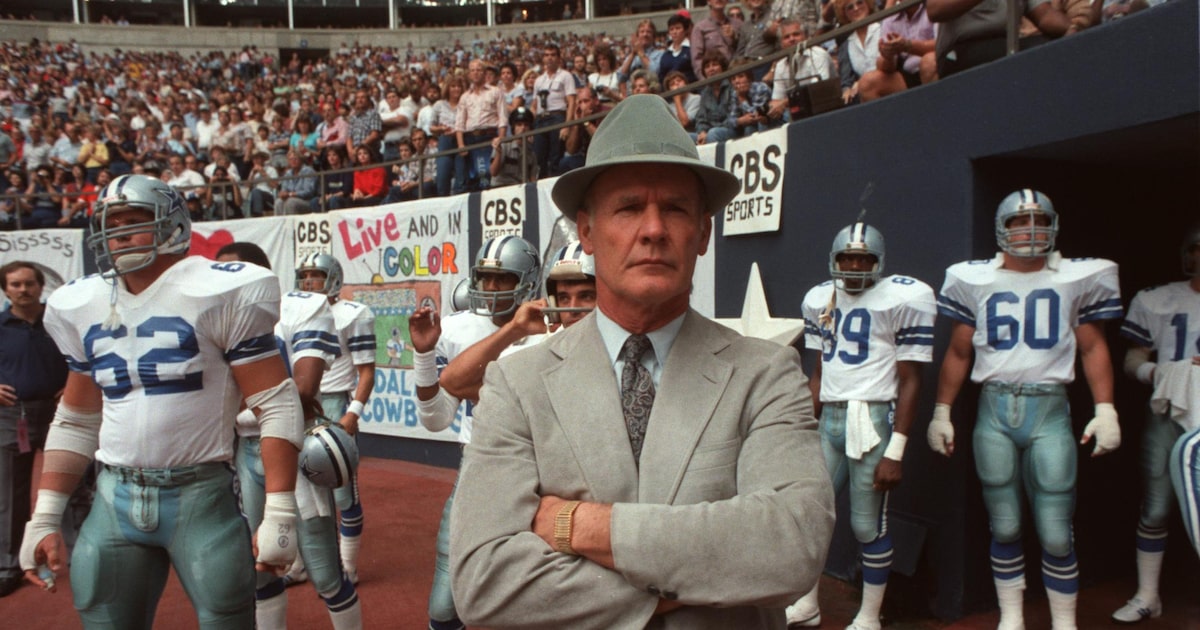
For The Dallas Morning News’ 140th anniversary, it was instructive, if not startling, to look over its embryonic pages and note the entirety of its sports contribution covered by an occasional one-column standing head. Hardly all the news that’s fit to print. Maybe a mention of horse racing results from nearby Terrell or winner of a prizefight in Chicago or something along the lines of this beauty under “Sporting Note” on Dec. 4, 1885: The survivors of a three-day “walking match” in New York.
SportsDay has raised the level of conversation considerably since, a natural result of the area’s unquenchable athletic interests and a newspaper war won largely by what Sports Illustrated once called “the Encyclopedia Britannica of sports sections.”
Over the last century or so, the paper’s coverage has been dictated by transcendent athletes and organizations that changed the perception of the area as well as Texas. Once Bill Ruggles took over as sports editor in 1919 and developed the paper’s first stand-alone sports section, the focus gradually shifted from minor league baseball, boxing and the sport of kings to Dallas’ galaxy of golf stars, Southwest Conference football and a full complement of professional sports, notably “America’s Team.”
The parade started with the greatest female athlete of the 20th century.
Cowboys
Best of the Best
Babe Didrikson Zaharias grew up in Beaumont, but she leapt to worldwide fame after moving to Dallas early in 1930 during her senior year in high school. She made the move at the behest of Col. M.J. McCombs, an executive of the Employers Casualty Company, who coached women’s AAU teams on the side.
Each of the women recruited to play for Employers Casualty’s teams eventually settled into some line of work at the company.
“All except Babe,” as Rubye Mansfield, a teammate, once told The News.
Didrikson was good at everything she tried, it seemed. Basketball, track and field, golf, baseball, harmonica, she mastered them all. Occasionally on her first attempt. In 1932, McCombs sent her as the company’s lone representative to the AAU track and field nationals, a qualifier for the Los Angeles Olympics. Of the eight events she entered, she placed in seven, won five and tied for first in another. Her 30 points bested the runner-up Illinois Women’s Athletic Club by eight points.
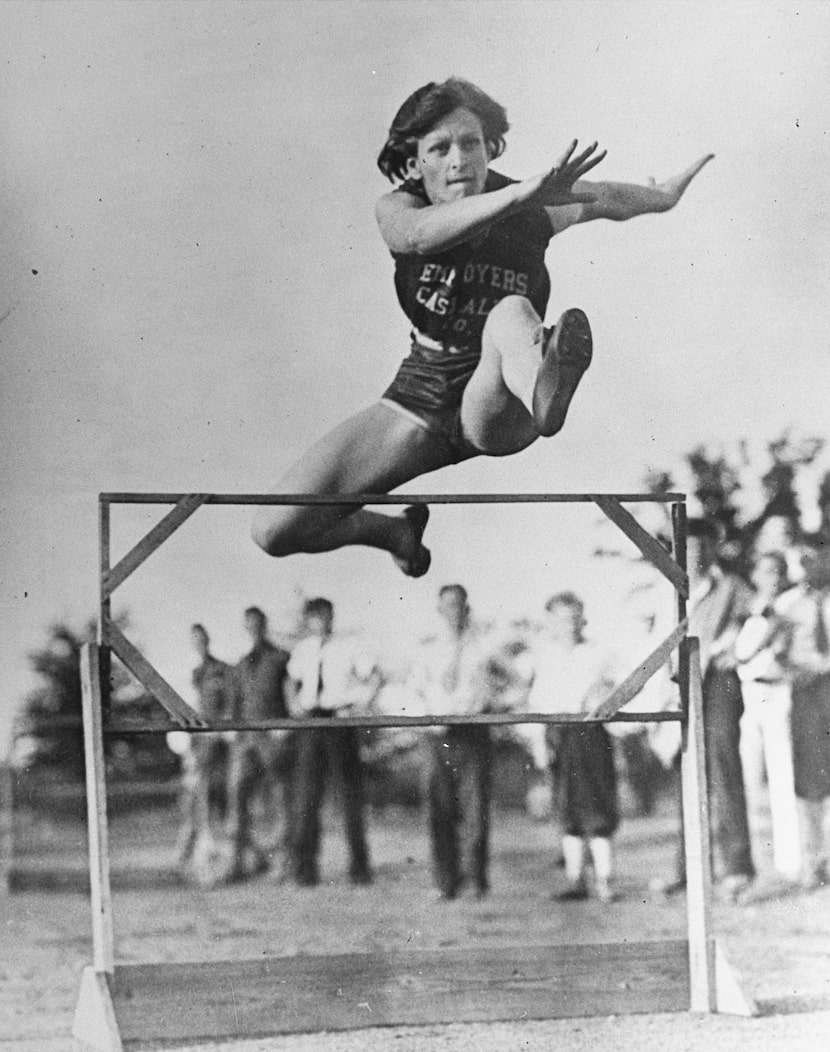
Olympic gold medalist and track and field star Mildred Babe Didrikson Zaharias jumps a hurdle in this 1932 photo.
AP
George Kirksey of United Press called it “the most amazing series of performances ever accomplished by any individual, male or female, in track and field history.”
Once she returned to Dallas after a side trip to Los Angeles, where she won gold medals in the javelin and 80-meter hurdles and was denied a third in the long jump when judges ruled her technique illegal, her adopted hometown put on the biggest party in its nearly 100-year history.
Thousands formed a nearly unbroken line of adulation from Love Field to downtown. A reporter wrote, “It was not unlike the reception Col. Lindbergh received when he came here after his epochal flight across the Atlantic.”
Even after co-founding the LPGA, winning 82 events and earning recognition as the female athlete of the half-century before her death from cancer in 1956, Didrikson would call Dallas’ tribute the greatest honor of her barrier-busting career.
Not long after Babe took the world by the throat, two private schools 40 miles apart made Dallas-Fort Worth the center of the college football universe.
‘Real Football’
Going into the 1935 season, the national media couldn’t have found a press box in Texas if it were on fire. Yet the biggest names in newspapers convened on Nov. 30 when the Horned Frogs and Mustangs, both undefeated, met in Fort Worth.
Grantland Rice, patron saint of press boxes, watched in awe as a TCU comeback led by Sammy Baugh fell short because of SMU’s daring, last-gasp play in a 20-14 win. Rice pronounced it “one of the greatest games ever played in the sixty-year history of the Nation’s finest college sport.”
A couple of days later, The News’ sports section led with this banner headline: “Grantland Rice Says ‘Real Football’ Is Played by Southwestern Elevens”
His syndicated column began, “In the Southwest they play football that crowds in the East, the Midwest and Pacific Coast dream about but never see. In addition to all the fundamentals – hard blocking, terrific tackling, fast running backs, passing and kicking – they gamble to the limit in the type of game the players and crowd demand.”
Rice turned sports writers’ heads toward the SWC for the first time. Over a four-year period, SMU, TCU and Texas A&M would claim national titles, and the Frogs’ Davey O’Brien, a Woodrow Wilson grad, would win the SWC’s first Heisman Trophy.
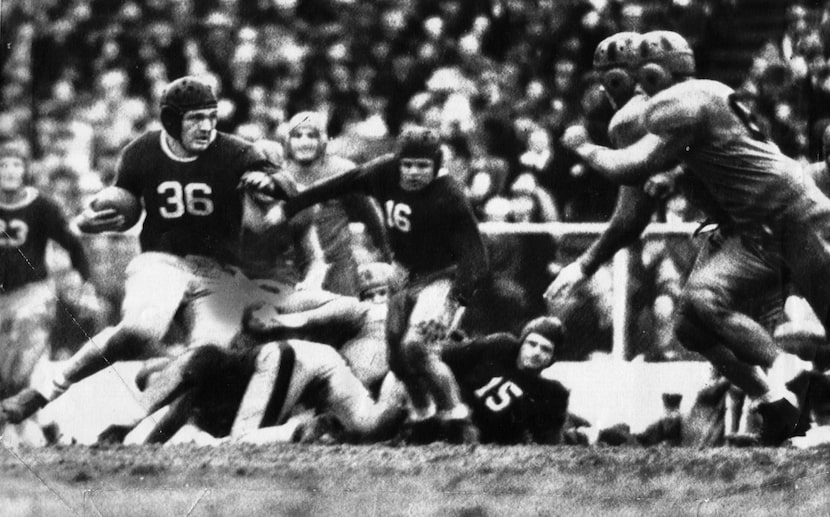
This 1937 file photo shows TCU’s Scott McCall (36) moving into the Marquette secondary for six long yards in the third quarter of New Year’s Day Cotton Bowl Clash. Marquettes’ defense, right, comes up fast to stop the play. TCU won 16-6
AP
A dashing Dallas oil baron was so enthralled by his experience at the ’36 Rose Bowl between SMU and Stanford, he decided he’d start up his own bowl. J. Curtis Sanford personally guaranteed $10,000 to bring TCU and Marquette to Fair Park Stadium on New Year’s Day of 1937.
Before persuading the SWC to take over sponsorship of the Cotton Bowl in 1940, guaranteeing a local attraction, Sanford paid the bills and lost a fortune. He would lose several over his 72 years and always come back laughing. He once told reporters 96 pigeons, two from every state, would be released at halftime and wing their ways home.
He didn’t fudge about the last part, anyway. Every last one of the Dallas natives was back in its Oak Cliff roost before the second half.
“You’d be surprised how many states we heard from,” wife Betty Sanford later said, “people saying they saw our pigeons.”
Doak’s house
If Sanford gave flight to the Cotton Bowl, Doak Walker gave it feet. An additional 20,000 pairs, to be exact.
The multipurpose back, who, with boyhood pal Bobby Layne had won a state football title at Highland Park, changed SMU’s fortunes on the field and at the cash register.
Because so many fans wanted to see the player whose movie-star mug adorned the covers of Life, Look and Collier’s and whose athletic ability made him a two-time All-American and the nation’s first Heisman winner as a junior, SMU vacated cozy Ownby Stadium for the cavernous Cotton Bowl to accommodate the crowds. Even it wasn’t big enough.
Before Doak was done in 1949, the Cotton Bowl had been expanded twice, from 45,000 to nearly 65,000, with an official plaque serving as the new cornerstone: “The House That Doak Built.”
His looks, talent and humility made him a triple threat. After the Associated Press named him to its All-America team, he wrote the committee a letter of thanks. In an era of low-watt offenses, he accounted for 475 yards total offense in a 19-19 stalemate against TCU in 1947.
“All I remember,” he’d say when reminded of his heroics, “is that I missed the extra point.”
A New Star
Dallas missed Doak and his sidekick, Kyle Rote, once they were gone, but another handsome, blue-eyed charmer proved a proper heir. Long after his days at SMU and as the most star-crossed quarterback who ever wore the star were over, Don Meredith neatly summed up his place in the city’s lineage of sports icons.
“I was Dallas’ answer to Doak Walker and Kyle Rote,” he once said, “and all the fantasies those two left Dallas with.”
Meredith bridged the gap between the city’s sports past – SWC football, Texas League baseball, Friday night lights – and its present. Except for a herd of Dallas-Fort Worth golfers including Byron Nelson, Ben Hogan, Ralph Guldahl, Harry Cooper and Lloyd Mangrum who led Gene Sarazen to call Texas “the golf capital of the world,” amateurs ran the show in the Lone Star State before 1960. Most of the city’s other pros made up Dallas’ minor league baseball teams, known over the years as everything from Hams and Griffins to Steers and Rangers. Wrestlers, who competed at the Sportatorium on the skirts of downtown, enjoyed a far longer run than most of the city’s legit pros, right up and through the tragedy-stricken Von Erichs. The NFL’s first stab at the local market, the 1952 Dallas Texans, was a one-and-done bust, albeit with an asterisk: Last NFL franchise to belly up.
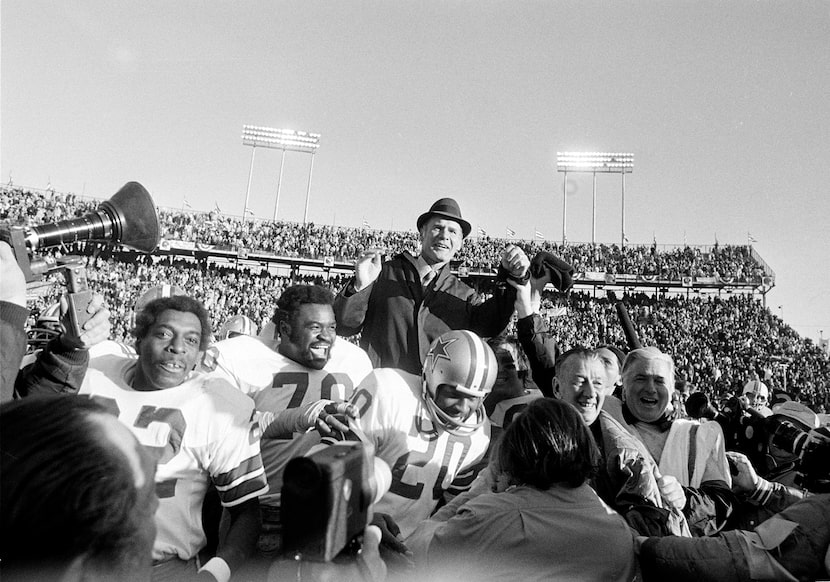
Dallas Cowboys coach Tom Landry is carried off the field on the shoulders of his players after they defeated Miami Dophins 24-3 to win Super Bowl VI in New Orleans, La., Sunday, Jan. 16, 1972. The players are Bob Hayes (22), Rayfield Wright (70) and Mel Renfro (20).
1972 File Photo / Staff
Clint Murchison’s Cowboys and Lamar Hunt’s AFL counterpart, also named the Texans, didn’t figure to improve the survival rate. Neither drew well at the Cotton Bowl. Not even when the Texans won the AFL crown in ’62, at which point Hunt conceded and packed up his franchise for Kansas City.
The Cowboys eventually prospered behind the backing of the NFL and under the ownership of local royalty. Scion of a vast family fortune and a Phi Beta Kappa graduate of Duke, with a degree in electrical engineering and a master’s from MIT, Murchison’s ego wouldn’t have filled a shot glass. Mostly interested in having a good time with his football team, he left daily stewardship to Tex Schramm, Gil Brandt and Tom Landry. Still, his mathematical bent made possible Brandt’s unprecedented use of computers, and his engineering background played a vital role in the conception of Texas Stadium.
He also made two moves to cement the organization’s rise: First, he signed Meredith to a personal services contract before the 1960 draft. Then, when critics called for Landry’s head after his first four seasons netted all of 13 wins, Murchison responded by giving him a 10-year contract, an unimaginable insurance policy then and now.
Landry rewarded the show of loyalty with an NFL-record 20 straight winning seasons, a streak that included 13 division titles and a couple Lombardi Trophies in five Super Bowl appearances. The night before the first one, the owner sent the head coach a note:
“Dear Tom: I’ve taught you all I can. From here on, you’re on your own. Sincerely, Clint.”
America’s Team’s City
The Cowboys’ unrelenting excellence helped enable the transformation of Dallas from the “City of Hate” in the aftermath of the Kennedy assassination to the home of a football team so popular, its fans could be heard everywhere. Their universal fan base inspired NFL Films’ Bob Ryan to christen the franchise “America’s Team” while it was still in its teens.
By the time the Cowboys picked up that nickname in 1978, the Rangers had been in Arlington six seasons, the Mavericks were two years away and the Stars still in Minnesota. Each of those franchises has contributed a league championship to the local trophy case since then, a civic imperative. If they haven’t already, the area’s newest franchises – FC Dallas, Dallas Trinity FC and the Wings – will soon learn this is a frontrunner’s market. Jerry Jones added three Lombardis to the Cowboys’ stockpile, and he’s flat out of grace.
For an idea of how long it’s been since the Cowboys’ last Super Bowl run, we sent 32 people to cover it. Not sure which would be more unlikely now, Jerry winning it all or SportsDay rounding up 32 volunteers.
10 PEOPLE, TEAMS OR EVENTS THAT SHAPED DALLAS’ SPORTS HISTORY
In chronological order:
1932 – Dallas’ Babe Didrikson, who would later be named the greatest female athlete of the half-century, brings home two gold medals from the Los Angeles Olympics after single-handedly winning the AAU team nationals.
1935 – SMU and TCU, both undefeated, meet in Fort Worth for what syndicated columnist Grantland Rice would call “The Game of the Century” after the Mustangs’ 20-14 win. Both schools would claim national titles.
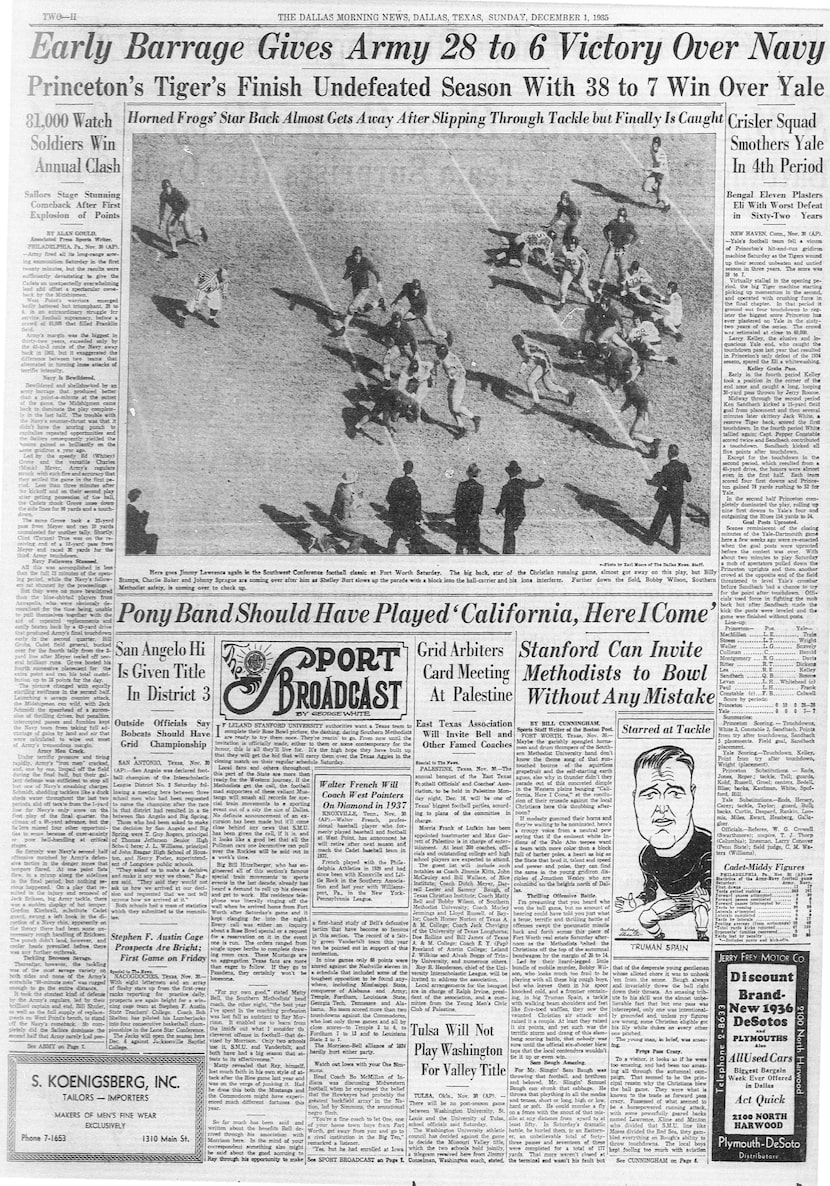
The caption in this Dec. 1, 1935 print edition of The Dallas Morning News reads: Here goes Jimmy Lawrence again in the Southwest Conference football classic at Fort Worth Saturday. The big back star of the Christian running game, almost got away on this play, but Billy Stamps, Charlie Baker and Johnny Sprague are coming over after him as Shelley Burt slows up the parade with a block into the ball-carrier and his lone interferer. Further down the field, Bobby Wilson, Southern Methodist safety, is coming over to check up.
1935 File Photo / Staff
1937 – Dallas’ J. Curtis Sanford spends $10,000 of his own money to bring TCU’s Sammy Baugh and Marquette to the State Fair for the first Cotton Bowl, a New Year’s tradition.
1964 – Clint Murchison Jr. signs Tom Landry to a 10-year deal, thus gilding the future of a franchise that had won 13 games in four years.
1968 – Byron Nelson, winner of a record 11 straight PGA Tour events in 1945, lends his name and credibility to the struggling Dallas Open, guaranteeing marquee fields until his death in 2006.
1972 – The Cowboys eventually exchange their nickname of “Next Year’s Champions” for “America’s Team” after beating Miami, 24-3, in Super Bowl VI, their first of five Lombardi Trophies. Only Pittsburgh and New England, with six apiece, own more.
1988 – Tom Grieve signs 41-year-old Nolan Ryan to a $1.8 million deal with an option. He goes on to play five years, recording two no-hitters, his 300th win and 5,000th strikeout. His Hall of Fame plaque is the first to bear a Rangers cap.
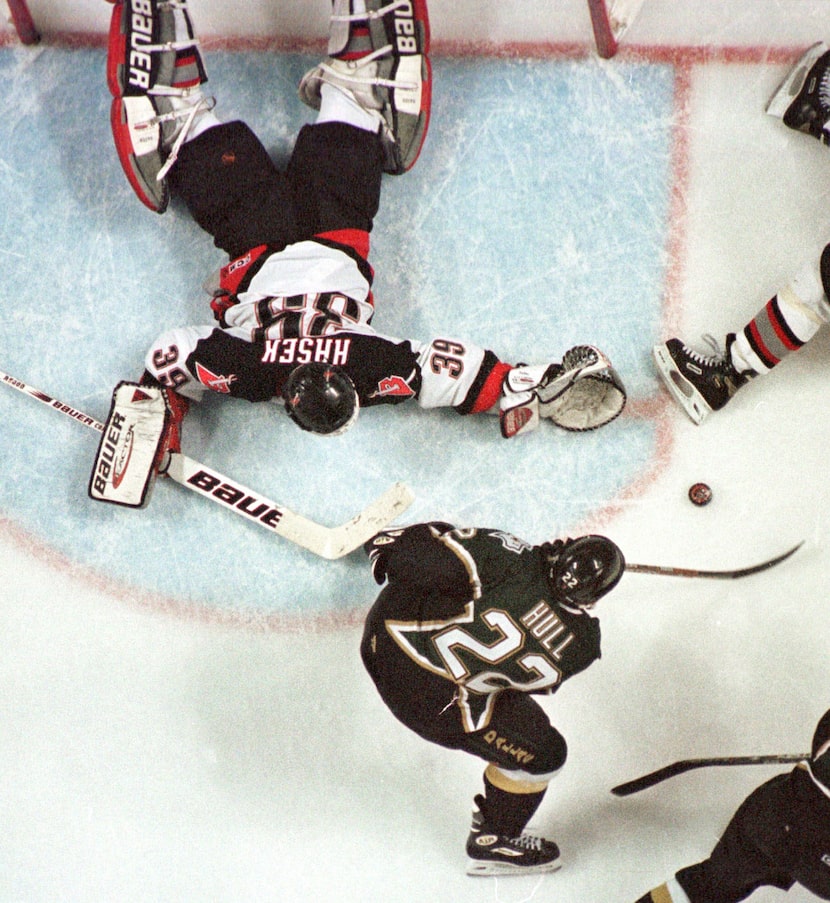
With one skate in the crease, Dallas Stars right wing Brett Hull (22) shoots the Stanley Cup winning goal past the sprawling Buffalo Sabres goalie Dominik Hasek (39) in the third overtime period of Game 6 of the Stanley Cup Finals in Buffalo, NY, early Sunday morning June 20, 1999.
Gene Puskar / AP
1999 – On June 20, at 1:30 in the morning in Buffalo, Brett Hull scores from the crease in triple OT to give the Stars a 2-1 win and their first Stanley Cup as a franchise, six years after moving to Dallas.
2011 – Dirk Nowitzki, the Mavs’ lone star, leads the Mavs past Miami’s three-headed monster of LeBron James, Dwyane Wade and Chris Bosh in six games to give the Mavs their first title.
2023 – In his first season as the Rangers’ manager, Bruce Bochy wins his fourth World Series title and the Rangers’ first. Over the course of the playoffs, the Rangers go 11-0 on the road, a feat memorialized on their championship rings.
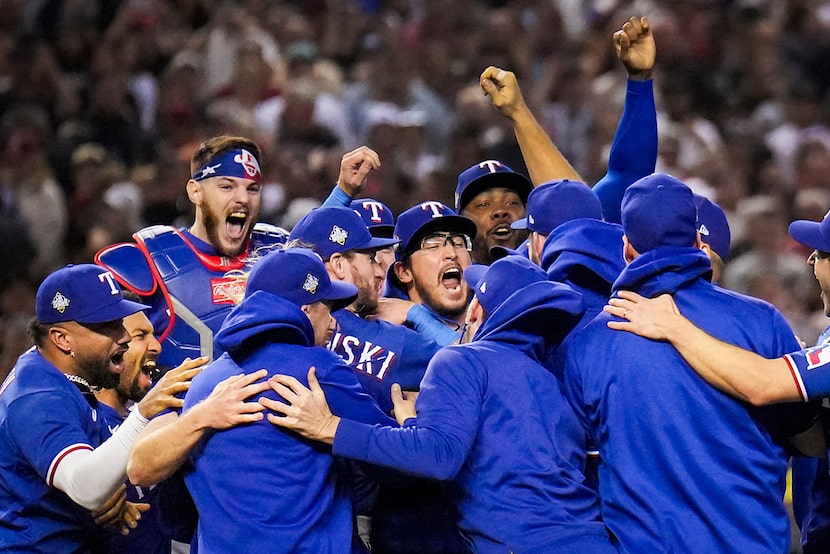
The Texas Rangers players celebrate the final out of a 5-0 victory over the Arizona Diamondbacks to win the World Series in five games, Wednesday, Nov. 1, 2023, in Phoenix.
2023 File Photo / Smiley N. Pool
For more sports coverage from The Dallas Morning News, click here.
To view subscription options for The News and SportsDay, click here.