
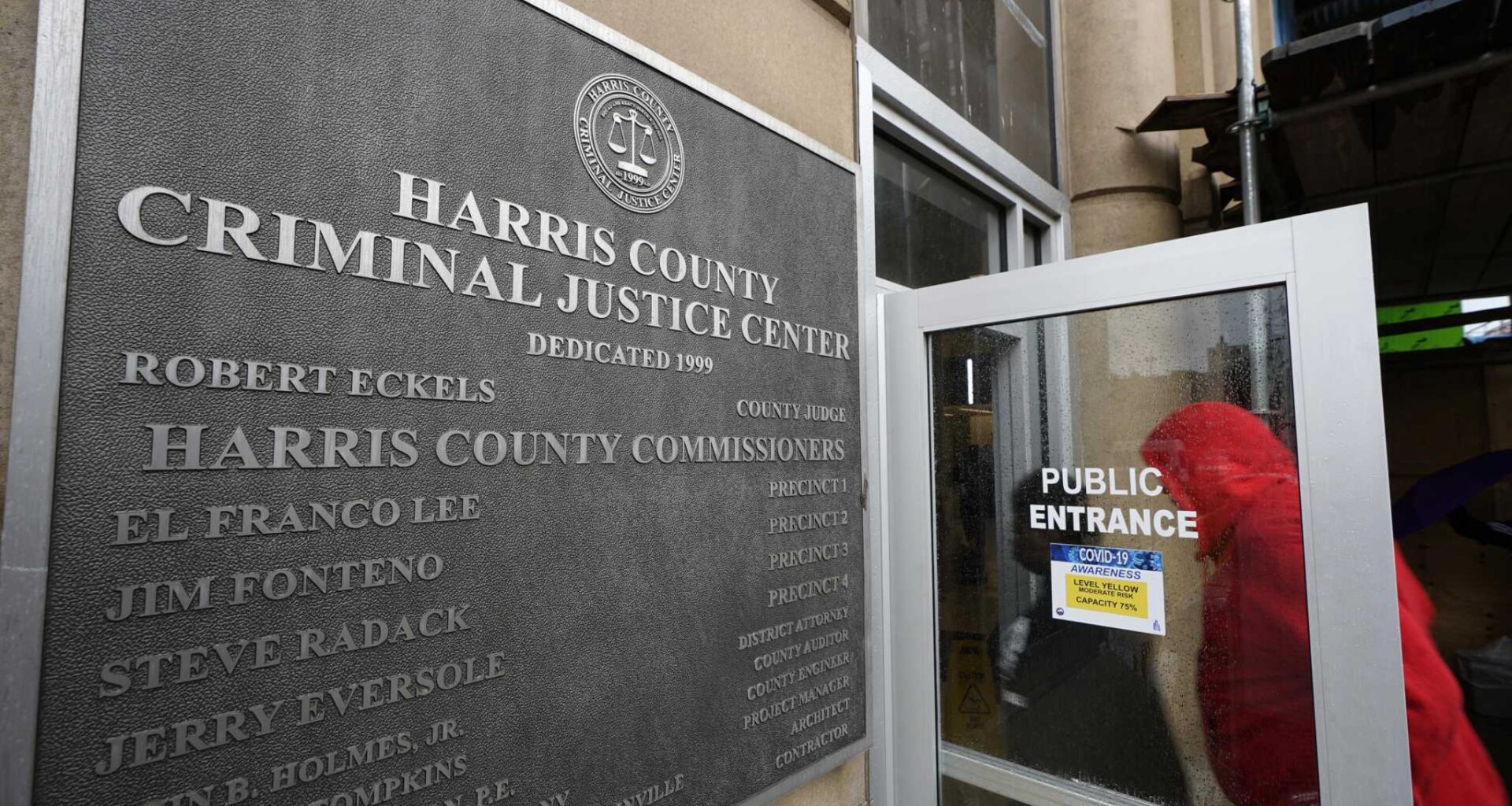
The Harris County Criminal Justice Center, 1201 Franklin St., is shown Monday, June 28, 2021 in Houston.
Melissa Phillip, Houston Chronicle / Staff photographer
Homicide rates are down in Harris County and across the nation. Lower than before the pandemic, and lower than before the 2019 bail reform instituted when a federal judge ruled that the old practices were unconstitutional. It’s known as the ODonnell Consent Decree after the named plaintiff, Miranda ODonnell. A waitress and single mom, she couldn’t afford the $2,500 bail set after she was arrested for driving with a suspended license. Rich defendants can easily pay that amount, but she spent days in jail.
Democrats who swept the judicial races for misdemeanor courts in 2018 quickly instituted reforms. Now, people charged with minor offenses who aren’t out on bail, probation or parole get a general order bond, meaning they can walk out without being processed. These are overwhelmingly low-risk cases where we want people to get back to their jobs, lives and families. An independent bail monitor found that the percentage of people with reoffenses didn’t increase. A bonus is massive savings to taxpayers by having fewer people stuck in our already overcrowded jail.
Judge, County Criminal Court at Law No. 1: Alex Salgado
Alex Salgado ★★★★ — This well-liked Democratic incumbent is running to defend misdemeanor bail reform from legal and political challenges.
Erin Swanson ★★1/2 — A Republican trial attorney and former Harris County prosecutor, Swanson did not meet with the editorial board.
Judge, County Criminal Court at Law No. 4: Shannon B. Baldwin
Shannon B. Baldwin ★★★1/2 — A former prosecutor, this incumbent judge is dedicated to keeping the public safe and helping defendants get their lives on track.
Rebecca Philips Aceto ★★★ — A defense attorney with 25 years of experience, she has her own critiques of the justice system.
Judge, County Criminal Court at Law No. 6: Kelley Andrews
Kelley Andrews ★★★1/2 — This Democratic incumbent focuses on tackling recidivism by getting to what she believes is the root cause of it: mental health.
Joshua Normand ★★1/2 — This Republican challenger has limited experience as a Harris County prosecutor.
Judge, County Criminal Court at Law No. 7: Andrew Wright
Andrew A. Wright ★★1/2 — This Democratic incumbent knows his stuff and is committed to protecting bail reform, but his judicial temperament still needs work.
Thomas Adam Broderick ★★1/2 — He has the resume of a qualified challenger but didn’t meet with us to make his case.
Judge, County Criminal Court at Law No. 8: Erika Ramirez
Erika Ramirez ★★★★ — This Democratic incumbent serves as a leader among misdemeanor judges and tries to help first-time defendants so their first visit to her courtroom is also their last.
Victor Flores ★★1/2 — This Republican is a promising young lawyer who could make a fine judge with more experience.
Judge, County Criminal Court at Law No. 9: Toria J. Finch
Toria J. Finch ★★★★ — This Democratic incumbent judge serves as a mentor, teacher and passionate voice for misdemeanor court reform.
Xavier Alfaro ★★★ — With experience as a prosecutor and defense attorney, this Republican challenger is certainly qualified to serve as judge.
Judge, County Criminal Court at Law No. 10: Juanita A. Jackson
Juanita A. Jackson ★★★ — This Democratic incumbent is deeply invested in helping veterans heal and avoid repeat offenses, and you may remember her from the Sisters in Law reality TV show.
Bao Hoang ★★1/2 — This Republican challenger didn’t meet with us and doesn’t seem to be campaigning.
Judge, County Criminal Court at Law No. 11: Sedrick T. Walker II
Sedrick T. Walker II ★★★1/2 — A by-the-book Democratic incumbent judge who is fair, consistent and knowledgeable.
Elizabeth Buss ★★★ — An experienced prosecutor, she’s qualified for the job but we don’t see a reason to toss the current judge.
Judge, County Criminal Court at Law No. 12: Ashley Mayes Guice
Ashley Mayes Guice ★★★1/2 — This Democratic judge was appointed to fill a vacancy on this court and then chosen by her peers to be presiding judge for all 16 misdemeanor courts.
Anna Emmons ★★★ — This Republican challenger has been a lawyer for 25 years and is currently first assistant district attorney in Liberty County.
Judge, County Criminal Court at Law No. 13: Raul Rodriguez
Raul Rodriguez ★★★★1/2 — Running for his third term, this Democratic incumbent is one of the most respected and well-liked judges in Harris County.
Amber Cox ★★1/2 — This Republican challenger is a Harris County prosecutor and did not meet with us in person.
Judge, County Criminal Court at Law No. 14: Jessica Padilla
Jessica Padilla ★★★1/2 — This is the one Republican incumbent worth reelecting to the misdemeanor bench.
Yahaira Quezada ★★★ — This Democratic associate family court judge also has some criminal law experience.
Judge, County Criminal Court at Law No. 15: Tonya Jones
Tonya Jones ★★★ — This Democratic incumbent judge should probably address her court docket’s late start time.
Stephen C. St. Martin ★★★ — A veteran lawyer, this Republican challenger says he’ll show up and get the work done.
We wish the debate over ODonnell were settled. Unfortunately, Attorney General Ken Paxton and a group of Republican misdemeanor judges sued to undo the consent decree. The lawsuit failed. This week, Judge Lee Rosenthal ruled they were far too late in challenging the 2019 settlement. Paxton appealed.
Article continues below this ad
A supermajority of pro-reform misdemeanor judges would keep the reforms in place. That’s what voters should want. The Houston Chronicle editorial board is nonpartisan and maintaining misdemeanor bail reform is a major consideration for us in balance with our top priorities for judges: relevant experience and competence. We look at each race and candidate individually, and encourage voters to keep the following incumbents on the bench.
Prior to meeting with Houston Chronicle Editorial Board, Aug. 29, 2018: Harris County Criminal Court #1 (D) Alex Salgado
Ana Goni-Lessan
For Judge, County Criminal Court at Law No. 1: Alex Salgado
Before Democrat Alex Salgado started his first term on the misdemeanor court bench following the 2018 Democratic sweep, he got a crucial bit of advice from a veteran judge: Keep a good poker face.
“Every day you have to learn to not say what may really be on your mind, what you’re really thinking, and make decisions based not on emotion, but facts and law, and sure, people aren’t going to be happy, but that’s the job,” Salgado, 44, told us.
Article continues below this ad
Now running for his third term, Salgado has always been confident in his principles. He first ran as a vocal advocate for misdemeanor bail reform and is now running to defend those same bail policies from legal and political attacks.
Yet he says he still had to overcome the perception that, as a career prosecutor, he would favor the state in his rulings. Salgado said he often worked his cases as if he were a defense attorney, and as such, said he tends to hold prosecutors to a higher standard in his court. In reality, both sides seem to agree on his reputation for fairness. Salgado gets superb marks in surveys from both the Houston Bar Association judicial evaluation and the Harris County Criminal Lawyers Association evaluation poll. It helps that he’s also efficient in managing his docket: He’s cleared 96% of his cases in the past 12 months.
Salgado’s opponent, Republican Erin Swanson, did not meet with the editorial board. She is a trial attorney and former Harris County prosecutor.
Judge Shannon Baldwin is shown in the Harris County Criminal Court at Law No. 4 in Houston Friday, Jan. 2, 2026.
Melissa Phillip/Houston Chronicle
For Judge, County Criminal Court at Law No. 4: Shannon B. Baldwin
Shannon Baldwin has served as presiding judge over all of the 16 criminal courts, as well as the SOBER Court and the Misdemeanor Veterans Court — a position she values deeply as a U.S. Army veteran. A former prosecutor, she tried cases ranging from misdemeanors to capital murder. As a judge first elected in the 2018 blue wave, she is committed to restorative justice. That typically means second chances for people accused of minor offenses.
Article continues below this ad
“Probably with my experience, I could have walked into any courtroom,” the Democratic incumbent said during our editorial screening. “But I chose a misdemeanor court because of the type of sentencing that we have.”
Her Republican opponent, Rebecca Aceto, 54, has more than 25 years of legal experience serving as a Harris County Assistant District Attorney, defense attorney and a mitigation specialist in capital murder cases. She spent a good chunk of the editorial screening criticizing Baldwin for taking too many vacation days, not showing up to court on time and the lack of courthouse professionalism. Aceto also went on to say she was “in the trenches every day,” having to wait for prosecutors and judges to show up.
While Baldwin is in the middle of the misdemeanor judges on the Houston Bar Association’s 2025 judicial evaluation, she received notable support on the Houston Bar Association’s judicial preference poll. Moreover, Aceto admitted she had never actually been to Baldwin’s court.
Aceto did highlight areas for improvement in the current system, pointing to high fees for pretrial intervention programs. Rich and poor defendants, she argued, still experience two different justice systems.
Baldwin has the experience and the dedication to ensure every person who enters her court receives a fair sentence while keeping the community safe. She has served well during her eight years, and Harris County residents should reelect her for a third term.
Article continues below this ad
Kelley Andrews, Democratic candidate for Harris County Criminal Court at Law No. 6, poses for a photo at the Houston Chronicle, Wednesday, Sept. 26, 2018, in Houston.
Jon Shapley/Staff photographer
Judge, County Criminal Court at Law No. 6: Kelley Andrews
Since taking the bench in 2018, Judge Kelley Andrews, 54, has been a part of the sweeping reforms in Harris County to address the problem of people who commit repeat offenses. She told us that “you really need to address people as individuals if you have any hope of stopping or slowing down recidivism rates.”
Her opponent, Joshua Normand, 48, said what he saw in the misdemeanor courts is “frankly disturbing.” The 13-year lawyer has a career practicing both civil and criminal law but less than two years working for the district attorney. He argues that big-name defense attorneys who donate to the judges get preferential treatment. That, he said, is not fair. Normand, however, has never been assigned to this court and had no criticisms specific to Andrews.
The incumbent flatly denied treating donors any differently, and noted she has raised very little money. One reason she said donations have dropped is because Democratic misdemeanor judges put in place a new system — Managed Assigned Counsel — which removes judges from the process of picking which lawyers are assigned and paid by the county to represent defendants who can’t afford counsel.
Article continues below this ad
Voters have little reason to replace a respected judge with deep experience in criminal law.
Andrew A. Wright, the current Judge at Harris County Criminal Court At Law # 7, poses for a portrait at the Houston Chronicle on January 19, 2026. He is the incumbent candidate for County Criminal Court at Law No. 7.
Sharon Steinmann/Houston Chronicle
Judge, County Criminal Court at Law No. 7: Andrew A. Wright
Andrew Wright, 43, got elected in 2018 on a platform of reform. Now he’s concerned about fortifying the progress he and his colleagues have made.
“I don’t want to see us go backwards. I’d like to see us continue that work,” he explained to us during his endorsement screening. It’s one of the main underlying reasons why he’s running for a third term. While we endorse him for reelection, his behavior on the bench remains a matter of concern.
As we noted during the Democratic primary, Wright has received low marks for his brusque demeanor from the Houston Bar Association and the Harris County Criminal Lawyers Association. In his defense, he said he’s tough on defense attorneys who he believes aren’t doing their job well.
The Republican challenger, Adam Broderick, is chief of the consumer fraud division in the Harris County District Attorney’s office. We didn’t get an opportunity to meet with him. That’s too bad, because we’re open to arguments that Wright’s judicial temperament, or lack thereof, should be a fireable offense.
Still, given Wright’s breadth of knowledge in criminal defense law, his solid clearance rate and commitment to reforms that are working, voters should keep him on the bench.
Judge, County Criminal Court at Law No. 8: Erika Ramirez
Victor Flores provided plenty of pokes, prods and high energy during the Chronicle’s endorsement interview. As the Republican challenger, that was his job.
But incumbent Democrat, Judge Erika Ramirez, did her job too, which was to defend her solid performance since taking the bench in January 2023 after defeating Franklin Bynum, the sitting judge at the time, in the Democratic primary.
Ramirez was quiet, almost subdued, during the interview. Still she stressed the importance of treating defendants with respect while clearing their cases efficiently — most of them resolved in six months or less. During her first term she also earned the confidence of her colleagues, who elected her twice to serve as the presiding judge of all 16 criminal courts at law. She also has among the highest ratings on the Houston Bar Association’s judicial evaluation.
Ramirez, 41, clearly has the gravitas and experience to keep her job.
Meanwhile, Flores, 32, made some arguments against Ramirez that fell short.
He talked critically and at length about a 2025 animal cruelty case in Ramirez’s court. Long story short, a woman abandoned a kitten near Lake Houston, then struck the creature with the rear wheels of her truck as she drove away.
For Ramirez, the case was straightforward. The defense attorney and prosecutor came to her with a plea deal that gave the perpetrator six days in jail. She approved the deal and moved on.
Flores, a seven-year veteran of the district attorney’s office, suggested the woman deserved a much stiffer sentence and that Ramirez blew the call. He said hundreds of followers of Facebook and Instagram agreed with him.
“I call balls and strikes,” Ramirez said. “I can’t make my decisions based on what Facebook says.”
We were happy to hear the kitten survived after great work by the Houston SPCA. Still, the problems of the cat the staff named Alex can’t compete with the challenges adults and children face in misdemeanor court every day.
Ramirez was right to take the plea deal and move on. And voters will be right to return her to the bench.
Toria J. Finch is the Democratic incumbent judge in Harris County Criminal Court at Law No. 9.
Jill Karnicki/Staff photographer
Judge, County Criminal Court at Law No. 9: Toria J. Finch
Almost certainly Republican Xavier Alfaro would make a capable misdemeanor judge. He really wants the job — he has run for it before — and he has the heart for public service.
Alfaro worked as an assistant district attorney in Harris County from 2007 to 2011, as a criminal defense trial attorney from 2011 to 2018, as an assistant district attorney and deputy division chief in Fort Bend County from 2019 to 2024 and now he’s back to his solo practice as a criminal defense attorney.
But Alfaro, 50, made a miscalculation in challenging Democratic incumbent Toria J. Finch. She’s done exemplary work since winning her first election in 2018, and she’s earned a third term.
Finch, 45, is a leader among the misdemeanor court judges. She’s a savvy administrator, mentor and teacher, much like her educator mother and pastor father. She sees herself as a part of a county-wide movement to mend — not break — the thousands of non-violent Houstonians who commit minor crimes every year.
Before bail reform, Finch would see defendants, still innocent until proven guilty, held in jail for days or weeks because they didn’t have the money to post bond. Every day brought them closer to losing their jobs, homes and families, Finch says. Often they would plead guilty so they could get out of jail for time served and scramble to salvage their lives.
But they couldn’t. With the guilty pleas, they had criminal records. They were marked.
The idea is to hold people accountable, help them work on their issues and reverse their downward trajectories, all the while maintaining public safety, Finch says.
She and her fellow judges have seen many of their charges make amazing recoveries. They’ve also seen reductions in case backlogs, reductions in active cases pending, reductions in the overcrowded jails and savings for taxpayers.
Much has been accomplished, Finch says, but there is still much to do.
“Sisters in Law,” a Houston-based reality show on the WE network. Juanita Jackson stars with five other prominent African-American female attorneys: Jolanda Jones, Vivian King, Rhonda Wills, Monique Payne and Tiye Foley. All of the women are friends in real life; they range in age from 29 to 56.
WE Network
Judge, County Criminal Court at Law No. 10: Juanita A. Jackson
Most attorneys, certainly most judges, inevitably slip into “legalese” — that lawyerly language regular folks do not understand.
Juanita Jackson, the Democratic incumbent judge, sticks to English. She keeps it real. She was even once on a reality TV show as a lawyer — Sisters in Law.
We won’t hold it against her. Jackson, 60, is an effective judge who has earned reelection.
The Republican challenger in this race, attorney Bao Hoang, didn’t meet with the editorial board. His website is blank except for a contact form and these five words: “Safety, Integrity, and Accountability first.” As far as we can tell, he’s a criminal defense attorney with roughly a decade of legal experience.
Jackson has practiced law for nearly three decades. In addition to her regular duties, she is deeply invested in Harris County’s misdemeanor veterans court, where she touts a 100 percent compliance record. She said that success stems from her positive approach with the wounded warriors. Instead of sending vets to jail for slipping up, she requires that they spend those days in her courtroom. It’s an education in humility, in what not to do.
When vets celebrate sobriety anniversaries in court, Jackson hands them handwritten notes from the bench.
“Congratulations. Judge Jackson is proud of you.”
Sedrick T. Walker II is the Democratic incumbent judge for Harris County Criminal Court at Law No. 11.
Mark Mulligan/Staff photographer
Judge, County Criminal Court at Law No. 11: Sedrick T. Walker II
Many mornings Sedrick Walker starts preparing for the day’s challenges before the sun comes up, he told us. The misdemeanor courts have gone through plenty of reforms since the Democratic incumbent was first elected in 2018. But there are still challenges, he says, such as the shortage of court reporters, interpreters and misdemeanor courts for a county as large as ours.
Walker, 43, is able to face those challenges and voters should send him back for a third term on the bench. While he thinks about the future of our county courts, he aptly maintains a firm grip on his daily caseload and his responsibilities with substance abusers in a specialty court devoted to treatment, counseling and recovery.
As the men and women progress, he says, “they motivate me to continue doing what I’m doing.“
His Republican challenger, Elizabeth Buss, 42, is the chief prosecutor in Harris County’s 495th District Court. Four years ago she narrowly lost the race for County Criminal Court at Law No. 5.
During the endorsement meeting, Buss criticized Walker for clearing his docket too slowly — more slowly than 10 of the 16 misdemeanor judges.
Walker said that he tries to move cases swiftly, “without railroading anyone, either the state or defense. If a case is lingering, I try to talk to the parties and find out what truly is going on. Even with that my clearance rate is pretty solid. From September 2025 through August of this year, it’s 98 percent.”
Solid. That describes Walker.
Ashley Mayes Guice is the sitting Democratic judge in Harris County Criminal Court at Law No. 16.
Ashley?Mayes Guice
Judge, County Criminal Court at Law No. 12: Ashley Mayes Guice
In Texas, Republican judges who lose elections often end up back on the bench through appointments by the governor to statewide, regional or district courts.
In Harris County, Democratic judges who lose can get appointed to county-administered courts. That was the case for Ashley Mayes Guice. She was appointed to a misdemeanor court in 2022, but too late for her to run for election in that same court. She lost a 2024 bid for another court. Last year, Commissioners Court appointed her to this one.
Confused? The point is that Guice, 43, has experience and is respected by her peers. She was picked by elected commissioners and the other judges chose her to be presiding judge over the 16 misdemeanor courts. In that position, she’s playing a lead role in the restorative justice reforms underway. Even with that responsibility, Guice keeps her docket moving. It had about 1,000 pending cases as of August, better than average for the misdemeanor courts. Voters should elect her to a full term.
Republican challenger Anna Emmons, 56, is currently first assistant district attorney in Liberty County. She’s been a lawyer for 25 years, mostly as a prosecutor but with two years in private practice. Emmons is qualified to be a judge, and has more years total under her belt than Guice, but voters have no reason to boot the incumbent.
Raul Rodriguez is the Democratic incumbent judge in Harris County Criminal Court at Law No. 13.
Marie D. De Jesús/Staff photographer
Judge, County Criminal Court at Law No. 13: Raul Rodriguez
Raul Rodriguez takes special pride in initiatives designed to interrupt the cycle of repeat low-level crime.
One he cited provides an alternative to jail time for some driving while intoxicated offenders who agree to attend recovery programs.
Another, called Fresh Start, is a quarterly event at which some eligible offenders can petition for their records to be cleared or sealed. Even minor records can impede access to jobs, housing and other needs.
This pride in his work is among the reasons we recommend Rodriguez, a Democrat, for a third term on this misdemeanor bench.
He received the highest rating of any misdemeanor judge in the Houston Bar Association’s judicial evaluation and more votes than any misdemeanor judge in the bar’s preference poll. Republican challenger Amber Cox, 51, is chief of fugitive apprehension and extradition in the Harris County district attorney’s office. She didn’t meet with the board, but in a written statement said her experience in that office gives her the “knowledge to make sure that the defendants are treated fairly and the community is safe.” We did not endorse her for a felony district court in 2022 after she compared defendants to “children” who “have to have boundaries” and be held accountable.
Before his 2018 election to this bench, Rodriguez, 67, served as an associate Houston municipal judge and was in private criminal law practice for 26 years.
Voters should return this reformer to the courtroom.
For Judge, County Criminal Court at Law No. 14: Jessica Padilla
When Republican Jessica Padilla ran for a misdemeanor court bench in 2018, we endorsed her successful Democratic opponent but encouraged Padilla to try again.
Four years later, she did, and voters elected Padilla to County Criminal Court at Law No. 14. In her bid for reelection, Padilla, 50, faces a Democratic challenger, Yahaira Quezada, 47, who has served for seven years as associate judge in the 246th Family District Court.
Incumbents get an edge because they’ve had on-the-job training, and we recommend that voters award Padilla another term — even as we encourage Quezada to consider running for judge again, though family court would likely be a better fit.
And we applaud her service on the 246th court. For most of this year, she has handled a large workload because the court’s elected judge missed months of work after the sudden death of her husband.
We have reservations about Padilla. She and three other Republican misdemeanor judges are fighting the 2019 ODonnell Consent Decree, which replaced the unconstitutional misdemeanor bail system in place for decades. Yet Padilla stands out because her critiques focused on places where the federal settlement conflicts with new changes to state law.
“Anti-reform, and taking it back to the way things were, is absolutely not what I have been saying,” she told us.
Padilla has championed court policies that direct qualified defendants to programs treating addiction and other problems that can contribute to criminal behavior. And she has kept the court’s busy docket moving, with its caseload among the lowest in the misdemeanor courts.
Quezada, born in the Dominican Republic, grew up in New York, then earned her law degree from Thurgood Marshall School of Law in Houston. She’s been a Harris County prosecutor and a defense attorney.
She noted that some of the issues that come up in family court — such as addiction, poverty and family violence — also affect people whose cases land in criminal court, and she has experience in both.
Padilla, however, has run her docket well for four years. We disagree on the bail settlement, but take her criticisms in good faith and believe that her criminal court experience better qualifies her for the job.
Tonya Jones is the Democratic incumbent judge in Harris County Criminal Court at Law No. 15.
Jill Karnicki/Staff photographer
Judge, County Criminal Court at Law No. 15: Tonya Jones
This is a tight race, but we’re encouraging voters to stick with the incumbent.
Republican challenger Stephen C. St. Martin is a veteran criminal lawyer making his first bid for elective office, and he makes a strong case against the Democratic incumbent. He says Democratic incumbent Tonya Jones makes poor use of other people’s time.
Her first docket call in County Criminal Court at Law No. 15 is at 10:30 a.m. That’s the latest among the 16 county criminal courts.
“She’s not doing the job,” St. Martin said of the two-term incumbent. “She’s not showing up till 11, 11:30.”
Jones responded with some numbers of her own: Court 15 had 1,065 active cases in August, according to county records. That’s about average for these courts. And Jones clears cases at about the same rate as most of her peers.
“Those things are more effective in determining my overall performance,” she said.
Jones, 40, attributes her later start time partly to staggered court schedules during the pandemic. But we’re five years out from that. Lawyers who otherwise give Jones respectable marks in bar association polls rate her lower on keeping to a schedule.
She notes that she serves as co-presiding judge, an administrative post that sometimes keeps her away from the bench.
St. Martin, 63, knows his way around the courts too. He is a former Harris County assistant district attorney whose 35-year legal career is split between prosecution and criminal defense. While the two argued about the ODonnell settlement, St. Martin offered a rare example of a defendant — Michael Maurice Mack — released on a low-level misdemeanor later being charged with a capital murder offense. When pressed, however, St. Martin agreed that even if the maximum amount for a misdemeanor bond had been set, the defendant could have secured release.
He insisted, however, that for the system to be treated seriously by criminals, a bail hearing before a magistrate is the minimum.
We still think the ODonnell settlement is the right way to run things, and that Jones should be reelected.