
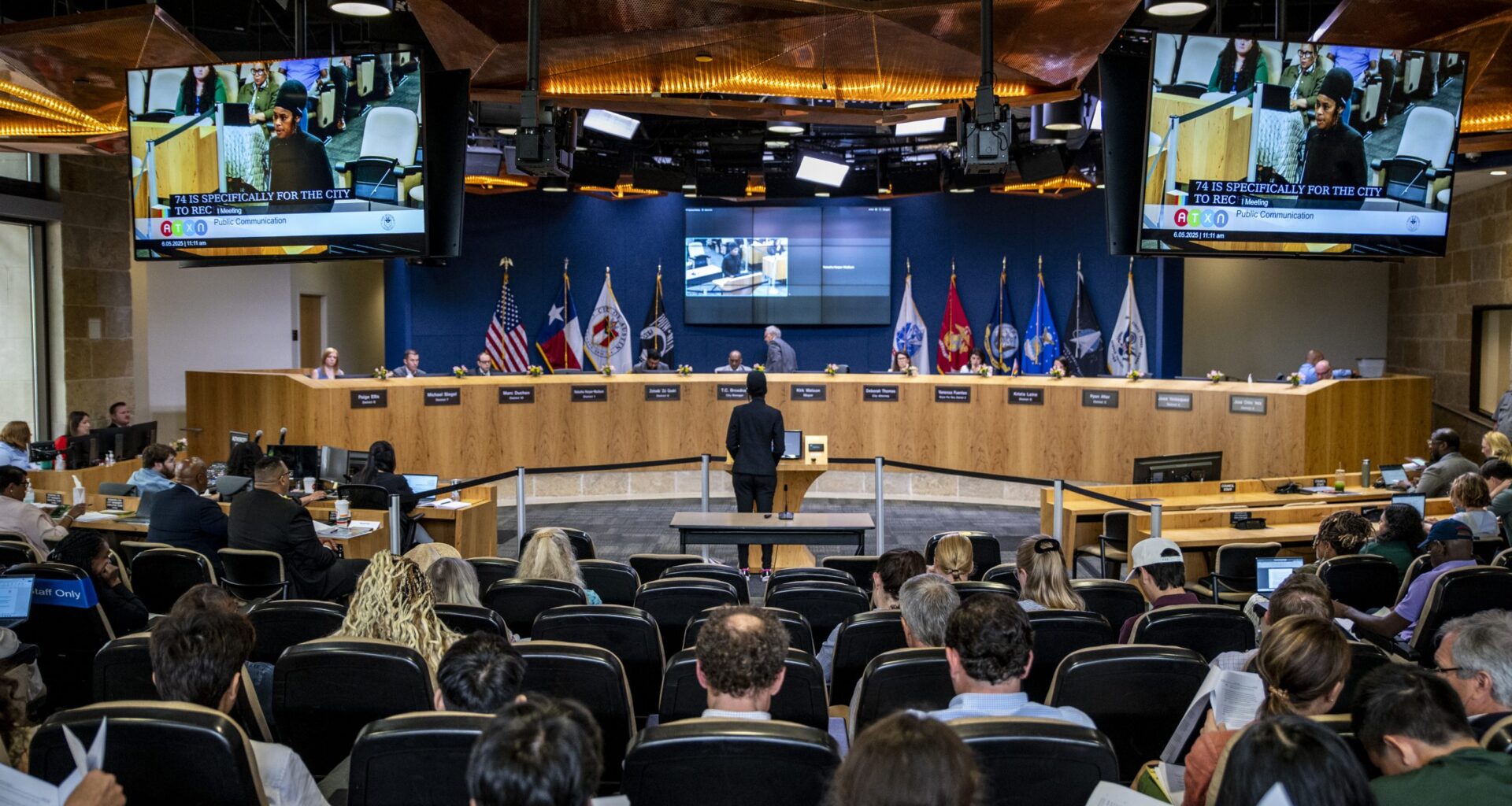
Austin City Council has borrowed $566 million without voter approval since 2024, a surge driven largely by one main reason: real estate.
The borrowing, through certificates of obligation, accounts for more than 60% of the $883 million Austin has issued over the last decade. Council members say it’s largely to buy or fix up buildings, a strategic move intended to save money by avoiding higher renovation costs for run down, city-owned property and reduce the reliance on leased office space.
But these bonds, which don’t go before voters, come at a cost. Austin repays the debt through property taxes, along with tens of millions of dollars in interest. Each $100 million in bond funding adds $14 to the average tax bill, putting more pressure on residents in a city increasingly seen as unaffordable.
While the council authorizes certificates of obligation in public meetings, the borrowing seldom receives much community scrutiny. Advocacy groups rarely fight them. Residents barely notice them.
Critics say the surge shows Austin is not living within its means at a time when the city struggles with state caps on property taxes, a slump in new construction and voter frustration over growing tax bills. They also question whether the city is using certificates of obligation too often and without enough transparency.
But City Council Member Chito Vela says the city has to move fast to buy property and could lose out on good deals while assembling a voter-approved bond.
“No one’s going to wait for us,” Vela said. “ We can’t say, ‘Oh, this is a great deal. Okay, give us about 18 months.’”
In recent years, the Texas Legislature has proposed tightening how the bonds can be used. The Texas Public Policy Foundation plans to push that idea again in the upcoming session, said John Bonura, a policy analyst with the politically conservative think tank.
“We’re going to be advocating for policies that limit all around the ability for local governments to take out debt,” he said, “specifically targeting certificates of obligation, limiting their use to things that are emergent items that require a quick passage, not just to fulfill your wishlist that didn’t get passed.”
That would be a mistake, said Adam Haynes, policy director for the Texas Conference of Urban Counties.
“The conservatives say, ‘Well, you can’t do a bond unless the voters approve it,’” he said. “That’s just not the way government financing 101 works.”
A public bond shrinks, but some projects return
Local governments routinely borrow money to pay for major projects, such as bridges, roads and buildings that would be difficult to fund in a single budget year. Some bonds go before voters. Certificates of obligation do not.
Austinites will vote next month on a $295 million parks and library bond. That package took two years to develop and went through a very public process that included community outreach, task force recommendations and council debate in meetings.
Earlier this year, City Council considered putting a far larger bond before voters, with one option as high as $766 million. But members backed away from the larger package after voters overwhelmingly rejected Proposition Q, a 2025 tax rate election that would have raised property taxes to pay for city services.
The defeat raised questions about voters’ appetite for higher taxes and whether the city is spending money wisely. So the council settled on a much smaller bond package.
But instead of abandoning all the projects left out of the smaller bond, the council later used certificates of obligation to add some back in, including $33 million for sidewalks, urban trails, and traffic programs, as well as $3 million to expand and renovate Austin Animal Services facilities.
“I don’t know if it’s necessary, for example, to go back to the voters to get $10 million in sidewalk money,” Vela said. “I think that there’s an expectation that the city is going to do what it needs to do to continue to build out what virtually everybody in Austin would call basic infrastructure.”
City policy and state law allow non-voter-approved debt “when expenses are urgent, unexpected, needed to avoid economic loss, likely to produce economic gain, or required for safety issues,” said city spokesperson Kimberly Moore.
Both certificates of obligation and voter-approved public improvement bonds are forms of general obligation debt repaid through property taxes. The key difference is who authorizes them: Voters approve public improvement bonds, while the council can authorize certificates without elections.
As of Sept. 30, Austin had $2 billion in general obligation bond debt, including voter-approved public improvement bonds and debt approved only by the council. Of that, $628 million stems from certificates-of-obligation. That does not include interest.
Do certificates bypass voters?
Critics like Bonura cast certificates of obligation as a way to get around the voters’ will. But Haynes bristles at the idea that certificates of obligation are handled without public vetting.
Notices of the proposed borrowing must be published in a local newspaper and bonds are authorized in public meetings. Government watchdogs, including the media, have an opportunity to raise red flags, he said.
While many expenses can be handled through voter-approved bonds, Haynes said residents often resist paying for prisons, juvenile detention centers and courthouses.
Travis County voters, for example, rejected a $287 million bond in 2015 to build a downtown courthouse. The county later funded a new court complex at a different location with certificates of obligation.
When one county commissioner accused the court of ignoring voters, then-Travis County Judge Sarah Eckhardt strongly disagreed.
“Please don’t keep saying that we are going against the voters’ will,” Eckhardt, now a state senator, said. “They told us no to a specific dollar figure, a specific financing mechanism on a specific location, a location that was dearly prized by the private development interests.”
The courthouse vote illustrates how difficult it can be to win public support for expensive government facilities, even in Austin, home to a bastion of liberal voters, Haynes said.
“If that’s going to fail in Austin, in Travis County, what’s [Williamson County] going to do?” he said. “What’s Llano going to do? What’s Burnet going to do?”
Bonura said the concern extends beyond any single bond: Certificates of obligation make it easier for governments to overspend without seeking approval from voters.
“One of the problems is that we find ourselves in an environment where local governments have an addiction to spending,” he said.
Borrowing also carries substantial interest costs. When the City Council approved $142.6 million in certificates of obligation in August, it estimated taxpayers could be on the hook for another $86.2 million in interest over the life of the debt.
The total estimated cost: nearly $229 million.
The case for moving quickly
Since 2016, the city has taken out nearly $883 million in certificates of obligation. But the current council has leaned more heavily on certificates of obligation than its predecessors, approving $566 million over the last three years.
Council Member Mike Siegel knows people don’t always see the machinery behind the city’s financial decisions. Austin has a $6.6 billion budget, with most of the money going to Austin-Bergstrom International Airport, Austin Energy and other enterprise funds.
But the real estate purchases over the last three years have been strategic and will ultimately save taxpayers money, Siegel said. Buying buildings gets the city out of paying millions of dollars in leases.
Some city properties are so dilapidated that they would cost far more to renovate than to buy something new, he said. Freeing up some of its properties also allows the city to redevelop or sell them.
“So the city could sell the Austin Police Department headquarters for private development and those tens of millions of dollars would go back to the city and the people of Austin,” Siegel said.
The $120 million the city approved in 2024 to buy and renovate a public safety headquarters is a good example of the kind of real estate the city needs, Vela said. The 386,000-square-foot structure, at Barton Skyway and South MoPac Expressway, will house Austin Fire, Austin Police and Austin-Travis County EMS.
“We bought that office building at the perfect time when the market was just trash for commercial office buildings,” he said. “It’s in a great location. It has highway access. It has quick access to downtown. It just in many ways fits a lot of our needs.”
But the city needs a more consistent bond cycle that reflects better strategy and planning, said Council Member Marc Duchen. Certificates of obligation, he said, should be handled in that context.
The council recently passed Duchen’s resolution directing the city manager to establish a six-year bond cycle.
“Its passage steers the city away from more frequent bond elections to an interval that encourages strategic use of the funding tools at our disposal and a comprehensive, long-range vision for addressing our city’s needs,” Duchen said.
Despite Austin’s financial pressures, Vela said the city’s top bond rating shows Wall Street remains confident in the city’s ability to repay its debt.
“Ultimately, though, I think the proof’s in the pudding,” he said. “I mean, a triple-A bond rating is a triple-A bond rating, right?”