
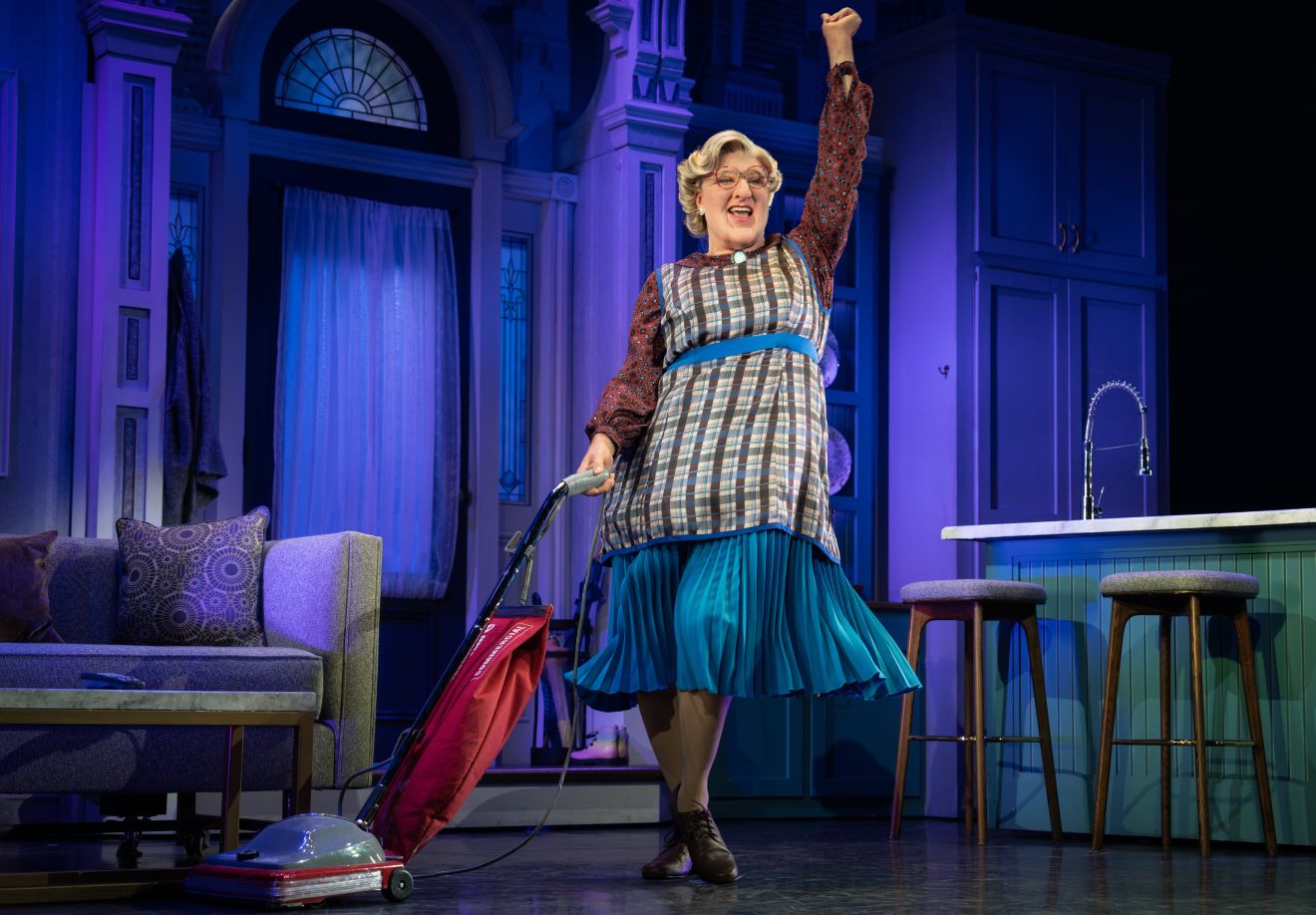
Work Light Productions, the producers of the musical adaptation of the mega-hit movie Mrs. Doubtfire, has lied to us.
The Playbill exclaims, “The New Musical Comedy.” This musical is not “new” by any definition of the word. Other than its ricochet references to LGBTQ+ relationships or its contemporary treatment of divorce (not a recurrent musical comedy theme), Doubtfire is a throwback not only to the 1987 film but any musical from the ‘50s.
This touring show, brought to the Hobby Center by Theatre Under the Stars, even looks like it’s been staged in the ‘50s with its constant “in-one” scene changes, where a drop flies in at Leg #1 so that the scene plays near the footlights while the next set can be arranged behind it. The backgrounds are painted flats, and the only substantial setting is the living room/kitchen of the Hillard house, from which Daniel (Craig Allen Smith) will be banished after a divorce.
Naturally, these paint-by-numbers film-to-stage musicals (Mean Girls, Tootsie, Big, Legally Blond, etc.) are instantly forgettable, usually because the music doesn’t add anything, it only lengthens the running time. The plots are the same, only badly translated. The producers rely on whatever good graces the films have and presume the audience will flock to see it again on stage. When the stars align, the effect can be magical – The Lion King, A Little Night Music, The Producers, Billy Elliot – but often the theater versions are pale imitations.
Updated from the movie’s late ‘80s vibe with more contemporary references, Doubtfire is a rather faithful, if bland, xerox, filling the time for the many miraculous costume changes in which Daniel transforms into Euphegenia – often in full view of the audience, so we can see theater magic in full force – with vigorous dance numbers, a solo number, or comedy sketch. Then the plot continues. It’s stop and go pacing, surprisingly directed by old Broadway pro Jerry Zaks who should know better. The national tour direction is by Steve Edlund.
This musical has a major problem right from the start. Who can compare or compete with the manic performance of Robin Williams whose extemporaneous, outrageous style cemented the film into comic heaven? It’s a losing battle. Smith does extremely well in channeling Williams with zany vocal impressions, a flub-a-dub dance style, and an average schlub look. He’s no great song stylist, but that’s not his character. He’s just a Joe who loves his kids and will do anything to be back at home with them. Even if that means dressing like a doughy, matronly Scottish nanny. It might not be admirable to hoodwink his family, but it’s understandable, especially during Smith’s serious moments when all seems lost. He’s relatable, and that goes a long way. He can’t eclipse Williams, who ever could?, but he manages to keep that shadow from completely overtaking him.
Mom (Melissa Campbell) has been beefed up. She’s now an entrepreneur on the rise, a fashion designer, so she’s got problems of her own. Strict with her children, she needs a lesson in parenting as much as Daniel. She’s given the soft anthem “Let Go” late in Act II, which she sings passionately, but the role is still underwritten. And she’s made into a cougar with her stud, almost-boyfriend Stuart (Collin Salvatore) lusting after her. His voice is one of the best in show, luscious and deep like a young Robert Goulet. But also in the running is Alanis Sophia, as teen daughter Lydia, deeply affected by her parents’ breakup. What a solid commanding voice she has! She’s a natural. Teddy Rayburn, as Christopher, and Layla Parton, as Natalie, play Daniel’s younger children with sassy Broadway know-how and a wry way with a laugh line. Troopers. (Forgive me, I couldn’t tell if Natalie was played by Parton or alternate Luciana Vandette. Apologies if I got it wrong.)
Unfortunately, the musical is marred by the fey gay stereotypes of Daniel’s brother and his husband (Brian Kalinowski and Devon Wycovia Buchanan), who work their cosmetic magic to transform Daniel into a combo of Eleanor Roosevelt, Julia Child, and Margaret Thatcher – with Scottish burr. These characters are throwbacks way before the ‘50s, as if their progenitors were golden age filmdom’s Franklin Pangborn and Edward Everett Horton. They prance and sashay with abandon, twinkling with bangles and sequins. It’s not a pretty picture. But this is musical comedy, and some out-dated notions refuse to die. Both actors get laughs, though, more’s the pity.
The music and lyrics by brothers Wayne and Karey Kirkpatrick are serviceable and almost instantly forgettable while you’re listening. A combo of rock, pop, a little flamenco, and Broadway belt, melt into the air instead of staying in your ear. The comic “Easy Peasy” is a keeper, as Doubtfire learns to cook from internet chefs. It’s a rousing dance number (choreographed on tour by Michaeljon Slinger after the originals by Lorin Latarro) where a cornucopia of cooks tap, strut, and hip hop as Doubtfire spatchcocks a chicken. It’s inventive and alive and actually adds to the plot. At one point, Doubtfire moves down the kickline and hits each tap shoe with his pan, clanging one after the other. It lasts only three seconds, but it’s mighty inventive.
If you remember the movie, the musical will stir up forgotten feel-good moments. If you don’t know the film, then the musical will feel old-fashioned and family-friendly with its “ahh” moments of togetherness and its warm embrace of love, however distant it may become. The writers receive credit for not leaving us with a fairy tale ending. In a quick afterword, Daniel, still divorced, now a children’s TV star, states the moral that love comes in many forms, whether you have two parents, one parent, two mommies, two daddies, foster parents, whatever combo. This message is definitely not from the ‘50s.
Mrs. Doubtfire continues through October 25 at 7:30 p.m. Tuesdays through Thursdays and Sundays; 8 p.m. Fridays and Saturdays; and 2 p.m. Saturdays and Sundays at The Hobby Center, 800 Bagby. For more information, call 713-558-8887 or visit tuts.org. $47-$178.
Related