
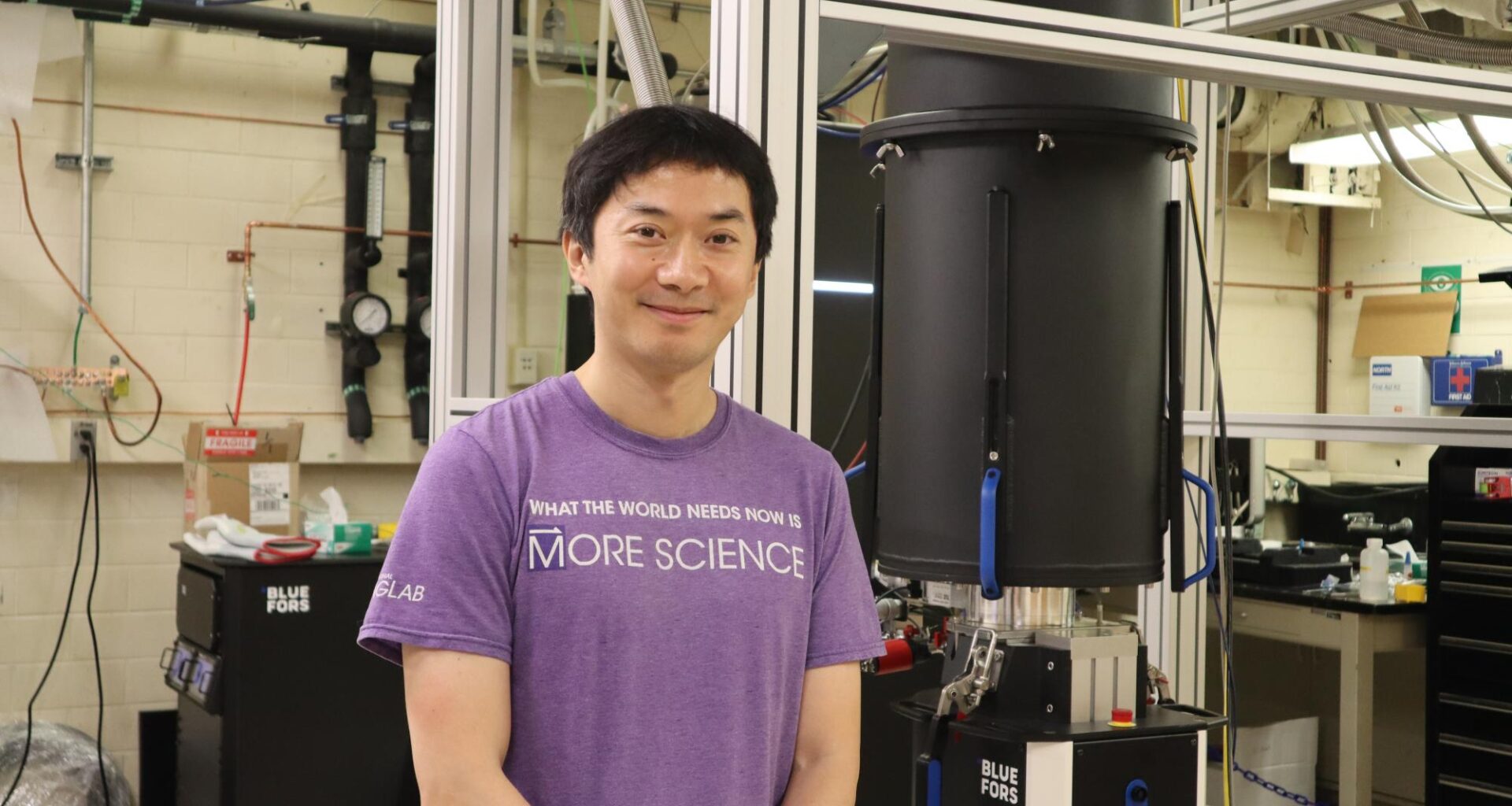
An associate professor of physics, was one of 21 scientists nationwide to receive $1.35 million over five years from the Gordon and Betty Moore Foundation to pursue high-risk physics experiments, according to an Oct. 1 news release.
The professor, Jia Li, will study a system that pairs free electrons floating on the surface of liquid helium with one-atom thick two-dimensional materials. A spokesperson from the College of Natural Sciences wrote in a statement that Li’s research could impact future technologies.
“This research has the power to shape everything from advances in our technologies to how much energy our devices consume,” the spokesperson wrote.
Li said this new hybrid system will improve quantum research, or research into the smallest possible units of matter.
“(The new system) is something that nobody has ever tried before,” Li said.
His work focuses on quantum mechanics, an essential foundation to quantum computation, which could help build faster, more capable computers in the future. The system is effective, Li said, because electrons on liquid helium can hold information for a long time.
“We’re close to knocking on the door of the next generation of computation,” Li said.
Pablo Laguna, chair of the physics department, wrote in a statement the award reflects the growing strength of quantum physics research at UT.
“This is a tremendous achievement for Leo and a moment of celebration for our entire department,” Laguna wrote.
Li said this was his third attempt at the award. The idea he submitted that ultimately received an award was one that he had always considered too risky.
Theodore Hodapp, program director for the foundation’s Experimental Physics Investigators Initiative, said in the news release that the program gives scientists more flexible support than federal grants usually can.
“That freedom lets them take on risky, high-reward experiments and follow ideas when research results lead them down new pathways,” Hodapp said in the news release.
Li said he hopes to see undergraduate students join the project.
“I fully anticipate that at some point an undergrad student will approach me and say, ‘Let’s try to do this together,’” Li said. “I’m waiting for that moment.”