
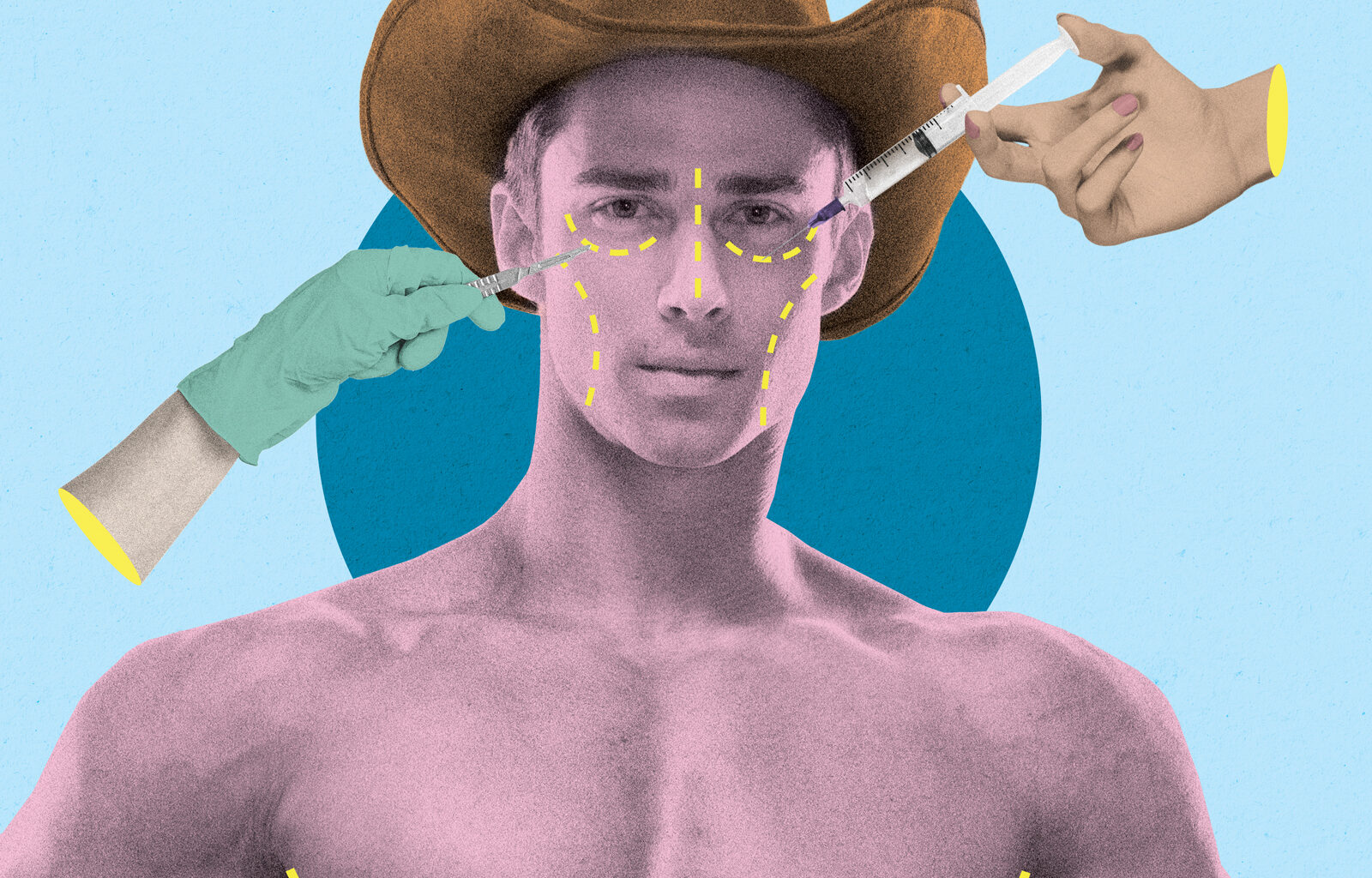
A Dallas man sits in the waiting room of a doctor’s appointment. He’s anxious, likely, but not because he’s worried about getting bad news. In fact, he’s there for an upgrade of sorts. Guitars and football jerseys hang on the walls, a mini-bar is adorned with phallic barware, and if he wants to take the edge off before taking his pants off, a small, indoor putting green rests at the center of the doctor’s office. He’s one of countless men seeking growth opportunities at Dallas Men’s Health.
For better or worse, the concept of “looksmaxxing” has permeated the many arms of culture this year. The term, popularized largely by Gen Z men, essentially gives name to the desire to reach prime physical attractiveness, whatever that might look like to anyone on its arguably destination-less quest.
At its most simplified, it usually comprises a holy trinity of a lean body, a full head of hair and chiseled, symmetrical facial features. Despite its now-gender-neutral reach, certain controversial figures adjacent to the movement might even declare things like being an “alpha male” necessary, too. We’re all waiting on the edge of our bench press seats for the scientific backing on that aspect of it.
More recently, it has launched firmly into the lexicon, getting meme’d across the internet in the process. Are you a regular on the Katy Trail? Now you’re a cardio-maxxer. Does the Las Palmas staff hate seeing you roll in for happy hour? Margarita-maxxing sounds sexier than “drunk on a Tuesday while the sun is still out.”
Sign up for the Arts & Culture newsletter to get the latest stories delivered to your inbox
THANK YOU!
You’re all set.
CLOSE
“Looksmaxxing” is hardly a novel concept on the surface — fitness, fashion, and maintaining hair that will get you closer to God are as ingrained in Texas culture as football, BBQ and air-conditioning. Somewhere along the way, though, podcasters, influencers and perhaps even keyboard-armored incels have started signaling permission for men to go beyond relying on weightlifting and a thick mustache.
Dallas, meanwhile, has long maintained a reputation as a mecca for the image obsessed. Men’s Health Magazine once named it the nation’s fifth most vain city because of the region’s unyielding appetite for cosmetic treatments and procedures. Plano bested Big D in the No. 2 spot on the same list. According to an Axios data analysis, Botox use rose across Texas last year.
“Everybody wants to look and feel their best at every stage of life, and I think that’s key in all of this,” says Sarah Hayes, co-founder of Bespoke Health and Beauty, an upscale medspa in Rockwall. “We now live in a time where we’re able to do those things for people — women and men.”
Our ladies who lunch make sure the toasted baguette on the table matches a Fendi Baguette purse. Our megachurches need to be blessed with the latest state-of-the-art production gear to ensure virality. And our aesthetic medicine professionals stay booked, keeping everyone right and tight along the way.
Big interest in Big D
“I think it’s part of Dallas culture — people in Dallas like to look pretty. They like to have nice things. They like to eat nice food and go nice places,” says Megan McKinney, a Dallas-based mental health counselor and founder of Pillow Talk Sex Therapy.
Guys of all backgrounds are quietly becoming more comfortable indulging in Dallas culture’s focus on looking nice, according to Dr. Michael Wierschem.
He offers a long list of aesthetic treatments at Dallas Men’s Health. Wierschem is a board-certified urologist with a doctor of medicine from UT Southwestern whose patients include divorced Highland Park dads, porn stars and even a fair share of women looking for things like laser hair removal. His office, tucked into Turtle Creek, has manifested like a man cave that made a wish to become a doctor’s office. Your bachelor uncle would feel right at home, and that’s the underlined point of what Wierschem does.
He did have to Google “looksmaxxing” when asked about it, but he immediately affirmed that versions of it have echoed in his exam rooms.
 From D-FW to Dubai: A map in the lobby of Dallas Men’s Health marks where patients visit from.
Alec Spicer for Dallas Observer
Wierschem says men not only in Dallas but across the world (a map filled with pushpins marking where his patients visit from hangs in the waiting room) seem more interested in cosmetic treatments lately, even if they aren’t forthright about it.
“Guys just don’t like talking about this stuff [openly], to be honest with you,” he says.
The doctor says that hesitance hasn’t subsided much, even 30 years into his career, and even as his lobby map fills faster than ever. The hushed tones still linger when his patients broach the subject of any kind of enhancement, but especially with anything south of the waistline.
“I’ve done all kinds of things, and guys just aren’t comfortable with any of it,” he says. “They just don’t like their junk being messed with. So I just try to make them comfortable, and usually after about five or 10 minutes, they’re pretty comfortable, because it’s an uncomfortable thing to talk about, whether it’s erectile dysfunction or enhancement.”
On the facial injectables end, Hayes, who is a registered nurse and certified aesthetic injector, has also seen a steady incline in patients over the last five years. She attributes the booming demand from men, in particular, to social media’s ability to meet curious scrollers where they are and on their own terms.
“It used to be unheard of to see a man in a before-and-after,” she says. “So I think the fact that we’re able to showcase that now, other men are able to see, ‘oh, he’s doing injections and he looks good. I’m going to go do injections.’”
Her male patients, which she excitedly says span “from rodeo cowboys to CEOs,” gravitate toward under-eye treatments and injectable jawline contouring the most. She adds that many of them are sent to Bespoke by their wives.
“I think a lot of people think only women and gay men get injections, and I will tell you, I have more straight men [patients] than I do gay men,” Hayes says. “Everybody is learning more. I think the injectable industry is starting to produce more normal looking people as opposed to the overdone look that was rampant when injectables really hit the market.”
More than face value
Aesthetic satisfaction isn’t limited to the face for the men of today.
Luke Garry is a 21-year-old Gen Z man living in Keller. He’s got a gynecomastia procedure on the horizon this month, something he first started looking into a couple of years ago. “Man boobs,” as they are often ridiculed, are largely non-threatening to physical health, but they’re dysmorphic, formidable foes in the mirror. For Garry, they’ve haunted him for nearly five years.
“It’s something that has just always been in the back of my mind since I was about 16,” he says.
Garry was prescribed SSRI medications around the age of eight, and he says doctors told him he developed enlarged breasts as a side effect, but because it’s a specific type of tissue that sits underneath the nipple, simply working out can’t offer any improvement. For him, going under the knife for a procedure that takes the same amount of time as an episode of “Love Island” is an easy trade if it means going to the beach won’t come with a wave of anxiety anymore.
“If I gained 400 pounds, that would be something I could change,” Garry says. “But this is not something I can deal with on my own.”
He’s also comforted by his surgeon’s — Dr. David Azouz in North Dallas — assurance that gynecomastia procedures are quite common, often reaching seven to eight in a single day at Azouz’s office. According to a study from the National Institutes of Health, nearly half of all adolescent men form some type of gynecomastia, while about 65% of men between the ages of 27 and 92 experience it.
As for Garry, although he is familiar with “looksmaxxing,” he doesn’t subscribe to it. He says his decision is ultimately inspired by the invitations he has declined from friends going to the beach, and by dreading those anxious nerves of changing at the gym.
“It just doesn’t look masculine to me,” he says. “It makes me feel just… uncomfortable.”
Down to girth
Wierschem does notice cultural trends among certain treatments. Gay patients make up the vast majority of his scrotum botox (yes, that’s a thing) appointments. Erectile dysfunction and hair-loss prevention seem to be the greatest equalizers. Meanwhile, younger guys — he will only see patients 21 and up — who are early in their sexual exploration wind up in his office after facing a near-universal panic that they’re a little light in the briefs. Wierschem quells some of their fears with honest analysis. Some of the guys who come see him don’t actually know what “average” looks like, and if he thinks they should be satisfied with what they’ve already got, he tells them.
“I’ve seen more penises than all of the prostitutes in Dallas combined, so I can tell you what’s normal,” he says.
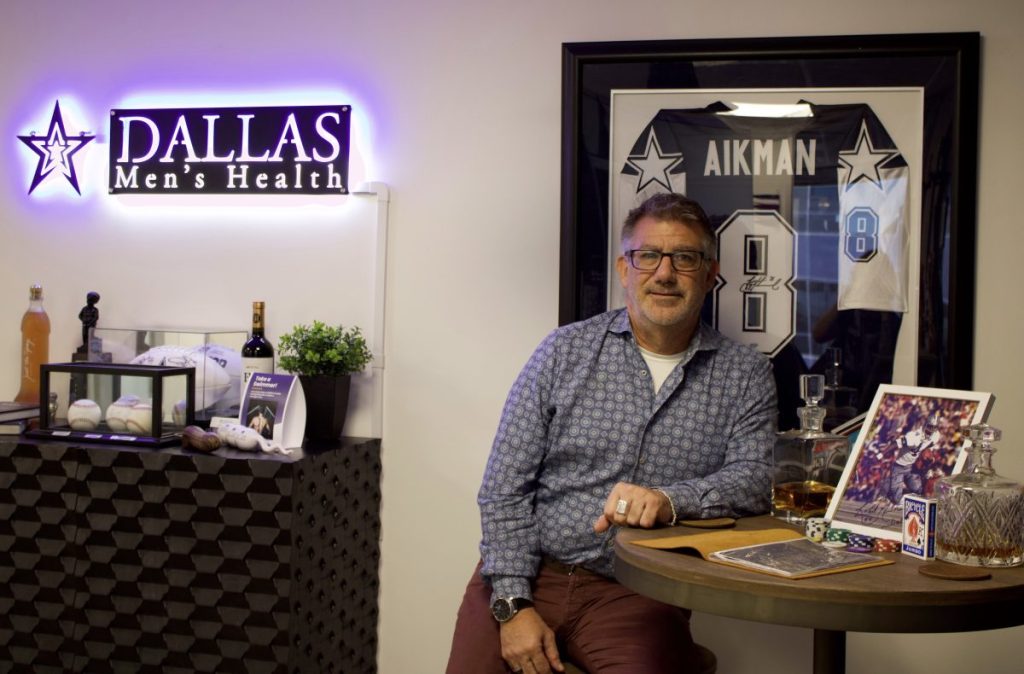 Dr. Michael Wierschem runs Dallas Men’s Health in Turtle Creek.
Alec Spicer for Dallas Observer
Still, his younger patients usually come for penile lengthening and girth enhancement. He says the former typically takes between three to six months to see noticeable results, while he says the latter can be felt by the time you leave the office, making it one of the most popular items on his menu.
“I’ve definitely seen a huge increase over the past 10 years,” he says. “I’m seeing a lot of young guys come in in their 20s, which always surprises me a little bit.”
For the girth treatment — which the doctor says can last between 2 and 5 years and will start your bill at $7,000 and up — Wierschem performs a minimally invasive, non-surgical procedure where he injects the penis with a hyaluronic acid filler to create volume.
“I just saw a guy last month, and I did [his treatment] five years ago, and he [still] looks like I just did it,” Wierschem says.
Older men are quietly investing in their physical appearance, too. Wierschem says some of his patients will realize that after a divorce or three, things start to look and feel different since the last time they were date-maxxing.
And though penis enhancement has become quite popular for men — and particularly young men — at Wierschem’s practice, he maintains it’s important to gauge a patient’s goals first.
“I don’t do anything on my patients that I wouldn’t have done myself. So, that’s the bottom line there,” Wierschem says.
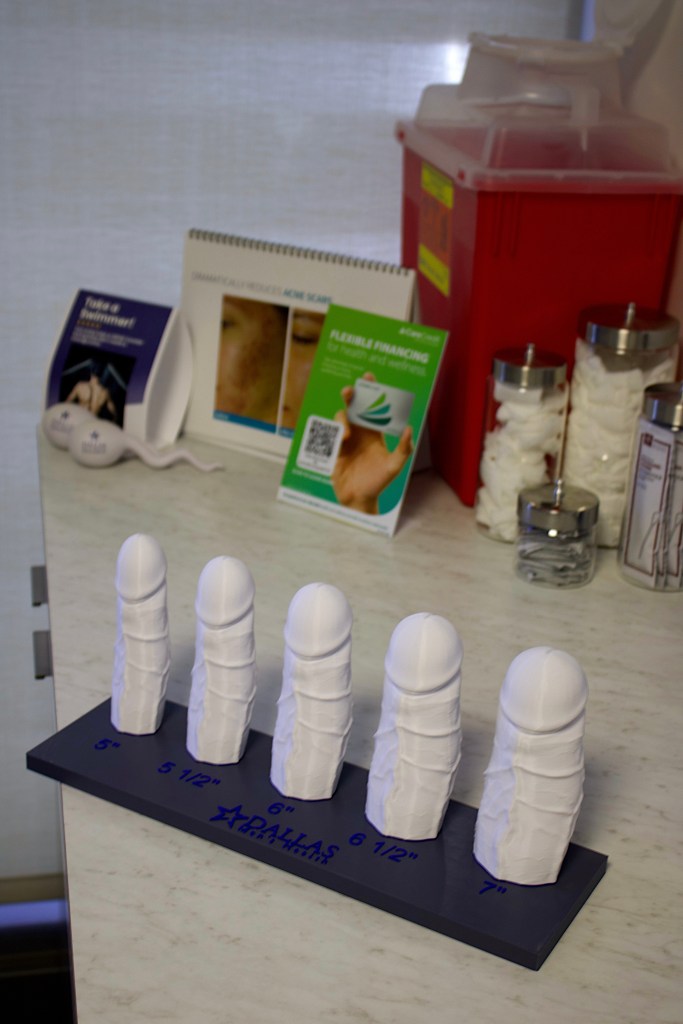 A lot of guys don’t know what “average” actually looks like. Various-sized anatomical models of penises often come in handy at Dallas Men’s Health.
Alec Spicer for Dallas Observer
Overweight men are often unknowingly burying an inch or two of their dicks in fatty tissue that can build near the crotch – he recommends a lifestyle change to them first, but if they’re insistent on modern medicine, he offers GLP-1 injections. Men on medication for attention deficit disorder are more likely to experience a loss in libido. Mental health struggles with stress and anxiety can affect the ability to keep it at full mast for more than five minutes. Or get it up at all.
“I look at their medications, I see what their social situation is, if they vape, how much stress they have,” Wierschem says.
Putting the men in mental health
As looksmaxxing flexes its oiled-up muscle as a cultural phenomenon, some experts are concerned about the potential mental effect it can have on young men’s body image issues and self-esteem.
Mental health professionals have expressed worries that, much like the litany of self-image issues women have been plagued by (and with far less medical research than men’s healthcare) since, well, the beginning of time, men will also see increased struggles with psychological well-being.
More extreme versions of looksmaxxing have been promoted by highly controversial internet personalities like Clavicular. Some men have gone so far as to use hammers on their faces, assuming it will give them a more chiseled bone structure. Obviously, experts and medical professionals strongly advise against harmful behaviors like that.
McKinney says nearly all of the men she counsels struggle with body image issues and self-esteem, which can often be tied to sexual setbacks.
“A lot of it is just psychoeducation,” McKinney says. “I get a lot of men coming in that think that they should just be ready to perform at the drop of a hat, or that men are just supposed to want sex all the time. That is not true.”
Much like Wierschem, McKinney has noticed more and more men in their 50s and 60s are seeking sexual-focused treatment after late-life changes like divorce and empty nesting. She has also observed parallels to Wierschem’s patients: younger men fixate on size, while older men prioritize endurance.
“We still have to make sure that you feel confident without [physical treatments], and that we’re still working on the inner stuff and the beliefs around that, because that’s the root of all of it,” McKinney says. “It kind of becomes a self-fulfilling prophecy — if you have anxiety about getting an erection and maintaining an erection, you’re not going to get an erection.”
Safety-maxxing
Like most aesthetic trends in healthcare, men’s treatments haven’t been without physical safety concerns.
A North Dallas wellness center called AdvancedYOU is currently facing a lawsuit for the death of a 36-year-old man from Round Rock. According to The Dallas Morning News, the man’s family says he suffered a pulmonary embolism shortly after a fourth round of “PhalloFILL” penis filler reportedly administered by the wellness center’s founder, William Moore, who is not licensed to practice medicine in Texas.
Wierschem warns that going to someone without proper and necessary medical experience is dangerous, and that he sees many patients who come to him to “get fixed” after previous experiences at other clinics.
“I’ve seen a lot of guys around here, who go to [places where] they don’t know what they’re doing… or using who knows what kind of product,” he says. “I’d be really careful with who you go to… there’s a lot of creepy people out there doing this stuff using crappy products.”
A spokesperson for the Texas Medical Board told the DMN it has received “a few complaints about this topic, but the number remains low.”
Additionally, the rise of interest in peptides, like all-protein-everything before it, has taken over the men’s wellness conversation lately. Influencers promote them on TikTok, wellness gurus swear they’re modern magic and aspiring maxxers are getting their hands on unregulated products.
“What happens with most of these peptides is that, because most of them are not FDA-approved, you have to get them through compounding pharmacies,” Wierschem says. “You really don’t know what you’re getting.”
Wierschem adds that he avoids peptides altogether unless they’re FDA approved, favoring treatments like stem cell therapies instead.
“You don’t know how sterile they are, right? You don’t know if you’re really getting what they say they’re giving you, and they’re not cheap,” he says. “And so what happens is the pharmacy sells it to the physician, and they sell it to you for experimental use only. So then you give it to the patient, and if the patient has some kind of a side effect, then it falls on the doctor, right? So we really shouldn’t be giving out peptides if they’re not FDA approved.”
Hayes agrees that the influx of interest in peptides so far outweighs access to safe, approved treatments.
“Peptides are definitely running rampant on the market,” she says. “But you have to be careful where they’re sourced from. You know, [people] can get them anywhere online now, like the ‘gray market.’”
McKinney, Wierschem, and Hayes all offer the same advice for anyone interested in these treatments: research and medical professional guidance are paramount.
Wierschem says that for men, the ultimate goal should always be healthier living, even if that means getting help, be it through mental or physical wellness.
“We get in our 50s and 60s, and I don’t know that [men] necessarily care about how long we live,” he says. “I always joke that if I live to be 75, great. But as long as I’m not wearing diapers, I can make love to my wife and I can remember my kids’ names — those things [matter], right? And so that’s what it’s about to me. It’s not just about living longer. It’s about living healthier.”