
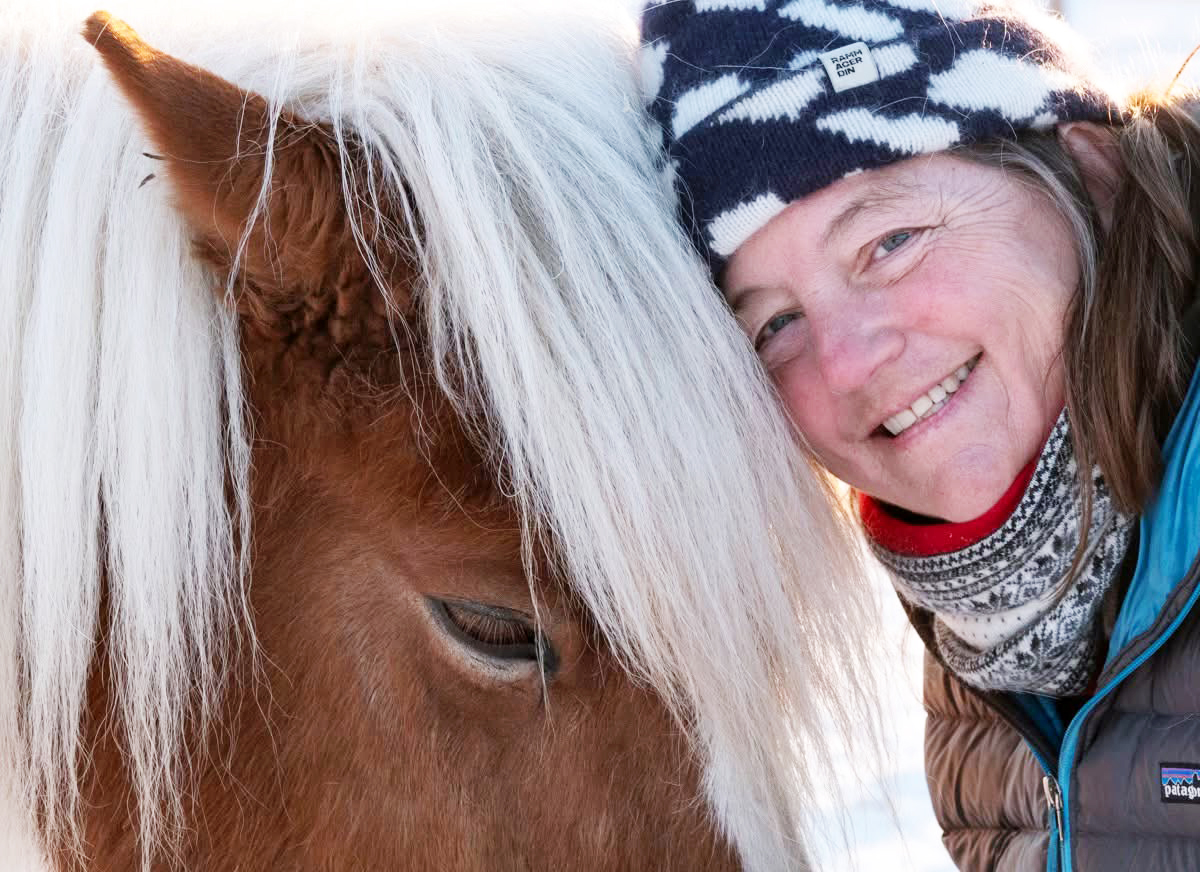
In many ways, writer Pam Houston’s latest book feels like a love letter.
A love letter to her husband, Mike Blakeman. To her guides on trips to Iceland and sub-Saharan Africa, whose expertise awes and inspires. To Iceland itself, for that matter.
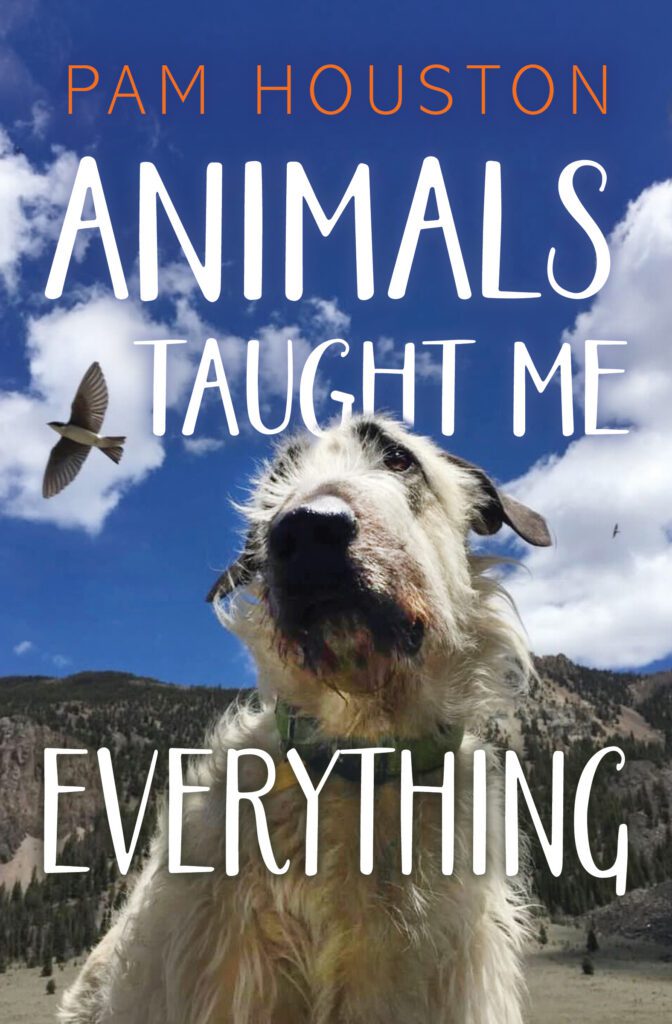 “Animals Taught Me Everything” by Pam Houston was released Tuesday, Oct. 13. Bellingham author Becky Mandelbaum took the photo for the cover. (Photo courtesy of Torrey House Press)
But, mostly, to her animals. In “Animals Taught Me Everything,” Houston remembers Henry, her late wolfhound who “always delighted in making his people laugh.” She describes saving Tank, a ram born prematurely on her ranch in Colorado, whom she bottle-fed and stayed up nights to keep warm. Salka, an Icelandic mare, appears loyal and strong even after an incident where Houston was thrown from her back.
These are just some of the many companions of other species depicted in Houston’s collection of essays, “Animals,” which was released Tuesday. Houston will discuss the book with Bellingham author Becky Mandelbaum at a KMRE (88.3 FM) “Chuckanut Radio Hour” event Oct. 22. In advance, Houston spoke with Cascadia Daily News in a phone interview about the themes in her recent work. Responses have been lightly edited for length and clarity.
What are the qualities that you think make relationships with other species so profound, and how do you compare them to relationships with other humans?
I think, because I don’t share a verbal language with animals, I have to be much more present to them with all of my senses. I have to be watching, I have to be feeling, I have to be listening to really be in communion or communication with an animal. I’m currently training a young horse, and so everything is information — every twitch of the ear, every turn of the head, every step away from my leg.
I write about this in the book. Let’s say I’m doing a travel story and they send me to Laos, say. I do not speak Laotian, not even vaguely, and the communication with the people I meet in Laos has to be boiled down to the simplest, most honest and direct communication. ‘Can you help me?’ ‘I like you.’ ‘This is great.’ ‘That hurts.’ We can’t protect ourselves the way we do when we know the subtleties and the nuances [of a shared language]. And I think it forces a level of honesty.
Speaking of language barriers, you travel a lot throughout the book. It struck me that I might struggle with that kind of lifestyle of moving around so much. Do you struggle with that? What does home mean to you, and is it important to you?
I don’t struggle with travel. I struggle with staying put.
But I wrote a book called ‘Deep Creek’ about my home here in Colorado. I’ve been here for 34 years now and it is home. I’m sitting in it right now, but it’s the first time I’ve been here in months, literally.
As soon as I got that book in the world, where I was really committed to how wise I was now that I’m older and how much I value home and all that, I just had a feeling … I was going to be launched. And then COVID happened, and [Donald] Trump got elected, and this place that has always felt very safe to me — it started to feel a little different.
Now that I’ve written this book, which is so heavily Iceland, I just got this little inkling of a feeling: ‘OK, what’s the next [place]?’
I do get homesick for sure, and I long for home, and I’m always happy to come home, but my natural mode is one airplane ticket in my hand and another one in my pocket.
Can you reflect on how you think about danger and safety with animals versus humans?
I obviously have a complicated relationship with physical risk. I grew up in a very violent household, and I have sought out physical challenges all my life. And [I] have managed that in therapy, and tried to really think about, ‘Am I doing this as some weird throwback to childhood?’
I’m 64 years old. I don’t think you get well and then you stop all your patterns. I still feel more exhilarated, more alive, happier — like really ecstatic — when I have faced a physical challenge.
But the difference in safety that I feel with animals compared to humans is really profound. It is very easy for me, as you read, to get in a place [of trust] with a horse. I’m so much more willing to do that with an animal than I am honestly with any human.
In the book, some of the lessons you talk about learning from your animals involve being softer: loving, playing, resting, trusting. And then some of them involve being tougher, like getting back on the horse when you’re quite injured. How do you square those two things?
The largest part of what I’m trying to learn from animals is to be softer with myself, is to rest. I mean, if there’s one lesson I just can’t fricking learn, it’s how to rest. And animals are so good at resting.
[As far as getting back on the horse], I don’t think that’s what the animals have taught me, I think that’s all me. And honestly, the day that I got back on Salka — to be fair, I didn’t really know I was injured until I started to unwrap all my buffs and whatnot — but in that particular moment, I fell so hard. I was just happy to be alive, and I was like, ‘Oh look, look, I’m alive! Look, I can still ride!’
I think I have empathy for a lot of beings, human and non-human, because I had a lot of suffering early and I like the way I crawled out of that and made a life.
And I turned to animals. Like, I said, ‘Oh look, over here! Here are these beings that it’s so much fun to be with, because the humans are not so great right now.’ From the time I was tiny, I was all about animals. So those are some of the gifts that [childhood] dysfunction gave me, and I feel pretty happy about that.
Pam Houston will talk about her new book with Becky Mandelbaum at 7 p.m. Oct. 22 at the Hotel Leo Crystal Ballroom, 1224 Cornwall Ave, Bellingham.
Sophia Gates is CDN’s lifestyle editor; reach her at sophiagates@cascadiadaily.com; 360-922-3090 ext. 131.