
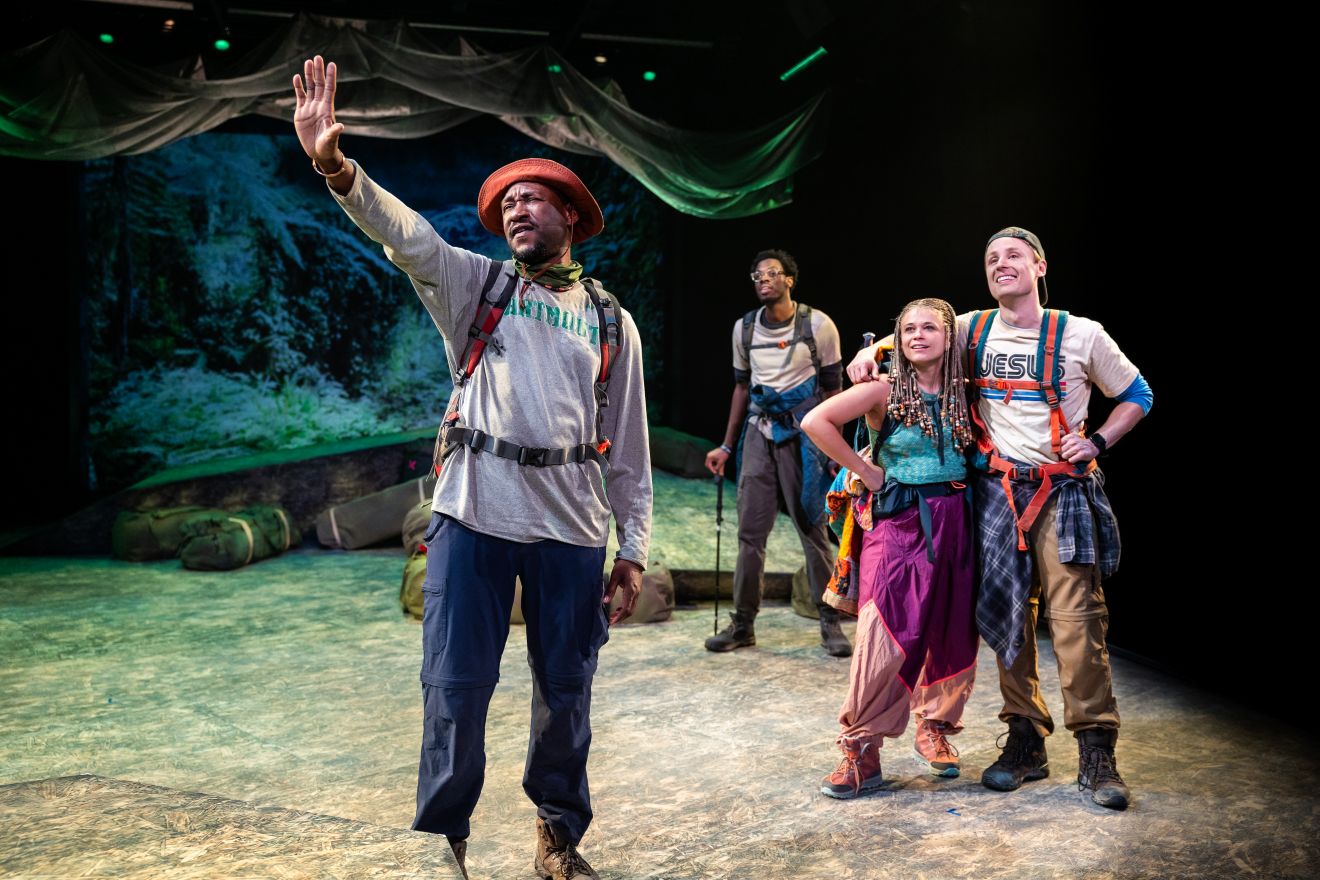
Uhuru was the play Gloria Majule was never going to write. As part of a class assignment during her graduate studies at Yale, she was asked to name a play she would never do and her response was that she would never write a play that didn’t center on black women.
Her professor’s assignment: go home and write the first scene of the play. “I racked my brain and the first thing that came to me was a guide leading two tourists up a mountain.” She took the scene back to class and her professor encouraged her to expand it to an entire play.
She decided to go home to Tanzania and climb its famous peak Mt. Kilimanjaro (after six months of strenuous physical preparation.) It was while she was on that climb, talking with porters and guides along the way, that she worked out the rest of the play about two missionaries hiking Mt. Kilimanjaro, accompanied by a Tanzanian guide. She added a fourth character, that of an American returning to Tanzania to try to capture his roots by climbing the world-famous summit.
Uhuru (the Swahili word for freedom) is a darkly comic, satirical take on the relationships among people and their built-in biases and perspectives due to history and culture. It is making its world premiere this week at Alley Theatre.
“We see the lead guide, his mindset is very still rooted in colonial times even though we’re in modern times. It satirizes this idea of aspiring to whiteness. Those eat-pray-love journeys of people going to Africa to find themselves,” says Majule. “It satirizes religious hypocrisy and the ways that people use religion to justify heinous acts even in modern times.”
Cast members include Oghenero Gbaje as Sprite, David Gow as Henry, Michael Oloyede (Broadway’s Jaja’s African Hair Braiding) as Mshale and Skyler Sinclair (Lend Me a Soprano, Agatha Christie’s The Murder of Roger Ackroyd). Shariffa Ali is directing.
Majule says she was born and raised in Tanzania and always fascinated by Kilimanjaro. “I went to missionary school and I went to international school and because of that I was exposed to a lot of teachers and people who had come to Tanzania from outside. A lot of them would want to climb Kilimanjaro and it was such a different significance for people who were outside Tanzania. Kilimanjaro is a symbol of our independence and our freedom.
“But it’s also this really big tourist attraction because it’s one of the seven summits. I was really fascinated by the dramatic tension that can exist with that difference in viewing of this mountain.”
She took that experience and the knowledge that the tourists who come to Tanzania (which did not receive its independence until 1961) have a different perspective on the mountain than its country’s residents and made it central to the play she was writing.
“We got independence in 1961. This play is set in present time. The tension that exists [is] how the ghost of colonization still manifests in the tourism industry. We talk about how white supremacy exists even in countries that are not predominantly white and Tanzania is one of them.” After the colonial period, Majule says her country was affected by visitors from America and China.
“I was really fascinated how tourists, predominately white tourists, are revered or are treated as royalty in some ways. So that tension exists when you have this Tanzanian-American coming home to his country that he believes is his country and he’s trying to reclaim this mountain. But this mountain is predominately dominated by tourists.
She was involved in theater in some sense from an early age. Her mother, who speaks five tribal languages, worked as a translator for missionaries. “They were doing a lot of work raising HIV/AIDS awareness and due to the illiteracy rates at the villages at the time, they would use theater as a way to educate a community. So I saw theater being used as a tool for education and social change. I acted in some of those plays.”
That acting experience included Christmas pageants and Easter productions, she says. “I didn’t study Shakespeare till I was in high school. I got into Cornell [University] for economics. I never took an economics class but I found myself in an acting class.” What she didn’t find were any roles written for Black African women. “I had a professor who encouraged me to write those roles. I wrote my first full length plays while I was in college and I’ve been writing plays ever since.”
Majule graduated summa cum laude from Cornell with a BA in Performing & Media Arts and Spanish. According to her website, she was the first African woman to receive an MFA in Playwriting from Yale School of Drama.
That “only” status extended even to her trek up the mountain, she says. “When I climbed Kilimanjaro, in my seven-day route, I was the only Tanzanian hiker on that trip. Everyone else was a foreigner.”
“Most Tanzanians who climb Kilimanjaro today do it for their jobs.”
Asked who her play would appeal to, Majule says: “If you’re the kind of person who loves to laugh but also loves to think, this is your play.”
Performances are scheduled for October 16 through November 8 at 7:30 p.m. Tuesdays through Thursdays, 8 p.m. Fridays and Saturdays, 7 p.m. Sundays and 2 p.m. Saturdays and Sundays at Alley Theatre, 615 Texas. For more information, call 713-220-5700 or visit alleytheatre.org. $40-$85.
Related