
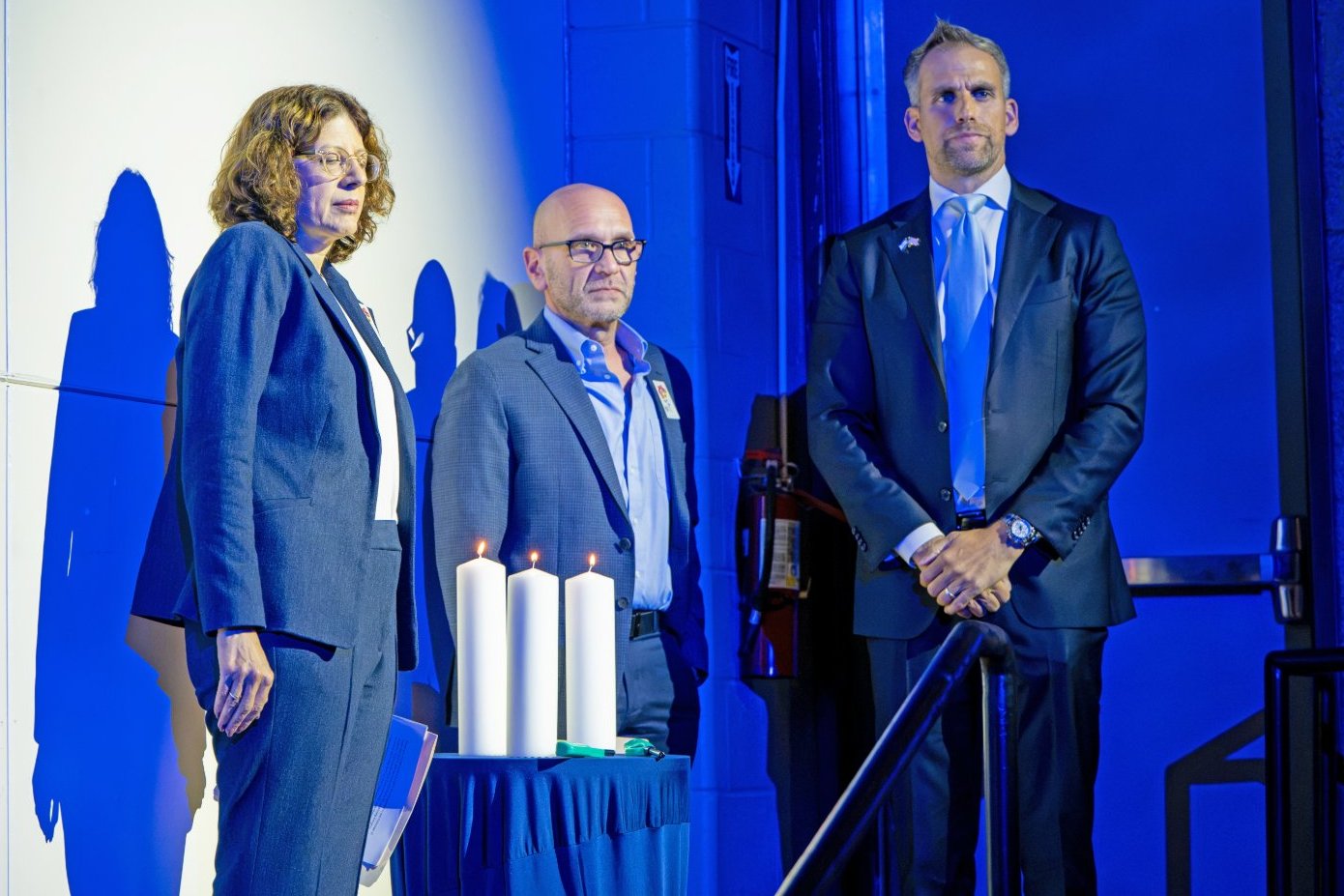
Three years after Oct. 7, 2023, the date still carries a weight that is difficult to put into words. For Houston’s Jewish community, it remains a marker of grief, solidarity and unresolved loss.
On Wednesday, Oct. 7, nearly 450 members of Houston’s Jewish community gathered in the Becker Theater at The Emery/Weiner School to remember the lives lost in the brutal Hamas attack, stand with Israel and hear the story of one young woman whose world – and whose family’s world – was forever changed.
The program, “October 7 – Marking Three Years,” was organized by the Jewish Federation of Greater Houston, the Evelyn Rubenstein Jewish Community Center and the Consulate General of Israel to the Southwest, with Emery/Weiner serving as host. EWS Rabbi Laura Sheinkopf, director of Jewish Life and Community Outreach, emceed the event, and Stuart Dow, EWS head of school, moderated the evening’s discussion.
For Beth Yeshurun Rabbi Emeritus Steven Morgen, the gathering was not simply important to show our support to friends and relatives living in Israel, but to all Jews everywhere.
“Particularly when so many people are ignoring or erasing the brutality and inhumanity of what happened on Oct. 7, and focusing instead on the destruction in Gaza, it’s important for us to remind the world what happened and why Israel felt the need to respond the way they did,” Rabbi Morgen told the JHV.
The evening included musical performances by EWS students Ella Navon, Yali Kaplan, Ethan Stulberg, Julia Ziff and Haley Lane; “El Malei Rachamim” was sung by EWS Rabbi Ari Vernon. The program included remarks from Israeli and Houston Jewish community leaders; a candle-lighting ceremony; poetry readings; and a screening of “Find Me, Okay?” a documentary about Eden Yerushalmi, who was kidnapped from the Nova music festival on Oct. 7.
Remembering the people behind the numbers
The program featured the human stories behind the statistics.
Israeli Consul Elad Shoshan described Oct. 7 as a date that “forever changed Israel and Jewish communities around the world.”
He recalled the morning of Oct. 7, 2023, when sirens began sounding at 6:29 a.m. What initially seemed like another rocket attack soon became an unimaginable tragedy.
More than 1,200 people were murdered and 251 were taken hostage.
But, Shoshan said, numbers alone cannot convey the human cost.
“These numbers help us understand the scale of what happened. But they cannot tell us whose seat is empty at the dinner table or who still reaches to the phone to call someone who will never answer.”
He also spoke about the ordinary people who responded that day – parents, neighbors, off-duty soldiers, first-responders and strangers who drove toward the gunfire to help others.
“Ordinary people do extraordinary things.”
Renée Wizig-Barrios, president and CEO of the Jewish Federation of Greater Houston, spoke about the Houston community’s response to Oct. 7 and the Federation’s continuing support for Israel.
“Our role as the Federation is to bring our community together, stand side by side with Israel and make sure that there are meaningful opportunities for connection.”
Wizig-Barrios noted that the Houston Jewish community raised more than $20 million in the aftermath of Oct. 7. The Federation also continues to support Israel through its Annual Campaign, allocating more than $16 million this year in grants to nonprofits working in areas including agriculture, small-business recovery, soldier rehabilitation and mental health services.
“The Federation is committed to continuing to bring the community together to stand in solidarity, to provide financial support, to build understanding about the complex country we love,” she said.
She also spoke about the rise in antisemitism and the continuing threats facing Israel.
“Today and always, we are united as one Jewish people. Am Yisrael Chai.”
One woman, one family, one story
The emotional center of the evening was the screening of “Find Me, Okay?” which tells the story of Eden Yerushalmi and her family.
What began as a family’s desperate effort to bring Eden home became a journey through hope, uncertainty, advocacy and heartbreaking loss.
Before the film, Larry Skolnik, CEO of the J, joined Shoshan for a candle-lighting ceremony.
The film distilled the enormous tragedy of Oct. 7 to the story of one person, making the abstract heartbreak painfully personal.
Rabbi Morgen said that singularity was part of what made the film so powerful.
“If you tell [the story] as one person and then multiply it by 1,200, you have a better sense of the horror of what happened.”
Following the screening, Dow moderated a conversation with producer Jeff Hoffman, director Yula Gidron and Arbel Ashkenazy, a survivor of the Nova festival and one of Eden’s closest friends.
For Gidron, making the documentary was difficult from the beginning. Originally, she turned down the job. Entering the Yerushalmi family’s home with cameras while they were dealing with the uncertainty surrounding Eden’s condition was difficult, she said, but ultimately, she felt the story needed to be told.
“In the point of view of the family, it’s intimate and also respectful. I’m proud that they did this.”
Ashkenazy also initially resisted participating in making the film.
“I didn’t want to do this movie. Really,” she said. “I think it was very unreal to bring cameras in to film people in the difficult time in our life.”
But after coming to the United States, she said she understood why the film mattered.
“Now, I know that this movie is important because it’s not a movie. It’s part of our life – and it’s part of my healing journey ….”
For Hoffman, the filmmakers wanted to tell Eden’s story rather than try to tell the story of Oct. 7 through a collection of images and statistics.
“At the end of that day, we just knew that this was the story we wanted to tell – what we heard about Eden, that she was just such an amazing, loving, fun, happy person that everyone fell in love with, that we thought this would just be an incredible story of tragedy, hostage, survivor and a reunion.”
Hoffman said the filmmakers initially expected the story to end with Eden’s return.
Instead, Eden was one of six hostages executed by Hamas on Aug. 29, 2024. The story became one of tragedy and loss but also of family, friendship and resilience.
For the filmmakers, it comes down to making sure Eden’s story – and the stories of thousands of others – are not forgotten.
Hoffman put it simply:
“This is just one story, one person, one family and, like I said earlier, there were thousands of these stories, and they were all as tragic and heartbreaking as this one.”
He said the goal is for people to understand what those caught in the attack experienced.
“We want the world to understand what these kids went through; what all these Israelis and non-Israelis went through that day. People are forgetting it. They’re denying it. They’re focusing on everything that happened after. But this is the real truth, the real story.”
The Israeli consul offered the audience a way to carry that remembrance beyond the walls of the event.
“Three years later, we carry the memory of those murdered on Oct. 7 and those lost in the war that followed. …” said Shoshan. “When you get home, I ask you to take a few minutes to find a name, look for a face, a story … then share that story with somebody else. That is how we remember the people behind the numbers.”