
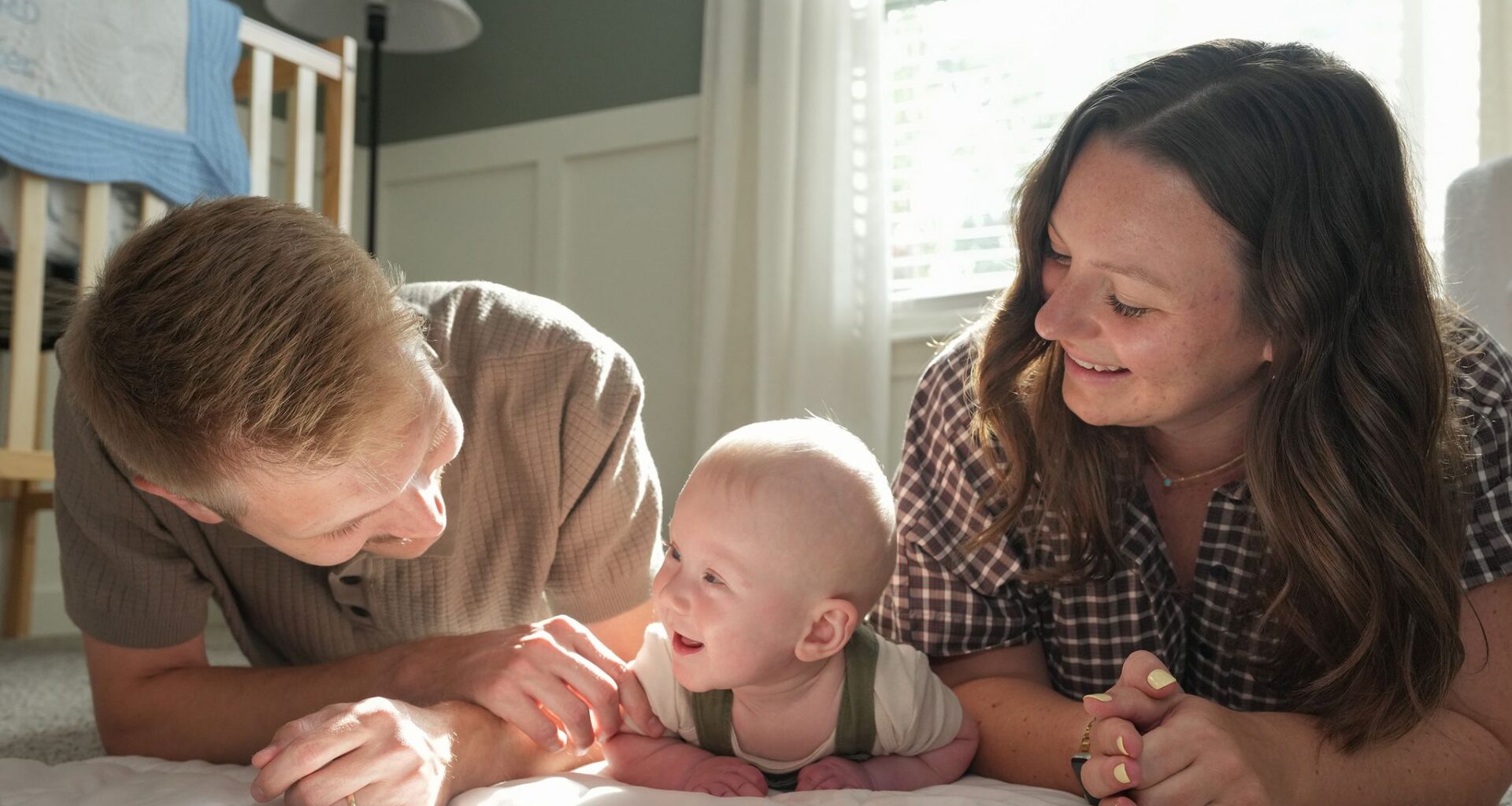
Jeff and Manda Barnhart play with their son, Koen, at their Cedar Park home. Koen, who was born in April, became the first baby to have spinal surgery in utero in Austin to repair a hole in his back caused by spina bifida.
Jay Janner/Austin American-Statesman
Five-month-old Koen Barnhart is enjoying tummy time on a blanket in his bedroom. He’s smiling and giggling and wiggling his legs.

Those leg movements are a triumph. Koen was diagnosed with a form of spina bifida, a hole in the back in which part of the spinal column is exposed. Koen had the most severe form, myeloschisis. Without any protective covering, the spinal cord is exposed to amniotic fluid, which can permanently damage the cord. These babies also risk nervous system damage from cerebral spinal fluid leakage.
Article continues below this ad
Manda Barnhart holds her son, Koen, at their Cedar Park home.
Jay Janner/Austin American-Statesman
Dr. Cara Buskmiller operates on Manda Barnhart to get access to Koen in utero to repair his spina bifida opening.
Provided by Texas Children’s Hospital
Texas Children’s Hospital surgeons work on Manda Barnhart and son Koen when he was 25 weeks gestation to repair the hole in his back that exposed his spinal cord.
Provided by Texas Children’s Hospital
Jeff and Manda Barnhart hold their son, Koen, at their Cedar Park home on Wednesday, Oct. 14, 2026. Koen, who was born in April, became the first baby to have spinal surgery in utero to repair a hole in his back caused by spina bifida.
Jay Janner/Austin American-Statesman
Jeff and Manda Barnhart hold their son, Koen, at their Cedar Park home on Wednesday, Oct. 14, 2026. Koen, who was born in April, became the first baby to have spinal surgery in utero to repair a hole in his back caused by spina bifida.
Jay Janner/Austin American-Statesman
Koen became the first baby to have surgery in Austin to close the hole before he was born. Doing so might have preserved the function in his legs, allowing him to walk. It also might have protected his brain from damage.
With Koen’s surgery in January, Texas Children’s Hospital became the first hospital in Austin to perform the surgery after 13 years of doing it in Houston. The Houston team has now done almost 300 of these surgeries and advanced this surgery from an open surgery to one that uses minimally invasive techniques to reduce the risk of the mother going into labor.
Two weeks ago Dell Children’s Medical Center announced did its first in utero spina bifida repair on a baby with myelomeningocele, a form of spina bifida in which the nerves and spinal cord are in a fluid-filled sac outside the back. The sac does provide the baby with some protection from damage by the amniotic fluid but still can limit a baby’s lower-body movement permanently if not addressed.
Article continues below this ad
“Mom is doing excellent. The baby is doing great.” said Dr. Alireza Shamshirsaz, the new director of Dell Children’s Medical Center’s Comprehensive Fetal Care Center and chief of fetal medicine and therapy at Dell Medical School.
Surgeries like this one are not a cure, Shamshirsaz said. The babies will need to be followed and have other interventions and even surgical revisions once born.
“We’re trying to decrease morbidities,” Shamshirsaz said.
Dell Children’s has some future surgical fetal interventions on the horizon, including repairing congenital diaphragmatic hernias to allow the lungs space to grow and reduce pulmonary hypertension in the newborns, and in utero cardiac surgeries in collaboration with Dr. Charles Fraser Jr. and the Texas Center for Pediatric and Congenital Heart Disease at Dell Children’s.
Article continues below this ad
Jeff Barnhart feeds his son Koen while Koen was in the NICU at Texas Children’s Hospital in Austin.
Provided by the Barnhart family
Saving babies from lifetime complications
Before Austin hospitals were doing these surgeries, parents would have to travel to and then stay near centers like Texas Children’s in Houston for months at a time for monitoring, surgery, the birth and then care of the baby in the neonatal intensive care unit. They would then return for follow-up care.
Before anyone was doing these surgeries during pregnancy, these babies would be born and then have a surgery to prevent further damage, but life-changing damage already had been done. By then, babies would have lost leg, bladder and bowel function, as well as needed shunts in their brain to empty excess fluid buildup. Neurological damage also is irreversible.
Article continues below this ad
“If it get hits by amniotic fluid, that’s a different story up to 39 weeks (at birth) than up to 26 weeks (with a surgery),” said Dr. Daxa Patel, a neurosurgeon at Texas Children’s in Austin.
In a myelomeningocele case, while the sac provides some protection from the amniotic fluid, the nerves and cord are at risk for infection and cerebral spinal fluid could also leak, though not as much.
Texas Children’s Hospital surgeons work on Manda Barnhart and son Koen when he was 25 weeks gestation to repair the hole in his back that exposed his spinal cord.
Provided by Texas Children’s Hospital
For Dr. Cara Buskmiller, the maternal fetal medicine doctor who cared for Koen at Texas Children’s, doing these surgeries in utero is often the difference between a child needing a wheelchair and a child walking. It also can mean a child with neurological damage and a child with minimal neurological delays.
Article continues below this ad
Every case of spina bifida is different, Buskmiller said. “We only offer the surgery in children who can get a benefit,” she said. That benefit can be seen in motor movement or brain development or both.
Cases similar to Koen’s suggest he will have double the chance of walking by age 2½ than if they waited to repair the hole until after he was born. If they had waited until he was born, the chance of Koen needing a shunt in his brain was 80% compared with 40% with an in utero surgery.
Discovering Koen
Manda and Jeff Barnhart were planning for a home birth with a midwife when at the 20-week fetal anatomy ultrasound, it seemed like the technician was being very diligent.
Article continues below this ad
They didn’t think anything about it. “This being my first baby, I had no idea how long it would take,” Manda Barnhart said.
The next day, the Barnharts got a call from the midwife that the baby had spina bifida and that they would not be able to have a home birth. They needed a specialist and were referred to Texas Children’s in North Austin, less than a 15-minute drive from their Cedar Park home.
Manda Barnhart immediately started searching the internet for “spina bifida,” which she had never heard of before.
“The first thing I saw was ‘paralyzed,'” she said. “I was freaking out.”
Article continues below this ad
The next week at Texas Children’s, they had another anatomy scan to confirm the diagnosis. They then met with the maternal fetal medicine team and later Buskmiller.
“There’s something about her,” Manda Barnhart said. “She really sets someone at ease and brings comfort.”
The Barnharts were given their options: Do the surgery if Manda and the baby qualified to spare some of the damage or wait until after the baby was born and not know how much damage there would be.
“My immediate thought was if I qualify for surgery, we’re doing surgery,” she said. “That was a better chance for him to have more opportunities down the line.”
Article continues below this ad
Manda Barnhart went through a series of tests: an amniocentesis to do genetic testing to make sure Koen didn’t have a trisomy mutation; an MRI to see if Koen had hip and leg movement; another ultrasound to confirm it was only one baby and to make sure her uterus was not in danger of going into labor any time soon; and a lot of blood work to make sure she was strong enough to go through the surgery.
“Things happened very quickly,” she said, though it was also the holidays, so she believed that was a good distraction.
Manda Barnhart holds her son Koen while he was in the neonatal intensive care unit at Texas Children’s Hospital in Austin. Koen was the first baby to have a spina bifida repair in utero in Austin.
Provided by the Barnhart family
A big surgery
The Barnharts could have opted to do their surgery in Houston rather than be the first one in Austin, but Manda Barnhart said she felt very comfortable with the team here.
Article continues below this ad
Counterparts from Houston also were in the operating room to assist if needed, which it was not. Buskmiller, along with Patel and pediatric surgeon Dr. Matias Bruzoni, had trained in Houston and run simulations in Austin before the Barnhart surgery.
“It didn’t feel like a first surgery,” Patel said.
“It was beautiful to see the fruit of all the simulations we’ve been doing for months,” Buskmiller said. “Everyone knew what instruments were coming next.”
They also had done other fetal surgical interventions together in Austin, including fetal transfusions, a bladder duct surgery and a surgery while a baby was born to remove a lung mass.
Article continues below this ad
“We want to continue to try to push things forward, and we want to be a center that tries new things,” Buskmiller said.
The team waits until the baby is 25 weeks of gestation because that is the ideal time to prevent the most severe damage from happening as well as have a baby that is very viable if the team had to do an emergency delivery or if the operation caused the mom to go into labor, which are risks. A younger fetus also would not have enough skin to repair the hole.
Manda Barnhart prepares for surgery on her son while he is still a fetus at Texas Children’s Hospital in Austin.
Provided by the Barnhart family
Manda Barnhart was given some anti-anxiety medication, an epidural for pain control and general anesthesia.
Article continues below this ad
The operating room is kept at a toasty 77 degrees to keep the fetus warm and prevent heart rate complications. Buskmiller then cuts a slit into the mother’s lower abdomen to partially expose the uterus, much like a C-section.
Using a laparoscopic camera and gripping tools, Buskmiller gives the fetus injections to reduce its movements, provide pain control and help maintain its heart rate. Many of the medications are what are given to babies in the NICU.
Then Bruzoni and Patel get to work placing the spinal cord and nerves into their proper place and then stitching up the hole. Koen’s hole was very large and needed three layers of repairs. The team also had to use a skin patch because of the size.
Once repaired, the team then refills the uterus with sterile IV fluid to make up for any amniotic fluid loss during the surgery. Buskmiller gently places the uterus back into the abdomen and sews up the mother.
Article continues below this ad
It can be a very painful recovery for the mother because she remains pregnant with a baby kicking and moving around where her scar is.
“It’s a lot to ask of the mom’s body,” Buskmiller said. By doing the surgery as minimally invasive as it can be, moms are able to have a vaginal birth and future vaginal births, Buskmiller said.
Manda Barnhart said even though she had good pain control, it definitely hurt when she moved. She stayed in the hospital for five days while they monitored her and the baby.
“They would put him on the monitor, and he would kick them or hit them. That was confirmation that he was OK,” Barnhart said.
Article continues below this ad
At first she had restrictions that she couldn’t walk more than 2,000 steps a day. After a month, she was able to move up to 4,000 steps a day.
“The biggest concern was for me to go into labor,” she said.
“I helped her follow the rules,” Jeff Barnhart said.
“He was very much like ‘No,'” she said.
Manda and Jeff Barnhart welcomed Koen to the world. His C-section after hours of labor without any progress was the second time he and his mom had been in an operating room together.
Provided by the Barnhart family
Koen Barnhart had a large bandage to cover the wound from his spina bifida surgery. He came home after two months of NICU care.
Provided by the Barnhart family
Life with Koen
At 38-weeks’ gestation, Koen came into the world on April 23. He stayed in the NICU for two months, mainly for monitoring and wound care. He had a small leak in the surgical site that needed to be repaired and he needed a skin graft from his right butt cheek to further help close up the hole in his back.
Article continues below this ad
He has not needed a shunt for his head, and Patel said this first year is critical to determine whether he will need a shunt at all.
They know he has movement all the way down to his ankle and believe he can also feel his feet.
They do use a catheter on him, but are able to go for longer periods of time between bladder-emptying sessions.
The Barnhart family leaves Texas Children’s Hospital in Austin surrounded by bubbles after successful in utero surgery for spina bifida and a successful birth.
Provided by Texas Children’s Hospital
A lot is not known yet until he will be able to tell them what he feels in his bladder or until he is developmentally ready for walking or potty training.
Article continues below this ad
Patel believes that if they had not done the surgery in utero, Koen would have had a brain shunt by now, and they would not be seeing movement in his ankles.
He is hitting all the normal baby milestones. The Barnharts have a friend who has a baby a month older. “When they are talking about their baby doing something, then Koen is doing it,” Manda Barnhart said.
Right now, she said, “he’s been doing this little giggle. It makes my day every single time.”
Article continues below this ad