
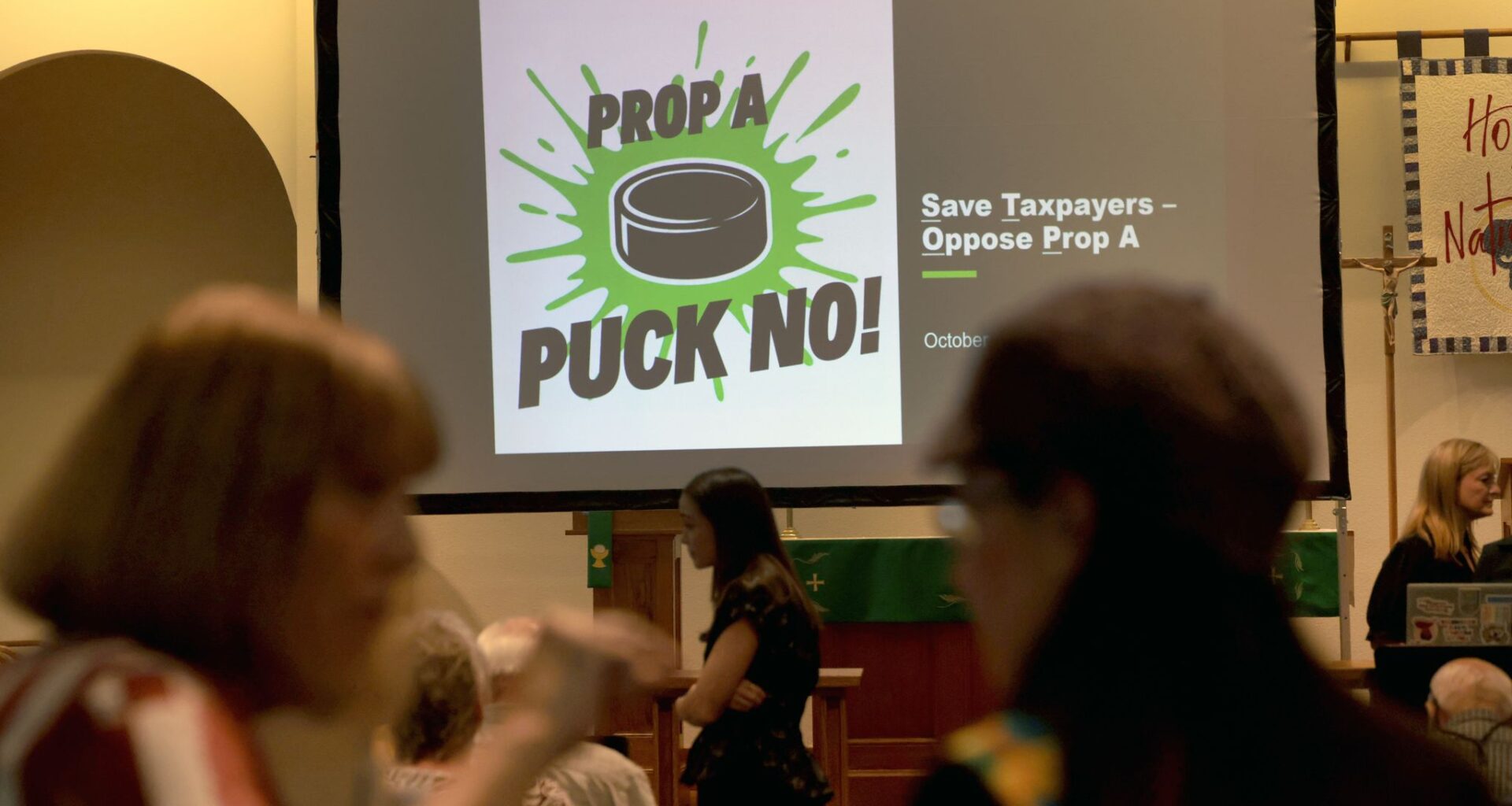
Event organizers converse before the start of a community event organized by the Stop the Stars political action committee in Plano on October 6, 2026.
Steve Hamm/The Dallas Morning News
PLANO — “The day an arena fits in a suburb area like Willow Bend is a day pigs fly,” Karen Dubrow said into a microphone, hiking up her pants to reveal sky-blue socks dotted with winged pigs.

In rows of a Plano church sanctuary one recent Tuesday night, dozens of residents gathered to hear Dubrow and other leaders of the Stop the Stars Arena committee make their case against Proposition A.
The local ballot measure asks voters to approve a menu of venue taxes to help fund a city-owned arena Plano plans to lease to the Dallas Stars for the next three decades when their lease in Dallas expires in 2031. The hockey team is preparing a move out of the American Airlines Center to the current site of The Shops at Willow Bend.
Article continues below this ad
As the start of early voting for the venue tax election approaches, some voters see more questions than answers.
“Self-funded sounds swell, and it sounds like a thrill. But the dome gets the gold and you get the bill,” Jody Venturoni recited to the church audience in a Dr. Seuss-style poem she authored.
Stop the Stars Arena organizer Karen Dubrow speaks to a crowd at an event hosted by the political action committee in Plano on October 6, 2026.
Steve Hamm/The Dallas Morning News
The proposed fees on tickets, parking, rental cars, hotel rooms and sports teams would help the city pay off $700 million in debt it committed to the arena, backed by a tax zone that collects new property tax revenue generated by development and invests it back into the area.
Plans include a surrounding mixed-use entertainment district with hotels, retail, restaurants and housing.
Article continues below this ad
Venturoni and other residents described the feared hidden costs of the project — strains on city infrastructure and services, maintenance costs and diverted tax revenue. Some questioned whether sports venues bring the economic boost they promise. Others are skeptical of how well the city will mitigate traffic and other disruptions.
The city, team and developers are still defining agreements, studying consequences and finalizing financing. And the community is still debating whether a major sports team and its arena fits in the suburb — even though the election asks for sources of funding, not approval of the arena itself.
Is Plano ready?
City leaders have sought to answer questions, publishing hundreds of responses online, and in some cases, defending the city’s investment.
Mayor John Muns has endorsed the proposition and said he approached a Stars-backed political action committee, Victory Green Plano, to support its campaign. The NHL franchise has contributed at least $200,000 to the PAC, according to its latest campaign finance report.
Article continues below this ad
“As partners to them in all this, we need to do our part and help get that election passed,” Stars CEO Brad Alberts said of the campaign.
Related: How Plano scored the Dallas Stars: The NDAs, $700 million and ‘wolf’ behind the deal
The Stop the Stars committee is taking on the Stars’ PAC, backed by a few dozen passionate and organized residents and more than $3,000 in campaign donations, according to a report filed earlier this month.
Muns said Plano is the only city in the state’s top 10 most populous without an arena or stadium for professional or college sports.
“We’re at 305,000 people,” he said. “Maybe we weren’t ready for this 20 years ago, but we are today.”
Article continues below this ad
A ‘waterfall’ funding plan
If Proposition A passes, Plano City Council will decide which of the five taxes to levy, and by how much.
Muns said his priorities are taxing parking, tickets and hotel rooms. One tax allows the city to collect up to $5,000 per game on each member of a major league team using the arena.
Alberts said “the intention is not to use” the tax on players. City Manager Mark Israelson said officials have yet to decide which of the five to levy.
A resident views a rendering during a community open house event regarding the proposed Dallas Stars arena project at The Shops at Willow Bend mall, on Wednesday, July 8, 2026 in Plano.
Shafkat Anowar/The Dallas Morning News
If the November ballot measure fails, Alberts said he is confident that the project will go forward. The tax zone, venue tax election and a project financing zone the city will pursue in the state Legislature are all efforts to pay off the $700 million in bond funding, and its unknown interest, faster.
Article continues below this ad
If projected revenues to help fund the project fall short, Israelson said, money will not come from the general fund to help cover the cost — some risk is held by the bondholders. The city “does not intend to be legally obligated to pay any shortfall for bond payments” according to a statement.
Deputy City Manager Doug McDonald said once the city pays off debt for the arena, or after 30 years, the taxes will go away.
Israleson said the city has taken a “fairly conservative approach to the projections” and hired “consultants checking our consultants” to ensure the investment is sound.
Dubrow doesn’t buy it.
“The city does not understand or know, but they want us to approve the unknown,” she said.
Article continues below this ad
‘More than hockey’
One of the most feared outcomes of the proposed arena is more traffic clogging the tollway and West Plano streets. City officials say the mall site is designed for easy access by car. Some residents worry its main access point is the already congested tollway.
Related: In Plano, competing campaigns over Dallas Stars arena taxes face off
An early traffic study is underway to identify where congestion may worsen. It accounts for the area’s growth and emergency vehicle access, officials said, and the city has had initial talks with Dallas Area Rapid Transit and the North Texas Tollway Authority on how to approach the project’s transportation needs.
Council members pushed for more at a presentation on the study earlier this month.
“When will the assumptions move toward more concrete answers?” Shun Thomas asked at the Oct. 12 meeting.
The number of seats, square footage, retail and restaurants, plans that will inform traffic and parking, are still undecided, Israelson said.
“We wish we were a little further along in some of those things, candidly,” Israelson said.
Related: Plano ISD to contribute up to $250 million to Dallas Stars arena funding
One unfinished agreement will define community benefits for Plano residents.
Plano’s school district, which is also contributing funds to the project, can use the arena for graduation ceremonies. McDonald said the city could negotiate use for concerts and performances.
“It’s more than hockey,” McDonald said.
‘Change Plano forever’
An hour before the puck drop, Alberts stood at the window of a boardroom tucked in the AAC, watching fans file in to watch his team face the Colorado Avalanche.
It’s his team, he said, paying for the police staff guiding traffic and securing the arena on the street below.
From left, Brad Alberts, Dallas Stars President and CEO, Bill Cawley, chairman and CEO of Cawley Partners, and Maher Maso, Principal at Ryan, LLC, and former Frisco mayor, during a talk in McKinney, Texas, Thursday, October 15, 2026.
Anja Schlein/The Dallas Morning News
“We’re going to run the arena,” he said of the Plano project.
Alberts said he hears “false narratives” that Plano’s election asks to raise property and sales taxes, and that the city will be on the hook for operating costs. Both are false, he said.
Day-to-day operations will fall to the team, and above the $700 million the city pays, the Stars will finance the rest of the estimated $1 billion arena.
Alberts chose the area north of Dallas for the new home ice to meet fans where they are as population growth skews north. The team’s CEO said the project will “change Collin County and change Plano forever,” but he does not believe it will “ruin suburban life.”
“Plano is still suburban,” Israelson said. “I don’t think anybody is talking about changing that.”
Early voting begins Oct. 19. Election Day is Nov. 3.
Sign up for our weekly Collin County newsletter here and email tips on all things Plano, McKinney and more to lilly.kersh@dallasnews.com.