
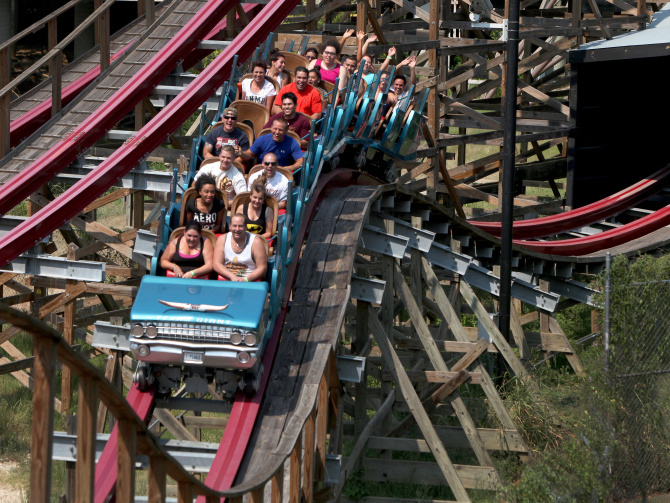
New Texas Giant opened April 22, 2011.
2013 File Photo/Staff
It was the stuff of nightmares.

On Monday afternoon, Hassan Jihad Ibn Kariem, a 42-year-old father, teacher and roller coaster enthusiast from Atlanta, boarded the Goliath at Six Flags Over Georgia, a 20-year-old Swiss-made steel hyper coaster — a class of roller coaster that typically doesn’t loop or invert but instead drops at high speeds to induce feelings of weightlessness. During the ride’s final descent, he flew out his seat.
Kariem’s fellow riders later described seeing him bounce multiple times off the moving coaster and other passengers before landing on the roof of a haunted house attraction. Emergency workers pronounced him dead at the scene.
Article continues below this ad
“He turned sideways, and he’s flipping in the air. He comes down, and he slams down on our cart,” one rider told media. “People reached out trying to grab him. Like everybody tried to save this man, and we couldn’t.”
The horrific death came as Six Flags Entertainment Corporation, which operates dozens of parks around North America, was already dealing with the fallout from new allegations from passengers who were seriously injured on a ride in California, as well as persistent financial pressure amid years of corporate reshuffling. The incident has cast a glaring new spotlight on both the company and the broader theme park industry, which is estimated at over $30 billion in the United States alone.
It’s also brought renewed attention to past amusement park tragedies — including one incident that occurred in North Texas over a decade ago, when a 52-year-old Dallas resident named Rosa Esparza died while visiting Six Flags Over Texas in Arlington.
“When the average person goes to an amusement park,” Frank Branson, a Dallas lawyer who represented Esparza’s family, told The Dallas Morning News this week, “they’re expecting a cheap thrill. And what they end up with many times is just their worst nightmare.”
Following Kariem’s death, Six Flags said in a statement that it was “deeply saddened by the guest incident” and offered condolences. In response to an inquiry from The News on Wednesday, a representative declined an interview request but shared a brief statement emphasizing the company’s commitment to safety. The Cobb County Police Department has said that its investigation remains ongoing, and that preliminary information indicates that Kariem was indeed ejected from the ride and collided with other riders.
Article continues below this ad
Roller coaster deaths are exceedingly rare. One commonly cited study, which tracked fatalities across all parks in the U.S. between 1994 and 2004, found a total of 40 deaths. Industry groups say that in the past two decades, serious injuries and fatalities have become even scarcer as ride designs and maintenance practices have improved.
“The odds of dying in a roller coaster are about one in 750 million,” said Christopher Penney, an associate professor of management at the University of North Texas and theme park expert. “You’re 7.9 million times more likely to die in a car accident on the way to go ride the roller coaster than you are to actually, you know, have a tragic situation like this on the roller coaster.”
But the incidents, of course, do occasionally happen.
Last year a 32-year-old man, who used a wheelchair because of a spinal disability, died after hitting his head and falling unconscious during a ride at Universal Epic Universe in Orlando. In 2022, an unusually rough ride on X2 at Six Flags Magic Mountain in Southern California — the same coaster that prompted the new lawsuits this month — allegedly caused a fatal brain bleed in a 22-year-old man. In 2010, a 21-year-old woman fell to her death from a ride at the Dixie Landin’ park in Baton Rouge.
And there was July 19, 2013.
Article continues below this ad
Esparza, who had never been to Six Flags before, arrived at the park in the afternoon with her daughter, Aracely Esparza Segovia; Aracely’s husband Ronal Segovia; and two of Esparza’s grandchildren. The family had been in the park a couple of hours when they approached a ride called the Texas Giant.
It was a well-known attraction. When it debuted in 1990, the $5.5 million ride was the tallest and fastest wooden roller coaster in the world. In the spring of 2011, a new version of the ride reopened after a $10 million construction project transformed it into a steel-wood hybrid. The remodel proved popular, earning the coaster a best new ride award from an industry group.
Guests ride the Texas Giant at Six Flags Over Texas in 2013.
Staff Photographer
In the two years before Esparza’s family visited, four injuries on the Texas Giant had been recorded with the Texas Department of Insurance, The News would later report, but there had been no high-profile concerns about the coaster’s safety.
Esparza and her daughter and son-in-law boarded the coaster around 6:45 p.m. Esparza Segovia and her husband sat next to each other in the last row of the train’s first car, and Esparza took a seat behind them in the first row of the second car, with the seat next to her unoccupied.
Article continues below this ad
But even before the ride began, there was at least some sign of trouble. According to one park visitor who was waiting in line as Esparza’s group boarded, after Esparza took her seat she became concerned the ride’s safety bar wasn’t properly secured. “She was nervous and panicking,” the rider, Carmen Brown, later told The News.
An employee monitoring the coaster, who had been on the job only four days, also had doubts about Esparza’s safety bar, according to a later police report, believing it may not be tight enough. But the employee then checked the ride’s control panel, where a green indicator light showed the restraint was secure.
The Texas Giant was about one minute in when the coaster began its first major descent, a steep 147-foot drop. It was roughly halfway down when Esparza Segovia heard screaming behind her, according to a lawsuit later filed by the family. Esparza fell 75 feet, the rough equivalent of a six-story residential building, and collided with a support beam before landing on the roof of a tunnel.
When the ride came to a stop, and Esparza’s family desperately tried to report the incident, Six Flags employees initially thought they were joking. A 911 operator was also initially baffled by Segovia’s call, questioning whether Esparza was even in the park. When paramedics did arrive and located Esparza, they quickly pronounced her dead.
“I’ve never discovered a day as long as this one,” Amado Esparza, a son of Esparza’s who was not in the park that day, wrote in Spanish soon after on Facebook. He added that this mom’s death was “like a nightmare that I can not wake from.” (The family did not speak directly to media outlets following Esparza’s death, and could not be reached this week by The News.)
Article continues below this ad
In the wake of the incident, Six Flags temporarily closed the Texas Giant, as well as a similar coaster, the Iron Rattler, at its park in San Antonio. The death — which occurred on the same day seven people were injured when a boat ride malfunctioned at Cedar Point in Ohio — brought new scrutiny to the company, including criticism that it wasn’t being transparent as it moved to investigate the incident internally.
It also renewed a public debate around roller coaster designs and safety protocols, especially for larger people, even as Gerstlauer Amusement Rides, the coaster’s German manufacturer, defended its safety bars. Some officials called for new federal regulations on coasters, which for decades have been regulated by states but not federal agencies.
“While the cause of this tragic accident is still unknown, one thing is clear: Roller coasters that hurtle riders at extreme speeds along precipitous drops should not be exempt from federal safety oversight,” Sen. Edward Markey (D-Mass.) said in a statement at the time. “A baby stroller is subject to tougher federal regulation than a roller coaster.”
When Six Flags reopened the Texas Giant, some two months after Esparza’s death, the ride included new seat belts, as well as redesigned lap bar pads and a test seat near its entrance. But the company denied all liability, even as it set aside $3 million to pay for the family’s suit. So did Gerstlauer, which blamed Six Flags for not properly checking Esparza’s safety bar.
In late 2014, shortly before the case was set to go to trial, the three parties settled. The agreement included a payment to Esparza’s family but no determination of fault. A press release included short statements of condolences from Steve Martindale, the park’s then president, as well as Branson and another lawyer who represented the family. All parties were pleased with the settlement, it added. This week Branson told The News he couldn’t comment further because of a confidentiality agreement.
Article continues below this ad
For a while the Esparza incident did dent Six Flags’ reputation, Penney said. “It was in the news,” he said. “I mean, it was all over.”
It also brought a serious financial hit, as prospective park-goers in North Texas and around the country temporarily stayed away. That quarter, the company’s net income dropped 52% compared to a year earlier, representing around $130 million in reduced profit.
This week’s Georgia incident, which came after years of financial trouble for the company, represents another blow. As of the end of Thursday, Six Flags’ stock price had dropped by more than a quarter since Monday. Over the past year, it was down by nearly 60%. The company is relocating its corporate headquarters back to Arlington from Charlotte by March.
“It’s a crisis, and it’s not just Six Flags,” Penney said. “This is actually affecting every other big amusement park company in America.”
Parkgoers walk through the Spain themed area at Six Flags Over Texas on Wednesday, July 8, 2026, in Arlington.
Elías Valverde II/The Dallas Morning News
But Penney commended Six Flags’ response to the Georgia incident, including its decision to shut down various rides around the country, and expected Kariem’s death to lead to new safety reforms.
“They’re not going to reopen these until they have more of an idea of why this occurred, in spite of all these mechanisms and all these safety checks and everything else they do every day,” he said. “Why did this happen? They need to figure that out.”
But as the bad news fades, theme parks generally recover their attendance numbers, Penney said, including parks where major incidents occurred. “I think Six Flags is going to survive,” he added.