
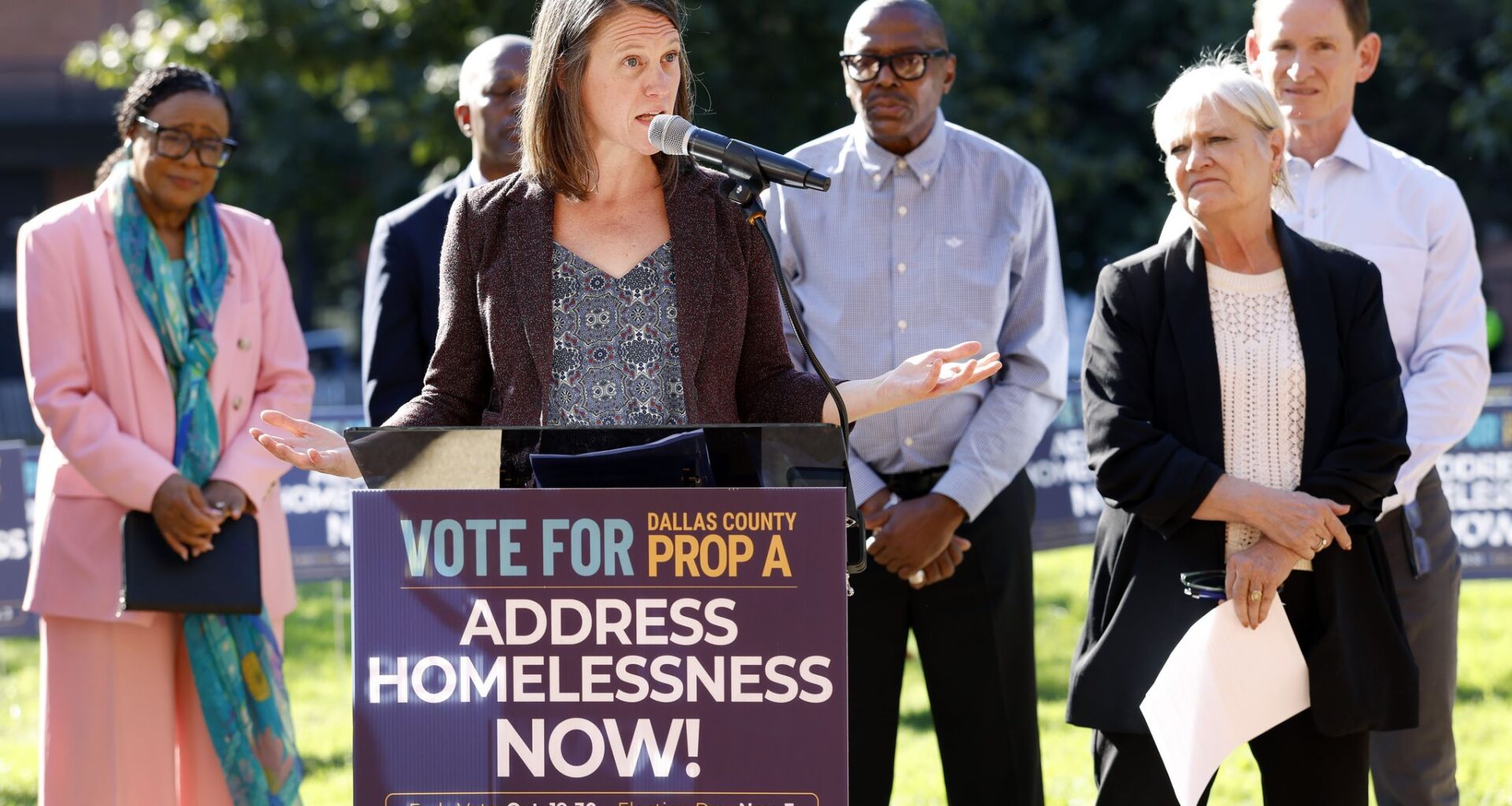
Sarah Kahn, Housing Forward president and CEO, and other supporters of a Dallas County tax increase measure at a news conference Oct. 7 at West End Square in Dallas. The November ballot proposal would raise property taxes to generate about $100 million annually for homeless programs.
Tom Fox/The Dallas Morning News
Danny Buford says Dallas County’s proposed homelessness tax could help more people get a roof over their heads. Bruce Butler wants more answers about what happens next.
Housing Forward, the nonprofit coordinating the area’s homeless response, proposed the tax to expand its work clearing encampments downtown into a countywide strategy.
Buford, operations director of the Stewpot homeless resource center, said the decline in people sleeping on downtown Dallas streets shows what’s possible.
“One solution won’t fix it all, however we have to do something,” Buford told Butler in a recent livestreamed discussion.
Butler, CEO of Union Gospel Mission Dallas, says the plan doesn’t explain enough about long-term mental health treatments or how it will move others more able off subsidies. Despite downtown gains over the past two years, he said demand at his men’s shelter in the Stemmons Corridor is up 25%.
“The worst thing you can do is put someone with deep mental illness or addiction in an apartment and isolate them,” Butler said.
Bruce Butler, CEO of Union Gospel Mission Dallas, left, and Danny Buford, operations director of the Stewpot, speak during a livestream discussion about the Dallas County homeless tax proposal.
Bruce Butler

Their exchange reveals a divide over the Nov. 3 tax proposal: Supporters say it would expand efforts already working, while critics say it asks taxpayers to commit millions indefinitely without enough detail about how the money would bring long-term results.
Proposition A would add 2.4 cents per $100 of taxable value to the county’s property tax rate, generating about $100 million annually for street-outreach teams, rental assistance, longer-term housing, mental healthcare and other interventions.
Article continues below this ad
Passage would put the county’s overall property tax rate 15.4% above last year’s, including a separate increase already approved by commissioners. The increase in Dallas County would remain in place until county officials voted to end it.
Divided providers
Under the proposal crafted by Housing Forward, the nonprofit would manage the $100 million annually and distribute it to providers with county oversight. The increase would mean $72 more a year on a home with $300,000 of taxable value.
“The homelessness that we still see on your way to work, on your way to drop your kids off at school … shows that we have to do more,” Housing Forward CEO Sarah Kahn told reporters last week. “Proposition A is about closing the gap.”
Kahn said current resources allow providers to reach only 60% of the 11,000 households that experience homelessness in Dallas County each year. The additional money would allow a coalition of providers to reach the rest, she said.
Article continues below this ad
The tax increase is backed by Dallas County Judge Clay Lewis Jenkins, Dallas Mayor Pro Tem Jaime Resendez and other leaders, who describe it as both an economic necessity and a quality of life issue.
“Homelessness hurts growth, and growth is how we pay for the things that families need without putting additional burdens on existing taxpayers,” Jenkins said last week.
The city’s code compliance department, among other contractors, clear out the belongings left by people staying in encampment zone 3 in downtown Dallas on Thursday, Sept. 26, 2024. More than 100 people recently found a fresh start through the Street to Home operation to find permanent housing for people living outdoors in downtown’s public spaces. The operation, launched this summer as a partnership between the city of Dallas and the All Neighbors Coalition, quarterbacked by Housing Forward, the agency tapped to design and carry out Dallas and Collin counties’ homelessness response.
Juan Figueroa/Dallas Morning News
Not all service providers have confirmed their support of the plan.
Annam Manthiram, CEO of The Bridge Homeless Recovery Center, Dallas’ largest free shelter, declined to comment because “we’re still gathering more information.”
The proposal Housing Forward submitted to the Dallas County Commissioners Court in August set goals of resolving homelessness for every child and adult within an average of 65 days, clearing encampments and preventing shelters from overflowing. Commissioners voted 3-2 to place the tax increase on the ballot, with Commissioners John Wiley Price and Elba Garcia voting no.
While the proposal includes money for caseworkers and connections to mental healthcare, Wayne Walker, CEO of outreach center OurCalling, said he wants more detail about how it would help people with chronic needs.
He worries this is “putting a lot more money on a problem without clear direction and accountability and specific goals.”
Article continues below this ad
The county has not finalized contract terms and performance requirements for Housing Forward to continue receiving money, but an agreement would be negotiated if the proposal passes.
Kahn said the plan would divide the county into six zones, with $20 million in annual funding for triage hubs to connect people to shelter or housing, mental healthcare or crisis stabilization.
The proposal states these hubs would be “located within existing service provider facilities in each zone.” Kahn declined to identify proposed locations because the providers have not yet been chosen.
County officials this year allocated $25 million to build a 100-bed deflection center in District 2, in northern Dallas County, where police could take people for stabilization instead of arresting them for nonviolent, low-level offenses. Kahn said the plan would use that center and other existing buildings, with no new construction.
The proposal also includes:
$68 million a year for case managers, up to 12 months of rental assistance, security deposits and administrative costs.
$8 million to fund longer-term housing and treatment lasting up to five years.
$4 million a year to cover short-term expenses to get people off the streets quickly, including travel to reconnect with friends or family.
Tracking results
If the proposition passes, Kahn said providers would be selected through competitive bidding and results could be judged by how quickly people get into housing, the number of people who exit the homeless services system and the degree to which they come back.
She points to the last five years as evidence the plan already works: Housing Forward has served about 25,000 people since 2021 in Dallas and Collin counties and 93% have not returned to the system, she said.
Housing Forward tracks that return rate through its federally approved Homeless Management Information System database, according to Kahn.
The database is a standard industry tool but can overstate success because it tracks people who connect with service providers, said Molly Brown, co-associate chair of psychology at DePaul University who researches best practices for homeless providers.
Brown said the database would not capture someone who lost housing and began living in a car or on the street without seeking services again. Nor would it track a return to homelessness outside Dallas and Collin counties.
Jenkins said the county auditor and staff who oversaw federal pandemic aid would closely monitor Housing Forward’s spending.
Article continues below this ad
Dallas County Judge Clay Lewis Jenkins answers questions at a news conference Oct. 7 supporting Proposition A at West End Square in Dallas. The measure would raise property taxes to generate about $100 million annually for homeless programs.
Tom Fox/The Dallas Morning News
Justin Marlowe, a professor at the University of Chicago Harris School of Public Policy, said local governments should use third-party evaluators to review large amounts of public money distributed through nonprofits.
Those independent reviews can determine whether spending follows contracts, performance goals are met and costs stay within budget.
“If you can’t get that right from the beginning, it’s a lot of money and potential for a pretty high profile failure,” Marlowe said.
Sustaining care
Butler at Union Gospel Mission doesn’t dispute the progress made in reducing street sleeping downtown. But for the tax dollars to make real change, he said there needs to be more detail on long-term mental health, substance abuse and other chronic needs while helping others be self-sustaining.
Article continues below this ad
“We need money, but we need money to address core issues,” Butler said.
Metrocare Services, the largest provider of mental healthcare in Dallas County, already connects its supportive housing clients with addiction treatment, medication management, peer support and therapy, said chief housing officer Ikenna Mogbo.
Metrocare would have to compete for a contract through Housing Forward, but Mogbo said the proposed hubs would help providers coordinate care.
“We’re doing this in the jail emergency rooms at our hospital, all kinds of different places so this is an opportunity to concentrate it in one location,” Mogbo said.
Metrocare received an $18 million loan from Parkland Health this summer to stay afloat. Its financial troubles concern Walker of Our Calling.
“To assume that they can just scale up with this when they’re having normal instability challenges, unless there’s some plan B it just doesn’t seem like there’s a lot of clarity,” Walker said.
Article continues below this ad
Mogbo said he believes Metrocare will have support from county partners to maintain its services to vulnerable people “for the foreseeable future.”
Early voting starts Monday and runs through Oct. 30.