
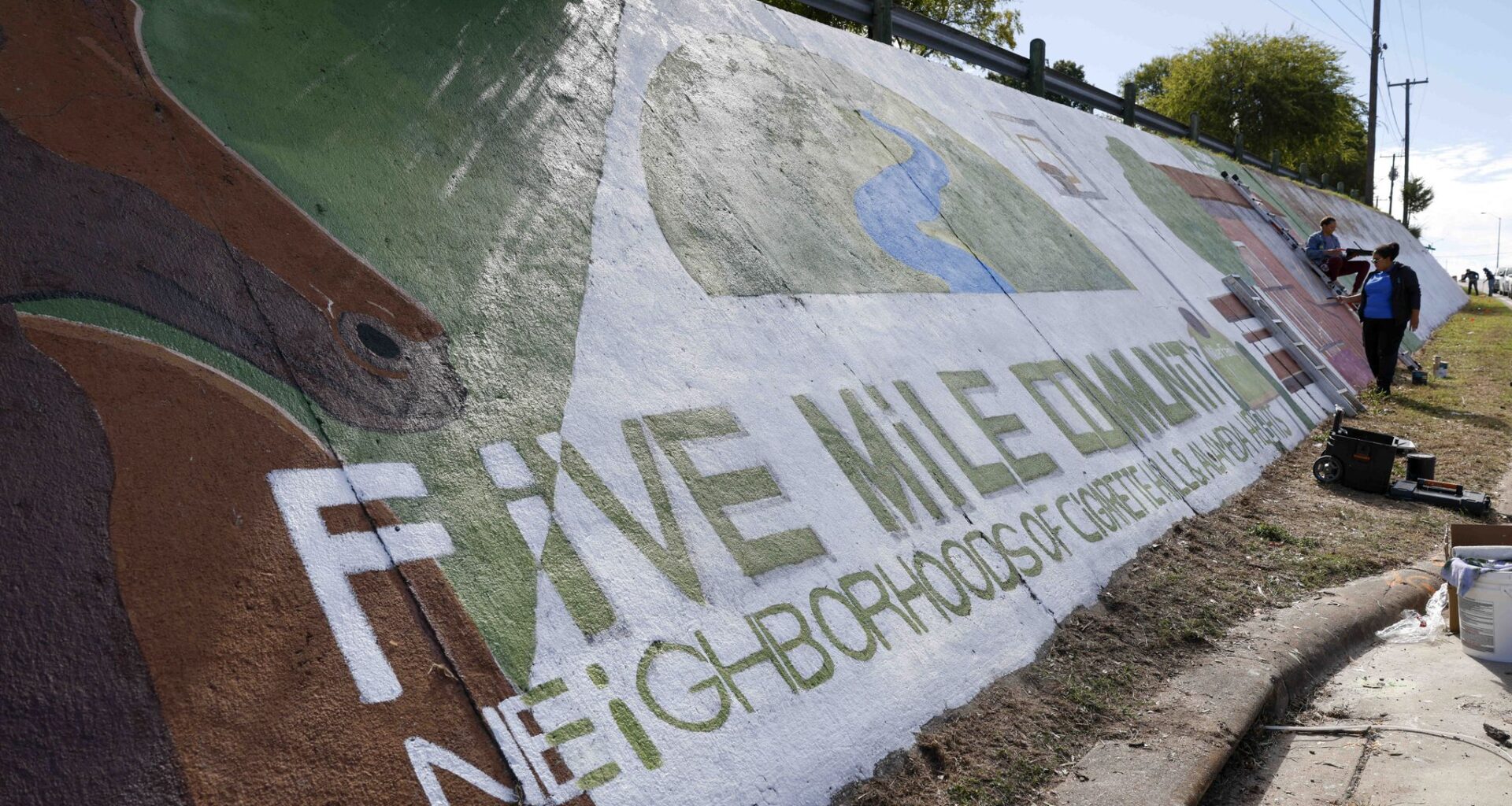
Artists and community members work to paint and restore the Five Mile Community Mural along South Lancaster Road on Sunday, Oct. 18, 2026, in Dallas.
Elías Valverde II/The Dallas Morning News
Nearly a decade after a mural first gave Five Mile a place to tell its story, residents returned Sunday to a concrete wall along Lancaster Road, paint brushes in hand and determined to keep that history from disappearing.

A horse, a winding creek and a small schoolhouse took on fresh color as artist Lakeem Wilson worked alongside students and neighborhood volunteers in the 5700 block of Lancaster Road.
Sunday marked the third and final day of a restoration that residents had spent four years trying to organize.
Article continues below this ad
For a historically Black community whose roots stretch back to formerly enslaved people who became landowners, the mural is more than a collection of neighborhood landmarks. It is a reminder of a history residents have spent decades trying to preserve.
A neighborhood’s story
A community member paints a word as they work to restore the Five Mile Community Mural along South Lancaster Road on Sunday, Oct. 18, 2026, in Dallas.
Elías Valverde II/The Dallas Morning News
The mural was created in 2017 after unsuccessful attempts to install a welcome sign for Five Mile on private or Texas Department of Transportation property, according to the Five Mile Neighborhood Association.
Artist Lakeem Wilson paints a park sign as he helps to restore the Five Mile Community Mural along South Lancaster Road on Sunday, Oct. 18, 2026, in Dallas.
Elías Valverde II/The Dallas Morning News
Artists and community members work to paint and restore the Five Mile Community Mural along South Lancaster Road on Sunday, Oct. 18, 2026, in Dallas.
Elías Valverde II/The Dallas Morning News
Artists and community members work to paint and restore the Five Mile Community Mural along South Lancaster Road on Sunday, Oct. 18, 2026, in Dallas.
Elías Valverde II/The Dallas Morning News
Artist Lakeem Wilson paints a tree as he helps to restore the Five Mile Community Mural along South Lancaster Road on Sunday, Oct. 18, 2026, in Dallas.
Elías Valverde II/The Dallas Morning News
Felicia Sewell, the association’s president, said former Dallas City Council member Erik Wilson, who represented District 8 and served as deputy mayor pro tem, helped the group secure the Lancaster Road wall for the original mural.
Article continues below this ad
“This community over here has been left behind for decades,” Sewell said.
The association spent four years organizing the restoration, which brought together neighborhood residents, students and artist Lakeem Wilson, 35, a South Dallas native who lives in Oak Cliff.
An associate curator at the African American Museum in Dallas and founder of NaturalBorn Studios, Wilson has created more than 30 murals, according to his website. His previous work includes a South Dallas tribute to civil rights activist Juanita Craft.
Despite his experience creating public art celebrating Dallas history, the Five Mile project introduced him to stories he had not previously known, including the neighborhood’s early schools.
“I’ve been getting exposed to a lot of new history working on this mural,” Wilson said.
Article continues below this ad
Wilson coordinated schedules with University of North Texas at Dallas students, ordered paint and selected colors for the three-day project. But the work meant more to him than refreshing faded images.
“It’s important because we’re preserving the cultural memories that lived in this neighborhood and in this community,” he said.
Artist Lakeem Wilson talks with community members as he paints a basketball hoop as he helps to restore the Five Mile Community Mural along South Lancaster Road on Sunday, Oct. 18, 2026, in Dallas.
Elías Valverde II/The Dallas Morning News
A history rooted in freedom
Five Mile’s history reaches back to the years following emancipation, when formerly enslaved people began purchasing land and establishing a farming community in southern Dallas.
Article continues below this ad
According to the Dallas Park and Recreation Department, Miller Family Park occupies land associated with a roughly 600-acre tract purchased by six formerly enslaved people. John Miller purchased a portion in 1874.
The land had previously been associated with William Brown Miller, a plantation owner who used enslaved labor to construct Millermore, a mansion later relocated to Old City Park, according to the department’s historical account.
For Zina Ashford, secretary of the Five Mile Neighborhood Association, the transition from plantation land to property owned by formerly enslaved people is central to the neighborhood’s identity.
“Once they got their freedom, and they bought that land, look at what has happened,” Ashford said.
Ashford helped coordinate volunteers and supplies for the restoration. She said state Sen. Royce West helped connect organizers with partners who provided paint and other materials.
Article continues below this ad
According to the neighborhood association, family tradition connects Five Mile’s name to its location approximately five miles from William B. Miller’s plantation house.
Persimmon Road, named for wild persimmon trees that once grew nearby, became part of the community’s historic center.
Tammye Derricks-Williams, president emeritus of the neighborhood association, recalled a time when farmland, horses and roosters were part of everyday life.
She hopes a historical marker will give Five Mile recognition alongside other historic Black Dallas communities, including Joppa and Tenth Street.
Derricks-Williams said she wants “the Five Mile community to be recognized” and hopes the marker’s eventual installation will bring residents and elected officials together for a celebration.
Article continues below this ad
One historic site in the neighborhood has already received state recognition. The Texas Historical Commission designated Tarver Cemetery, along Persimmon Road, as a Historic Texas Cemetery in September 2025.
A separate historical marker recognizing the broader Five Mile community remains a goal, with its timing dependent on the Texas Historical Commission, Derricks-Williams said.
A history lesson on Lancaster Road
Simone Wilson, wife of artist Lakeem Wilson, helps paint the Five Mile Community Mural as they work to restore the mural along South Lancaster Road on Sunday, Oct. 18, 2026, in Dallas.
Elías Valverde II/The Dallas Morning News
Among the mural’s images is a small schoolhouse depicting Lisbon Colored School, where Black children attended classes during segregation.
For Alissia Richard, a criminal justice student at the University of North Texas at Dallas who lives in Garland, restoring the mural became an unexpected history lesson.
Richard learned about the volunteer opportunity through a student engagement email. As she painted alongside neighborhood residents, she listened to stories about the community and the landmarks depicted on the wall.
“It was really interesting to hear a lot of the story around the mural,” Richard said.
Wilson hopes the restored images will spark similar curiosity among people traveling along Lancaster Road.
“What is that school? Or what is that place that they’re highlighting on the mural?” he said.
By Sunday, the horse, creek and schoolhouse had taken on fresh color, bringing renewed attention to a neighborhood whose history stretches back generations.
For longtime residents, the restoration was another step toward preserving their community’s past. For Richard, who knew little about Five Mile before volunteering, it was an opportunity to help tell a story she had only recently discovered.
“It feels pretty good, even if, like, no one’s gonna know I did it,” Richard said.
Her contribution may go unrecognized, but the history she helped preserve will remain visible along Lancaster Road, where generations of Five Mile residents have worked to ensure their community is not forgotten.