
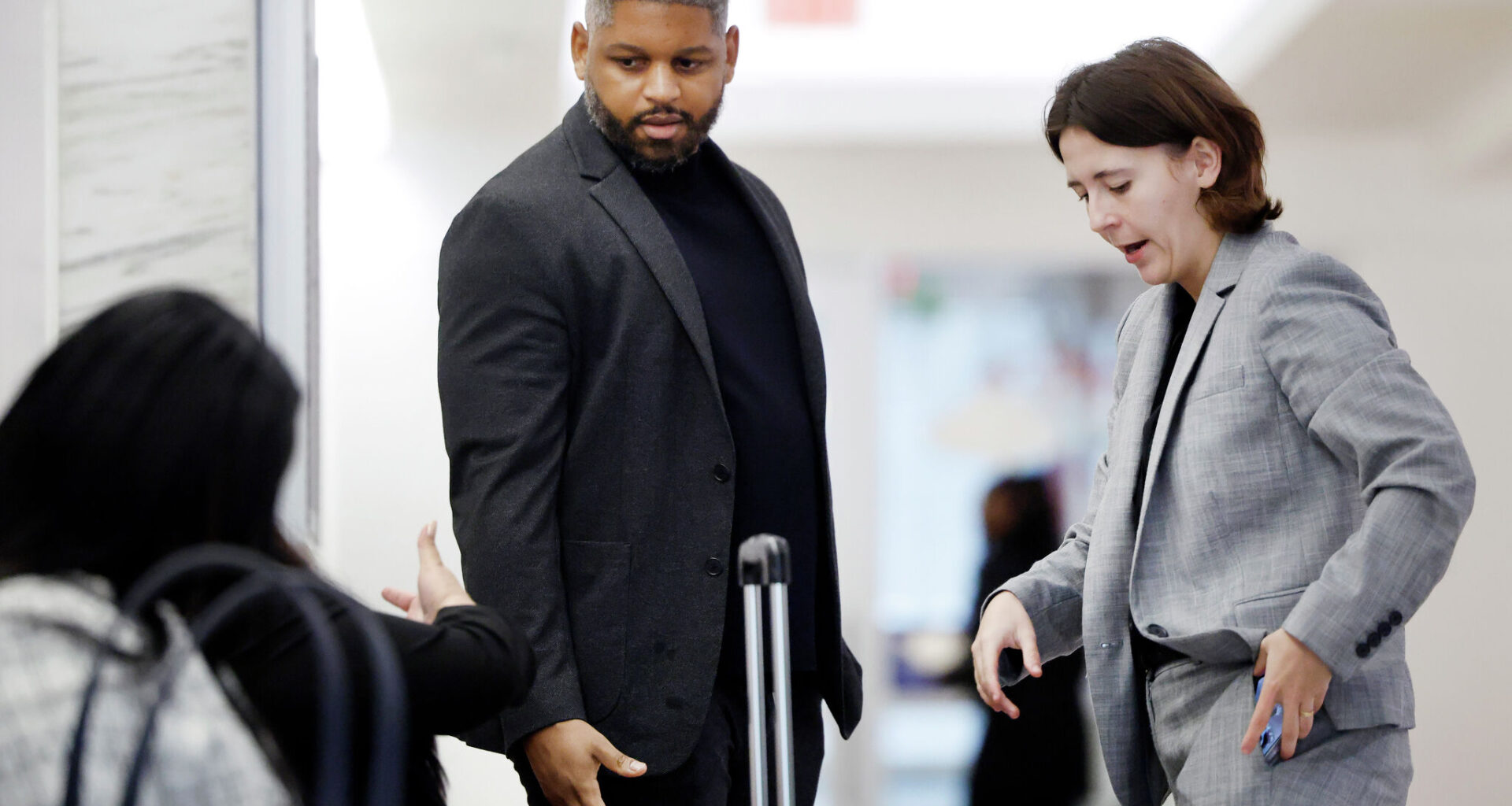
Gary Alton Matthews Jr. (right), a man who has fathered multiple children in Texas and Louisiana, resulting in five child support cases, meets with his legal team before appearing in Judge Andrea Plumlee’s 330th District Court at the George Allen Courts Building in downtown Dallas, March 26, 2026. Matthews appeared before Plumlee to determine child support in one of the cases.
Tom Fox/Staff Photographer

Gary Alton Matthews Jr. had more than enough money to support his children.
Article continues below this ad
That much was clear from the extensive financial records the state of Texas had subpoenaed in his child support case against Kaitlyn Morris. Kaitlyn was one of seven mothers who accused Gary of impregnating them, largely through reproductive coercion. She was one of five who filed for child support.
What had also been revealed in those records was a financial relationship between Gary and Sheena Chan. In multiple transactions, the records showed, Gary had paid Chan, a Dallas-based private DNA collector, at least $24,000.
Even before those payments surfaced, Nadia Sutton, another mother whose child support case had overlapped with Kaitlyn’s, had been suspicious of Chan. Chan represented in testimony and through testing records that she had collected Gary’s DNA three times in 2024: once in Dallas and twice when Gary supposedly flew her to Bahrain.
The DNA samples Chan had collected from Gary had erroneously excluded him as the father of Nadia and Kaitlyn’s children. His paternity had been confirmed in those cases only after his DNA was compelled in court.
Article continues below this ad
RELATED: The DNA test was supposed to settle everything. Instead, it launched a multi-year legal battle
Nadia and Kaitlyn had discussed how implausible the Bahrain story sounded.
Nadia began digging into Chan’s background. She found her Facebook page, which indicated she also had children.
“It’s amazing to me how a MOTHER can be so concerned about her own kids meanwhile is out here using her COMPANY to defraud the government & a child of her parentage & support,” Nadia wrote in a post on Facebook that linked to Chan’s page. “Illegally defrauding the govt for a known serial predator and putting your business & your livelihood at risk.”
Kaitlyn and Nadia had already known Gary manipulated his DNA for their paternity tests, but they hadn’t known how. The series of payments to Chan indicated he wasn’t operating alone.
Article continues below this ad
Through his attorney, Gary declined to comment for this story. Chan did not respond to requests for comment.
A trial in Texas
In February 2025, after four years of litigation, Nadia had secured a court order legally requiring Gary to financially support their child.
Now it was Kaitlyn’s turn. In March 2026, the trial to establish Gary’s financial obligation to her child, now 3, would finally come to pass.
In the nearly three years that Kaitlyn had battled Gary in court, there had been many times she had wanted to give up. For so long, she had felt dismissed, disregarded and disbelieved by people with authority and power — by attorneys, by judges and by Gary.
Article continues below this ad
She had pushed past those feelings. She was doing this for her son. She was doing this for herself. And she was doing it for the other women who she felt had been silenced and shamed by Gary.
Kaitlyn Morris plays with her 4-year-old son she had with Gary Matthews at her Jackson, Mississippi apartment, August 22, 2026. Morris gave birth to Gary Matthews’ son in Baton Rouge in September 2022 and had a sprawling multi-year family court case in Dallas.
Tom Fox/The Dallas Morning News
Maybe this time, she hoped, Gary would be held accountable.
On the morning of March 26, Ashley Philip, an attorney with the office of the Texas Attorney General’s Office, arrived on the third floor of the George Allen Courts Building in downtown Dallas pulling a large wagon — the kind used by TV crews to transport their equipment — loaded with multiple thick binders. She had brought reams and reams of records for the trial against Gary.
In the hallway outside the 330th District Court, Gary conferred with his attorney, Taylor Adler of Walters Gilbreath, a family law firm with offices throughout Texas.
Article continues below this ad
Kaitlyn logged into the proceedings on Zoom from her home in Mississippi, where she had recently moved. Her attorney, Rosalyn Lark, was inside the courtroom.
RELATED: He told women he wanted to ‘go half on a baby.’ Then he disappeared
Judge Andrea Plumlee, the presiding judge of the 330th District Court, would be overseeing the trial. Lark had told Kaitlyn that the state, with its extensive evidence against Gary, would handle the bulk of the arguments.
Gary’s legal team would have less to work with. In December, an associate judge had sanctioned Gary for “abuse of the discovery process” after he repeatedly failed to respond to the state’s requests for records. His attorney had been prohibited from submitting any evidence at the trial that had not already been previously exchanged with the other parties.
Philip opened with an overview of the case. A DNA sample from the father had been requested in September 2023, but Gary did not submit to a test until 2025. In that time, she said, he failed to cooperate with the court and establish child support. He transferred ownership of his business to his father to avoid responsibility, she said, and attempted to hide his assets. His lavish lifestyle, including frequent travel, Philip added, indicated his ability to pay.
Article continues below this ad
The state sought the maximum amount in child support under Texas law.
RELATED: As child support cases mount, a Dallas man faces fraud allegations in court
Adler, Gary’s attorney, said in her opening statement the case was not about shirking parental duties. It was about a man who was unable to support his child at the level requested by the court due to financial hardship. Tax returns from three years prior, she said, did not reflect his current financial reality, and he was also legally responsible for supporting another child — Nadia’s. Gary’s reputation and ability to work, Adler added, had been damaged by disparaging social media comments made by the mother.
The state called Gary to the stand.
Philip asked him if he was the father of Kaitlyn’s child. Yes, he said. It was the first time he had made such an admission. A few questions later, he admitted to being the father of Nadia’s daughter, too.
In a series of questions, Philip outlined the delays in the case, including the requests for private testing and Gary’s failures to show up for court-ordered tests. Gary reiterated what he had been telling the court all along — that he had been out of the country. The state’s exhibits, which included three years of his credit card transactions, contradicted that statement.
Gary said he currently lived in Dallas, at a townhome south of downtown, with a mortgage of almost $3,000 a month. That bill, and another $5,000 in monthly expenses that Gary listed on a financial worksheet, he said, were being paid by his father, Gary Alton Matthews Sr. So, too, were his legal expenses, which included pursuing restraining and protective orders against three of the mothers.
Gary testified that he transferred ownership of his private consulting business, Gary Matthews Healthcare Consulting LLC, to his father at the beginning of 2024 because he was interested in transitioning from project-based work to full-time employment. He said he also donated a group of properties that he previously owned in New Orleans to his father that same year because he was no longer living there and was unable to keep up with expenses.
Philip asked if he had bought a Tesla Cybertruck in 2024. There was also another Tesla, a Model 3, and a Corvette Stingray, both purchased in 2022. And a BMW X5 SUV. All of those vehicles, Gary said, were purchased by his father or the company.
RELATED: A mother warned a Dallas court Gary Matthews would fake a DNA test. She was ignored
Then she asked Gary if he had been aware of how much money had been deposited into the bank account associated with his healthcare company during the course of this child support case — $230,968.60 in 2023, $384,133.29 in 2024 and $402,152.68 in 2025. More than $1 million over a three-year period.
Gary said he wouldn’t have access to that information because he no longer owned the company.
If that was the case, Philip asked, why was the company still registered to his home address in Dallas? Why did he need to transfer a company making $400,000 a year to his father?
Gary said the contracts and the associated profits from that work belonged to his father.
“The company is not a traditional company,” he said. “It’s not like a laundromat.”
Plumlee, the judge, instructed Gary to answer the question that was asked. It wouldn’t be the last time she admonished him.
Gary said he could not keep up with expenses and the company’s business loans.
He said he believed the fact he and his father shared a name had led Chase Bank to erroneously respond to subpoenas with account information that belonged to his father.
When Philip asked Gary to provide his father’s age, he said he didn’t know. He was unable to be more specific than somewhere in his 60s.
Philip’s other questions targeted his extensive travel history in the context of his missed court dates.
She introduced a travel log for Gary that had been subpoenaed from American Airlines. The records indicated that throughout the time Gary said he was working abroad, he had been flying frequently within the United States. There were trips to Louisiana, California, Indiana, Massachusetts and Florida. The receipts for the flights were sent to Gary’s personal email address.
“It has my dad’s name on there,” Gary said. “It’s his middle name also.”
The state of Texas had subpoenaed his records, Philip said. Not his father’s.
“Why is it you can travel to these destinations,” Philip said, “but you cannot travel to court on these dates?”
Gary stuttered. The judge ruled Gary was non-responsive. She gazed at Gary, her eyebrows raised.
RELATED: How establishing and enforcing child support works in Texas
At different points in his testimony, which had been punctuated with long pauses and moments of apparent confusion, Plumlee had rolled her eyes and propped her face in her hand. At one point, she tossed down her pen.
After Gary had been testifying for about an hour, Plumlee called for a recess. She turned to his attorney.
“Counsel,” she said. “Your client is absolutely not believable.”
Plumlee said she had never seen the state mount such a detailed case — not because it couldn’t, but because it usually was not necessary. Plumlee instructed Adler to consult with her client. If Gary made her sit through another “mountain of lies,” Plumlee said, she would come down on him with every available extent of the law.
The judge walked briskly out of the courtroom.
‘Beyond the pale’
After the recess, Gary’s testimony continued for more than an hour.
During questioning by his attorney, Gary said he had been terminated from a contract and could not find steady domestic work. He testified he had participated in 50 job interviews but said his reputation had been damaged.
“Has Ms. Morris contacted people,” Adler asked, “in a way that reflects poorly on you?”
“Yes,” Gary said. “I haven’t been able to find work because of it.”
His legal team had submitted an example, a screenshot of a private conversation, as Exhibit R-18.
“Do you know Gary Matthews?” Kaitlyn asked a woman in a private message. “Just was going to tell you not to let him get you pregnant. He has a lot of children that he doesn’t take care of and will coerce you into pregnancy.”
When he had owned the consulting company, Gary said, he enjoyed a nice lifestyle, traveling and working whenever he wanted. That was no longer the case, he said.
Lark, Kaitlyn’s attorney, asked Gary if he had spoken with her client or sent her any money to support their child. Gary said he had not.
A photo of Gary Matthews and Kaitlyn Morris, taken by Kaitlyn.
Courtesy of Kaitlyn Morris
“We have a broken relationship,” he said.
Three hours into the testimony, it was Kaitlyn’s turn to take the stand.
She testified she had met Gary online and told him she was pregnant within days of finding out. The news, she said, had ended their relationship. She had filed for child support in November 2022, while living in Baton Rouge. Gary, she said, had only seen their son once, when they appeared at the Dallas courthouse together to give their DNA. He did not help her pay for prenatal care or any expenses related to raising their child.
“How does that make you feel,” Lark asked, “knowing he’s made hundreds of thousands of dollars and never offered you a dime?”
“Repulsed and enraged,” Kaitlyn said, “being as he actively family planned with me, and then used his resources to legally bastardize his son and other women’s children as well.”
Kaitlyn Morris dumps out a baby bottle as she leaves for dinner in Jackson, Mississippi with her sons, ages 4 and 1, on August 22, 2026. Morris had a sprawling multi-year family court case in Dallas.
Tom Fox/The Dallas Morning News
During closing statements, Philip said Gary had been uncooperative throughout the case and had avoided taking responsibility for his child. Gary wanted the state to believe he was unemployed, she said, all while tens of thousands of dollars were being deposited into his account each month.
Adler said her client was not trying to deceive the court. He just wanted to pay an amount, she said, that was sustainable based on his current finances.
“This case,” Lark said, “is ultimately about responsibility, delays and fraud.”
After more than three hours, the judge had heard enough. She was ready to rule.
“This court finds it particularly egregious that the respondent, father, even after he was confirmed as the father of the child, just refused his responsibility as the father,” Plumlee began. “It would be one thing if he acted in that manner and didn’t know, but we’re going to skip forward to the time when he knew.
“And the thing that you have to ask yourself is, really, how could there be tests that were done outside of the courtroom and were only handled by the father, and those came back negative; but when he was required to appear before the court, that that test, and that test only, was positive?”
The judge then articulated what Kaitlyn, and the other mothers, had been trying to tell the courts for years.
“The father is not a reliable witness. He only admits something when he is confronted with evidence to substantiate whatever the question is. He lies when the truth would do him better. When he would just simply say, ‘Yes.’ He can’t even acknowledge when he should be able to discern when he’s backed into a corner. He refuses to, even then, give an inch.
“This court finds that he is intentionally underemployed, that he intentionally thwarted the process in determining parentage in this case.”
Plumlee granted all requested relief sought by Kaitlyn and the AG’s office — $2,048 a month in child support, $202 per month in cash medical assistance, $5,000 in attorney’s fees and $72,296 in back child support, to be paid back at a rate of $1,000 per month starting April 1. Those payments, she said, would be in the child’s best interest.
“And, quite frankly,” Plumlee said, “the fact that you would pay attorneys to come down here, sir, to literally spit on a child that has been confirmed as yours, and you know is your child, is just absolutely beyond the pale.”
When Adler asked the judge if Gary should pay Kaitlyn directly on April 1, she said no. He needed to set up an account with the AG’s office and make the payment, she said, “because nobody would trust that he would do it anyway.”
Kaitlyn logged off from the trial with a sense of closure. For the first time, Gary had admitted to being the father of their child. And for the first time, she had been given an opportunity to talk about how the case and Gary’s behavior had affected her. Gary had been exposed, and the judge had taken him to task.
Still, she wasn’t under the illusion Gary would pay her the significant sum of child support she had been awarded, even though she believed he still had the money somewhere. After all, he owed Nadia nearly $100,000, more than a year after an order had been issued in her case.
Kaitlyn didn’t think this setback would deter Gary. Nothing, she believed, would stop him.
Conflicts of interest
The court proceedings in Dallas, and those in New Orleans, never publicly answered Plumlee’s question: How was it possible that multiple private paternity tests had excluded Gary as the father of two of his children?
The payments of more than $24,000 to Chan, who owned Rapid Drug Testing Service in Dallas, were never raised in trial testimony by either court. Neither was the origin of the DNA samples. Nor were the backgrounds of Chan, who collected Gary’s DNA multiple times throughout the course of 2024, or Candace Gabriel, who collected his sample at a Labcorp location in Houston in 2022.
During court-ordered paternity testing, DNA collectors and laboratories are obligated to maintain what’s called a chain of custody — a documented record of identification, collection and transport of DNA samples by a neutral third party. The person’s identity is verified through the collection of government-issued identification, a signature, fingerprints and a photograph. Samples are certified by the collector, placed into tamper-proof packaging and sent to the lab for testing.
RELATED: The Father: The lengths a Dallas man went to deny paternity in multiple child support cases
The documentation by Chan and Gabriel for the samples they collected from Gary appeared authentic.
Multiple forensic DNA experts who reviewed the paternity test results and accompanying records in Katilyn and Nadia’s cases at the request of The Dallas Morning News said there did not appear to be problems with how the private and court-ordered tests had been handled by the labs.
Labs only have the ability to test the samples they receive, said Matt Quartaro, a private forensic DNA consultant based in Dallas.
Instead, the experts said, the most likely explanation was that something happened at the point of collection, since it’s the weakest part of the chain of custody.
With court-ordered paternity tests, this typically isn’t an issue. Many states across the country contract with DNA Diagnostics Center, or DDC, a national lab, for their testing services. It provides a standard process for testing that is designed to withstand legal scrutiny.
Gary tried to submit his sample using private collectors multiple times. Twice, those samples were accepted by the court. Theoretically, the collection process for those privately submitted samples should have matched the requirements for court-ordered testing.
In these two cases, with these two private collectors, there were multiple red flags, including troubling conflicts of interest, an investigation by The News found.
RELATED: Court records, bank records, family trees: Investigating a Dallas man denying paternity
The two dozen payments from Gary to Chan, were the most visible example. A legally admissible paternity test typically costs from $300 to $500.
Chan opened her testing business as a sole proprietorship in Dallas County in April 2018. On its website, the mobile testing company advertises same-day appointments and round-the-clock availability for the collection of samples for drug and DNA testing under court orders — such as in child support, probation and CPS cases — or as required by an employer.
Two years before Chan created the company where she would drug test customers, she was arrested for possession of two ounces or less of marijuana in a drug-free zone. She was later convicted of the offense.
In March, Labcorp, the national private testing chain, sued Chan for breach of contract for failing to pay for $16,902.55 worth of tests that it performed for her company. An exhibit listed dates for Chan’s outstanding bills from the same timeframe she reported having collected samples from Gary. In early July, a default judgment was entered against Chan after she failed to respond to the court and pay her debts.
In the chain of custody documentation, Chan indicated she twice flew across the world to collect samples from Gary in Bahrain. Yet there is no evidence Gary ever lived in that country, according to three years of financial transactions obtained by the court in Dallas and reviewed by The News.
The second collector, Gabriel, took Gary’s sample at a Labcorp location in Houston in 2022. Two days before that sample was given, financial records show, Gary purchased a pair of plane tickets from New Orleans to Houston — despite the existence of numerous Labcorp locations in Dallas and New Orleans, where he spent the vast majority of his time.
Gabriel grew up in the same area of New Orleans as Gary. She also attended the same high school, Warren East Fundamental Senior High School, as Gary and his brother. Their photos both appear in the 2001 edition of the school’s yearbook.
DDC, the lab contracted to perform paternity testing for Texas and Louisiana, requires tests to be collected and administered by a neutral third party. The person collecting the sample, the lab states on its website, cannot have a “vested interest in the outcome of the test” and must not “attempt to falsify the specimens in any way.”
The News attempted to reach Gabriel by phone. After a reporter identified herself to Gabriel, she hung up.
There were other irregularities with Gary’s cases.
In Nadia and Kaitlyn’s cases, he submitted his DNA sample at least six times — once at the courthouse in New Orleans, once at the courthouse in Dallas and four other times with the private collectors. Forensic DNA experts in the New Orleans case testified Gary’s sample in the private tests originated from a different person than the sample that was collected in open court.
However, forensic DNA experts told The News those two DNA profiles have enough similarities to suggest there was a strong likelihood of a close familial relationship between the two men who submitted the samples.
In other words, there was a good possibility that Gary was related to the person who provided the samples in the private tests that he represented to the courts as his own.
Another analysis of all the tests, including a specific kinship analysis between the two DNA profiles, would be needed to officially confirm a familial link, the experts said.
“They share more genetic information than I would expect from an unrelated individual,” said Cynthia Cale, the co-founder of DNA Mavens Forensic Services, a nonprofit forensic consultant group in Houston.
Texas law — Chapter 160 of the Texas Family Code — states that a paternity test result is inadmissible if another person provides a DNA sample “with the intent to affect the outcome of the proceeding.” Falsifying or fabricating genetic evidence in a case determining a child’s parentage is a third degree felony under Texas law.
Joanna Grossman, a legal scholar at the Southern Methodist University Dedman School of Law who specializes in family and parentage law, has written extensively about misrepresentation of paternity in family court cases. The misidentification of the biological father of a child by a parent, knowingly or unknowingly, she said, is not rare.
What is unusual, Grossman said, is the fabrication of DNA tests and the submission of false evidence to multiple courts. She has never seen another case like it.
The egregiousness of the conduct in these cases, she said, opens the door for a possible criminal investigation and potential civil suits for fraud by the mothers.
“Certainly there is somebody in the DA’s office who should be looking into that behavior,” Grossman said. “I have no doubt that it violates some laws.”
Seeking visitation
Gary’s legal troubles were not over.
Child support had been ordered in two of his cases. There were two other open cases to establish his paternity and child support in Texas and Louisiana.
One had been opened in St. Tammany Parish in 2020 for a child born in 2012. The other had been opened in Collin County in 2025. Gary had been served in that case at the Dallas courthouse, while appearing for a hearing in Kaitlyn’s case.
Initially, Gary had entered a general denial in the Texas case, filed on behalf of a 2-year-old boy who was born in 2023 and lived in Plano.
In late May, Gary filed a counter petition. It was different from all the ones that had come before.
This time, Gary was seeking legal decision-making power for the child. He also wanted visitation. A trial was scheduled for June 3.
The mother in the case — who asked The News not to identify her to protect the identity of her child — messaged Nadia. The News verified her account through a review of court records and other public records, text messages and other interviews.
“I got notified last night that Gary is claiming joint conservatorship,” she wrote to Nadia. “I’m absolutely freaking out right now.”
She didn’t know what to do, she added. She knew she needed to hire an attorney, but she worried it would be too expensive.
Nadia tried to reassure the mother. Gary didn’t actually want custody, Nadia said; it was likely a scare tactic, an attempt to get her to drop her case.
Within a week, the mother was represented by Lark, the same attorney who represented Kaitlyn.
Rosalyn Lark, an attorney for two women with child support cases against Gary Matthews Jr., is photographed at the George Allen Courts Building in Dallas, July 28, 2026. Matthews’ child support cases have been contentious, with conflicting paternity test results and rulings by multiple judges that he has intentionally under employed himself.
Tom Fox/The Dallas Morning News
On the morning of June 3, Lark and the mother arrived at the courthouse in McKinney. Gary arrived with a new attorney, Yoel Zehaie, who ran a solo practice in Arlington. Since 2021, Gary had hired at least nine law firms to represent him in his child support cases and related litigation.
The June trial was a greatly condensed version of Kaitlyn’s case, with some deviations.
The mother in the case testified through an interpreter that Gary had never met their child, who only spoke Spanish, or provided any financial assistance. She said she was fearful because the last time she had spoken with Gary, he had told her he was living in Japan due to death threats from a business associate.
The mother said she tracked down Gary on Facebook, where he was going by the name Philippe Laurent, to inform him about the pregnancy in early 2023. Gary would later deny that was him.
She testified Gary had told her to terminate the pregnancy, even though abortion had been banned in Texas the previous year.
“With the new circumstances of my life. I honestly can’t be there or help you financially with this,” Gary had written in a text reviewed by The News. “I will be living in Japan until further notice. Different time zone, different life, and I need to limit my contacts with the US as attempts have been made on my life there. The most viable option is to go the abortion way and that way you can cut ties with me.”
“Stop being a coward,” the mother had texted back. “YOU made this and YOU asked for it, you disappeared 2 days after consciously making it and had the chance to decide about it and now it’s way too late for an abortion I am definitely not going that route.”
The mother told the court if Gary were granted visitation, she preferred it to be supervised.
Gary testified that he acknowledged the child and had seen the court’s DNA results. He said he had just started a new job as an application support specialist that paid $55,000 annually. He also said he had to pay child support for two other children.
“The other two women,” Gary testified, referring to Kaitlyn and Nadia, “they have done a lot of what you’re seeing right now, which is create false accounts.”
Gabriel Arteaga, a litigator with the AG’s office, introduced some of the same records that had been subpoenaed in Kaitlyn’s case, including transactions from the bank account linked to Gary’s consulting business.
When Gary’s attorney objected, Arteaga said the records were evidence of intentional underemployment. The judge, Shelly Dukes, allowed the admission the records, limiting them to the date of the child’s birth.
“I don’t own this company at all,” Gary protested.
“That doesn’t mean it’s not giving you money,” the judge said.
Dukes ordered Gary to pay $1,872 a month in child support starting July 1, plus $44,928 in retroactive support.
With the new order, Gary’s total monthly child support obligations, not counting arrears, had risen to $5,989 a month for three children. Retroactively, he owed more than $200,000 in support.
The judge also approved a graduated visitation plan, with supervision by the child’s grandmother, starting that week. Gary would be able to see the boy every Thursday evening from 6 to 8 p.m. at a local McDonald’s and at an indoor playground on alternating Saturday mornings for the first round of visits. The father, she said, would be responsible for bringing someone along who was capable of translation. He would also need to purchase a car seat.
Three days later, the mother drove with her son and his grandmother to the indoor playground, as the court had instructed.
The boy, 2½, ate pizza and sipped from a juice box in between bouts of playing with his grandmother. He had a head of dark curls and a face that bore a resemblance to his father.
The family waited for more than an hour.
Addendum
On June 10, Nadia gave birth to a child from another relationship. About a month after her cesarean section, she returned to work at her job working 12-hour shifts at a group home. Gary owes her more than $100,000 in back child support. On Aug. 13, she said she was served with papers from Gary indicating he is seeking legal decision-making rights and visitation for their 5-year-old daughter, as well as a modification of the monthly $2,069 child support obligation. A court hearing is scheduled for Oct. 20.
In June, Gary’s DNA sample from Nadia’s case was merged with samples from the mother and daughter in the pending child support case in St. Tammany Parish. The mother in that case, Jennifer Dodson, told The News she was notified the resulting paternity test had established Gary as the father of her child, a 14-year-old girl. Dodson said the state planned to seek a default judgment against Gary after the court struggled to locate him to notify him of the case’s hearings.
On July 20, a district court judge ruled in the Collin County case there was “no question” that Gary was intentionally underemploying himself to reduce his financial obligation for his child, the 2-year-old boy. The judge also increased the amount of back child support Gary owed from $44,928 to $65,520. Gary testified he did not attend the supervised visitations with his son because he had trouble logging into the parenting app they agreed to communicate through. The court had provided to Gary the dates, times and locations for those visits.
In late July, Kaitlyn’s attorney filed a motion to enforce child support payments in her case. Gary had failed to make a single payment since the March trial. He had failed to pay $9,286.68 in child support that was due since April 1, and his back support totaled $82,391.69. He also owed $809.01 in medical support and $5,000 in attorney’s fees for Lark’s representation. A week later, Kaitlyn said, Gary made a payment of $750.
Lark further requested Gary be held in contempt of court and be jailed for up to 180 days and fined up to $500 for each non-payment, with sentences served concurrently. She asked that Gary be held in the county jail after completion of his sentence until he complies with the court’s order. A hearing was scheduled for Oct. 19 to consider Lark’s requests. It was canceled after a process server was repeatedly unable to serve Gary with notice of the hearing.
Researchers Rachel Friend and Sarah Haldeman contributed reporting.