
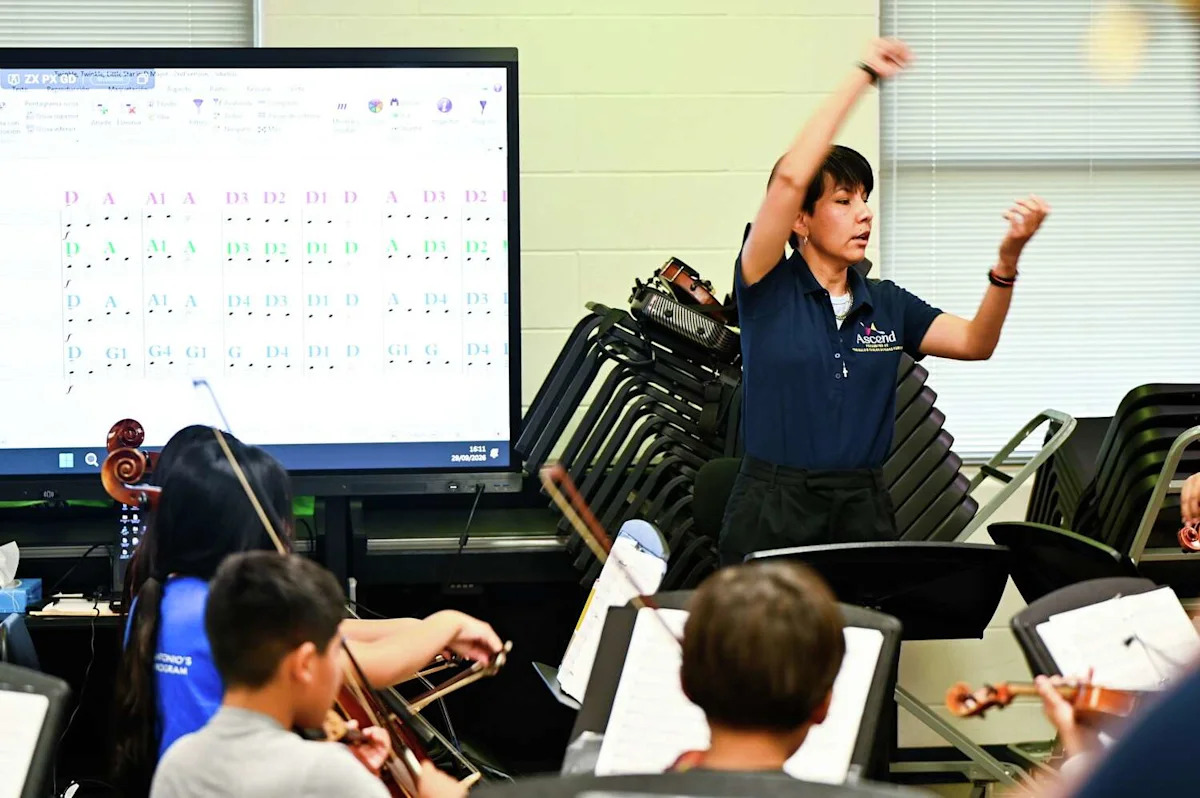
Sitting straight in their chairs, bows poised on their on stringed instruments, the student musicians focused intently on Marian Castro Anton, waiting on her to start the music.
Anton, the principal double bass player with Orchestra San Antonio, is also director of Ascend, the orchestra’s official education program.
On this day, she was at Stafford Visual and Performing Arts Elementary, leading the first half of a two-hour instruction program.
Like a maestro conducting a symphony, she swept her arms in the air and called out notes for students to hold.
“One, two and three, and go!” Anton said. “Aha! One more time!”
Fourth-grader Shandon Shipman was among the students. He gripped his double bass, which was a head taller than him, as he pulled the bow with his right hand across the strings.
“My favorite thing I’ve learned is to work as a team,” Shandon said before practice. “And always be respectful to others.
‘Music is the way’
Anton is one of the leaders of an 11-member Ascend team on a mission to make music accessible to children through the free after-school program. Ascend offers comprehensible classical music classes for students in the Edgewood Independent School District and San Antonio Independent School District.
The musicians teach theory and purpose through collective practice, Monday through Friday, two hours each day for 400 hours of instruction a year.
The program is funded by donors and sponsors, including the Malú and Carlos Alvarez Family and the Najim Foundation.
Ascend began as a pilot program in 2024 at Stafford Elementary. In August, the program expanded to Japhet Elementary School in SAISD, mentoring more than 100 students.
“We want every kid in San Antonio to feel like a winner,” Anton said. “We are creating pillars for life. Music is the way, the tool. We are teaching immersive consistency with consistency.”
‘Shift the mindset’
Anton became enthralled with music when her father taught her four chords on the cuatro, a traditional Venezuelan instrument. By age 15, she was playing the double bass with the Youth Symphony Orchestra of Carabobo, leading her section, clapping and singing rhythms at the top of her voice.
From Venezuela, she went on to teach music in Florida, where she caught the attention of Orchestra San Antonio. An invitation to perform with the orchestra in the opera Hansel and Gretel made her think, “I want to do this for the rest of my life.”
She said Ascend contributes to San Antonio by offering students a music program modeled after her homeland’s cultural institution.
As a teen, Anton trained in the internationally acclaimed initiative El Sistema Nacional de Orquestas y Coros Juveniles e Infantiles de Venezuela -which translates to English as the National System of Youth and Children’s Orchestras and Choirs of Venezuela.
Daniela Diaz, Ascend’s chief programs officer, said Ascend adopted the initiative’s philosophy of music as an instrument of social transformation. Diaz, who is also from Venezuela, a violinist and former El Sistema student, said they try to connect the excellence artists bring from the stage to the classroom for a real hands-on experience.
Ascend aims to build protective factors to help young people become more hopeful for their future, Diaz said.
“We want to shift the mindset that classical music is for kids who can afford it,” Diaz said. “We want to be part of having the opportunity to pose questions on how the arts and music education can drive resiliency, workplace and economic development in the long term.”
‘Follow the rhythm’
In the classroom, posters encouraged students to sit with good posture, care for their instruments, work hard and be their best.
Sophia Cortez chose the cello because it looked cool. She said the Ascend program has taught her to focus, pay attention and be a leader.
Her classmate Isabella Ramirez began playing the violin because she loved hearing her mother strum the guitar and her sister play the cello.
“Most of the class are my friends,” Isabella said. “One friend named Sarah helped me in things I didn’t know. And Mr. Face helps me, always.”
Coordinator Sofia Salazar said “Mr. Face” is the kids nickname for senior director Eliezer Anteliz, because he teaches them that in sheet music, the spaces for each note in the treble clef combine to spell out “F-A-C-E.”
In the second hour, Anteliz welcomed first- through third-graders into his room. After they settled in their chairs, he guided them to hold notes for a collective tone.
“OK, OK,” Anteliz said, “Follow the rhythm, follow the rhythm.”
‘We love the program’
Sugeetha Ramakrishnan said the music her daughters Nadhi and Inila Arvind play is part of their family’s life.
Since January, her daughters, both virtual school students, have attended Ascend lessons at Stafford Elementary.
Ramakrishnan said they live on the South Side and though afternoon U.S. 90 traffic gets jammed, it was important their daughters had access to an immersive music experience.
Nadhi, the youngest, plays the cello. Her older sister Inila plays the violin. After class, they practice for two hours, sometimes longer until their parents say it’s bedtime.
“I see them getting more confident,” Ramakrishnan said. “They’re no longer shy to play their instrument when somebody visits us. It’s like concert time.”
She credited the teachers for keeping lessons engaging and interesting for the students.
“We love the program,” Ramakrishnan said. “We would love for it to go to other schools so more kids can benefit from it.”
Subscribe
There’s more to San Antonio with the Express-News. Subscribe today for just 25¢.
This article originally published at How an Orchestra San Antonio program is making music accessible for kids.