
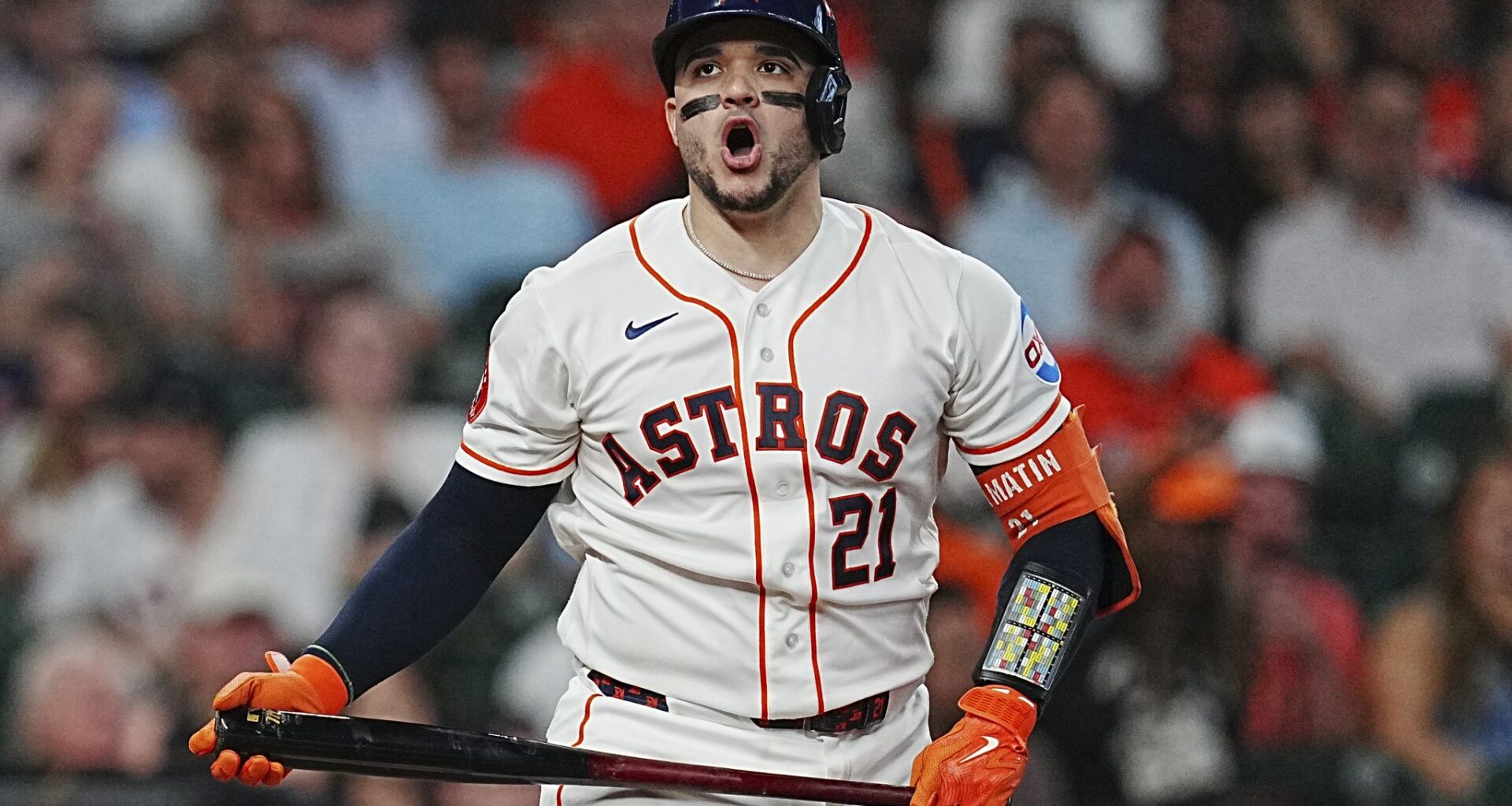
Houston Astros Yainer Diaz (21) reacts after striking out to end the fourth inning during Game 1 of an American League Wild Card Series in Houston, Tuesday, Sept. 29, 2026.
Jason Fochtman/Houston Chronicle
Sixth in a series on the Houston Astros‘ 2026 season, which ended with an AL West title but a sweep in the opening round of the playoffs.
Catcher
For their catching tandem in 2026, the Houston Astros paired primary receiver Yainer Diaz’s offense-first profile with a seasoned backup in Christian Vázquez. An oblique injury that cost Diaz six weeks resulted in Vázquez making just two fewer starts than Diaz behind the plate.
Article continues below this ad
The overall result resembled a counterbalancing of their traits. Houston’s catchers ranked 17th out of 30 major-league teams in OPS, buoyed by Diaz’s second-half upturn. They totaled minus-1 defensive runs saved, per Sports Info Solutions, with Vázquez’s positive marks neutralized by Diaz’s numbers.
Diaz and Vázquez combined to start all but 10 games at catcher for the Astros, with César Salazar and Collin Price covering the balance. They combined to accrue 1.6 wins above replacement, per Baseball Reference, which ranked 19th, while FanGraphs assessed them 1.7 WAR, which ranked 21st.
What went right
Offensively, Diaz rebounded from a slow start. Diaz batted .248 with a .688 OPS before the All-Star break, then hit .318 with an .850 OPS after the break and a .364/.394/.626 slash line in his final 28 games. Diaz had a career-high 54.7% groundball rate and a career-low 38.8% hard-hit rate and continued to chase out of the zone at a garish 42.1% clip. But among catchers with at least 200 plate appearances, he ranked fourth in batting average (.282), seventh in slugging (.475) and 11th in weighted runs created-plus (116).
Defensively, Vázquez compiled a strong season by public metrics. Sports Info Solutions assessed him six defensive runs saved; just 11 players who logged an inning at catcher accrued more. Statcast gave him a plus-5 fielding run value, 12th among its 45 qualified catchers. Vázquez was worth plus-six runs via pitch framing, per Baseball Savant, tied for fifth-most at the position. He also rated 1.8 runs above average at ABS challenges, per Statcast, which ranked eighth among catchers.
Article continues below this ad
Houston Astros catcher Yainer Diaz, right, gets between Taylor Trammell and umpire Ryan Additon after Trammell was called out on strikes to end the top of the second inning of an MLB baseball game at Sutter Health Park in Sacramento, California, Sunday, Sept. 27, 2026.
Jason Fochtman/Houston Chronicle
What went wrong
Defensively, Diaz rated poorly in public metrics. Sports Info Solutions assessed him minus-7 runs saved, tied for the fourth-worst mark at catcher, while Statcast assessed him a minus-5 fielding run value, tied for sixth-lowest. Diaz accrued minus-4 runs from pitch framing, per Statcast, with neutral performances in blocking and throwing. He did throw out 23% of would-be base-stealers, matching the MLB average. He rated minus-0.6 runs above average for ABS challenges, per Statcast, despite a 57% overturn rate.
It marked a step back for Diaz in his third season as the primary catcher. Framing pitches at the bottom of the strike zone remained a weakness (minus-5 runs saved, per Statcast). Vázquez’s framing resulted in an overall positive mark from Astros catchers, but they had net negative marks in blocking (minus-2) and throwing (minus-1). If factoring in pitchers’ performance, the Astros allowed the seventh-most runs per game, with the majors’ 12th-highest strikeout rate (22.8%) and second-highest walk rate (10.5%).
Number to note
25%: Caught stealing percentage for Houston.
Article continues below this ad
Teams ran nearly at will against the Astros in 2025, when they ranked 29th in caught-stealing percentage (16%) and stolen bases allowed (157) despite making combatting the running game a point of emphasis. This season brought progress, albeit modest.
That involved both the pitchers and catchers. Baseball Savant’s “estimated caught stealing” metric for catchers calculates the probability of throwing out a runner based on factors including the runner’s speed, where he is when the pitch is received and pitch location. In 2025, Astros catchers had a 17% estimated caught stealing rate, tied for lowest in the majors, indicating their pitchers were not giving them chances to throw out runners. This season, it was 23%. Just five teams had a higher one.
The catchers, meanwhile, logged an actual 22% caught stealing rate, per Baseball Savant. Though lower than their estimated caught stealing rate, it was up from 15% last season, indicating the catchers did a better job of converting their throw opportunities. Vázquez had an actual caught stealing rate of 25%, compared to an expected 22% rate, and Diaz had an 18% actual rate compared to a 17% expected rate.
Contract status
Diaz is entering his second year of salary arbitration eligibility. Last offseason, Diaz and the Astros failed to reach a salary agreement by the deadline to exchange figures and went to an arbitration hearing. Diaz won the hearing and received a $4.5 million salary; the Astros had submitted at $3 million. MLB Trade Rumors projects Diaz will receive a raise to $6.3 million for 2027.
Article continues below this ad
Vázquez, whom the Astros initially signed to a minor-league deal this spring, is set to reach free agency again. After concluding a three-year, $30 million deal with the Twins, during which he played 260 games and accrued 0.1 bWAR, Vázquez went unsigned last offseason until mid-March. But he could generate interest as a veteran backup this winter after filling that role suitably with Houston.
Jason Schiavone (55) could take a jump to majors next season. Cather poses with Will Bush (56) at spring training last March.
Kelly Gavin/MLB Photos via Getty Images
In the minors
The biggest breakout in Houston’s minor-league system this year belonged to catcher Jason Schiavone. An 11th-round draft pick playing his second full professional season, Schiavone became the first minor-league catcher since 1981 to record a 30-home run, 30-steal campaign. He climbed two levels to finish the season at Triple-A and the Astros named him their minor-league player of the year.
Schiavone compiled a .922 OPS across 123 games this season, starting 69 of them at catcher along with 29 at first base and 24 at designated hitter. He exhibited some swing-and-miss tendency – a 65.1% contact rate, per FanGraphs, and a 32% strikeout rate – while also drawing a 17.4% walk rate. He will play winter ball in the Dominican Republic to continue his development this offseason.
Article continues below this ad
Walker Janek, the Astros’ 2024 first-round pick and a non-roster invitee to major-league spring training this year, played in 72 games during the season due to injuries. Janek spent most of that at Double-A, where he hit .230 with a .643 OPS in 59 games. Janek fell to No. 21 in MLB Pipeline’s latest ratings of the Astros’ prospects and No. 27 on Baseball America’s list.
Houston Astros catcher Christian Vazquez flips his bat after slapping a 2-run single off Los Angeles Angels starting pitcher Jack Kochanowicz during the second inning of a Major League Baseball game at Daikin Park in Houston, Sunday, March 29, 2026.
Brett Coomer/Houston Chronicle
Key question
Do the Astros see Schiavone contributing at the major-league level in 2027?
Schiavone began this season at High-A and played just nine games at Triple-A before it ended. But his abrupt ascent invites the question of whether the Astros envision him being a factor in 2027.
If so, it could impact their approach to the catching position this offseason. At the least, with Vázquez poised to be a free agent, the Astros will need to fill the backup role, whether by retaining Vázquez, making an outside addition or promoting from within. They did not entrust Salazar with that role this spring. Price, who is on the 40-man roster, appeared in just seven games in a brief call-up.
Houston’s recent stance has been that prospects need everyday playing time for their development, whether at the major-league level or in the minors. It is unclear how that might change under a new general manager and manager. Maintaining it would seem to quell the idea of Schiavone reaching the majors initially as a traditional backup, though.
Diaz has two more seasons before becoming a free agent, giving the Astros the option of continuity next year. He has been an above-average offensive catcher in the majors and reversed a two-year trend of declining OPS this season. If the Astros believe in Schiavone’s breakout and consider him a potential catcher of the future, still, it lends Diaz’s long-term outlook some uncertainty.
Schiavone’s upper-level experience is minimal; he has caught just 49 games above A-ball. Yet Houston has proven willing to accelerate some prospects to the majors in recent seasons.
The Astros have paired Diaz with veteran backups in Vazquez and Victor Caratini the past three years, so securing a similar profile this winter makes sense regardless of whether personnel at catcher could evolve next season. Such coverage would put the Astros in a seemingly enviable position, not having to rush Schiavone as they gauge whether he can continue this year’s trajectory.
Summary
Diaz rescued his season with a strong second half at the plate, but his defensive metrics still invite scrutiny after three seasons as the primary catcher. Vázquez gave the Astros what they could have expected in his age-35 season, which included catching his 1,000th career game. Overall, the Astros were 34-43 in games Diaz started at catcher and 45-30 in games Vázquez started behind the plate. Vázquez’s impending free agency creates a vacancy to address.