
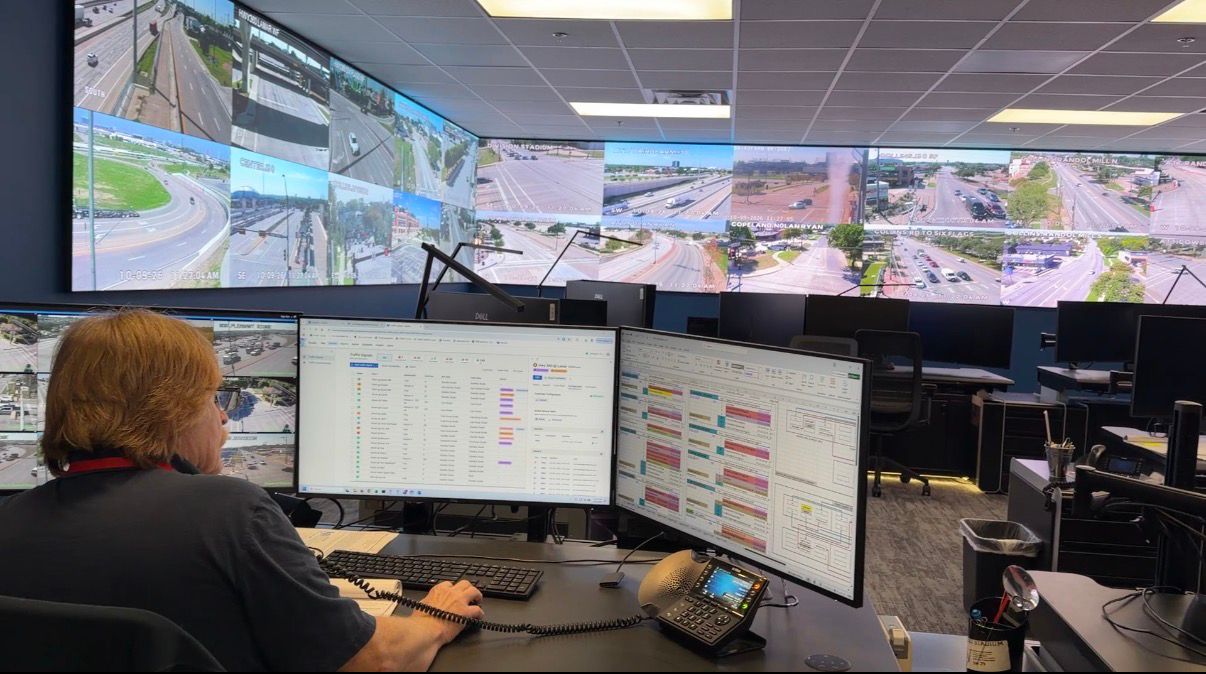
TEXAS — Ever sit at a red light and wonder if anyone knows you’re there? In Arlington, someone does. The city has opened a new Traffic Management Center, which uses new technology to keep drivers moving in a city that’s home to a major sports and entertainment district.
After 20 years, the City of Arlington retired its old Traffic Management Center and opened a new one built to ease congestion.
“We’ve laid a larger foundation for technology in Arlington. It allows us to be more proactive when responding to things on our roadways,” said Arlington City Traffic Engineer Chris Funches. “So, we’re not waiting for people to call us and tell us something is happening on our roadways. We’re able to see it and get alerts.”
The new center has more space, more cameras, updated technology and LED screens. It brings Arlington up to par with other Texas cities like Houston, San Antonio and Austin, which already use high-tech traffic management centers to keep drivers’ commutes smooth.
“With this one being larger it has 10 workstations, so we can invite outside agencies such as TxDOT, COG, law enforcement and other partners to be able to come in here and see what we’re seeing during events and during the day, to be able to help us, help them mitigate some of the concerns also,” said Funches.
Traffic signal system engineers like Manisha Shi watch nearly 200 cameras covering Arlington’s 380 signalized intersections. They can adjust signal timing and get first responders to a crash site faster.
“Right now, I’m looking at Cooper Street to see if there’s congestion or not. Based on the congestion, our team will adjust the timing so that there is less congestion,” Shi said.
That work ramps up during events at AT&T Stadium and Globe Life Field.
“We stay two to three hours after the event is finished, and we start four hours prior to the event,” Shi said. “When a situation does come up, we are here to fix it. We call APD. We call our guys in the field, and with their help we try to solve the problem.”
The system also flags problems at everyday intersections, such as a train stop or a light that never turns green.
“Our signal health feedback, it tells us if the signal is working correctly. Those are the green dots. Then it also lets us know if we’re having detection failures. That happens when people are sitting at the intersection and they’re wondering, ‘Why am I not getting a green light? Why am I sitting here so long?’ That lets us know we need to go out and check the detection,” said Funches.
So the next time you’re waiting at a light a little too long, know that someone may already be working to get you moving.