
The Houston Chronicle editorial board endorsed in 140 races and one proposition vote for the 2026 general election.
Evan Mintz
For Texans, today is the first day of early voting. For the Houston Chronicle editorial board, it is a day that marks the culmination of months of interviews, research and writing so that we could provide endorsements in 140 different races across Harris and Fort Bend counties — and also Houston’s vote on Proposition A.
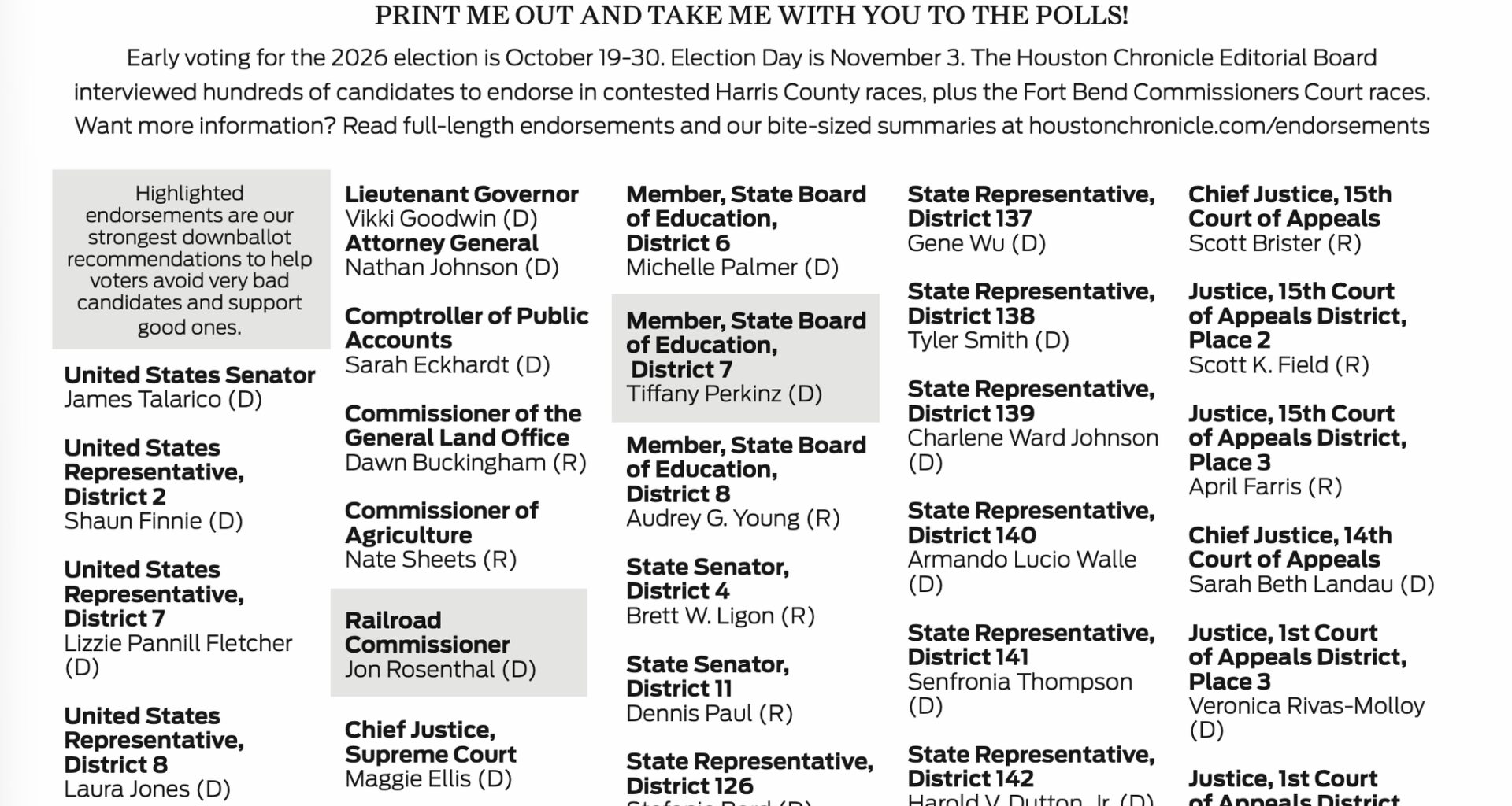
Even if you’re absolutely confident in who you’re voting for at the top of the ticket, let me encourage you to read through our endorsements for the down-ballot races — especially the judicial seats where the Ds and Rs next to candidates names are often more of a procedural requirement than reflection of policy difference. We even compiled our endorsements into a two-page printable PDF that you can take into the voting booth.
And if you’re a dedicated partisan unwilling to cast a crossover vote, at least read through our list of the worst candidates on the ballot and consider skipping some races.
Article continues below this ad
With early voting underway, I wanted to take a moment to answer some of the common questions we have received about this year’s endorsements.
Texas Democratic U.S. Senate hopeful James Talarico addresses supporters at his election night watch party in South Austin Wednesday, March 4, 2026.
Mikala Compton/Dallas Morning News
Question 1: Why did you endorse so many Democrats?
By my count, we endorsed 102 Democratic candidates and 35 Republicans — plus the three nonpartisan candidates running for the Harris Central Appraisal District board. That’s roughly a ratio of 3 to 1.
You may be tempted to point to that statistic as evidence of a partisan bias, but there are actually several explanations for that outcome unrelated to partisanship.
Article continues below this ad
The first explanation is that our greatest bias is for incumbency — especially in judicial elections. Back in 2018, when Republicans held most of those down-ballot seats, the editorial board endorsed 66 Republicans and 58 Democrats. But Democrats flipped the county in 2018 and largely held it in 2022, meaning Democrats simply had more incumbent candidates. If you want to see that dynamic benefiting Republicans, look at our endorsements in races where Republicans held incumbent status — say, Harris County’s newly created felony courts or the 15th Court of Appeals.
In total we endorsed 65 Democratic incumbents and 23 Republican incumbents.
The second explanation is that part of Gov. Greg Abbott’s electoral strategy involved recruiting Republican candidates to run in safe Democratic seats — juicing the number of endorsed Democratic incumbents on the list. For example, Democratic state Rep. Armando Walle has been in office since 2008 but this year was the first time he had a Republican challenger in the general election. Normally we’d skip that one because there wouldn’t be candidates from both major parties on the ballot, but this year we issued an endorsement.
The third explanation is that many Republican candidates didn’t meet with the editorial board for endorsement screenings. When candidates meet with us in person, they can make their best cases to us and rebut arguments from their opponents. It would have been much more difficult to endorse Republicans like, say, Land Commissioner Dawn Buckingham and Nate Sheets, who is running for agriculture commissioner, if they hadn’t talked to us and answered our questions about their platforms and plans for the future. On the other hand, we ended up endorsing the Democratic candidates in three open congressional seats largely because their Republican opponents didn’t show up to argue otherwise. Those seats have been gerrymandered for Republicans, but all we had to go on was campaign content that seemed tailored more for national MAGA audiences than local Houston concerns.
A final matter to keep in mind is that the Republican Party’s policies have shifted over time. This editorial board largely supported Republicans over Democrats back when they were the party of free trade, free markets and free people. We endorsed Mitt Romney for president in 2012, John Cornyn in 2014 and Greg Abbott in 2018. The party’s positions have changed under Trump — ours have not. The Republican Party of Texas is no longer the party of George Bush and James Baker. It isn’t even the party of John Cornyn. It’s the party of Ken Paxton and Bo French.
Article continues below this ad
Nate Sheets speaks to the crowd during an election watching party at Bottle Rockets Bar & Grille, in Plano, Texas, on Mar 3, 2026.
Jason Janik/Dallas Morning News
Question 2: Why did you endorse so many Republicans?
Plenty of local Democratic voters have critiqued our endorsements of Republican candidates by pointing to, say, their support for President Trump or their lawsuits challenging the 2022 Harris County elections, and saying those characteristics should be disqualifying. We take those sorts of issues into account, but they’re not dispositive. We can’t ask Republicans to not be Republican and we can’t ask Democrats to not be Democrats. Our priority is to support candidates from across the political spectrum who understand and care about the issues facing their constituents in Houston and effectively work to address them.
Harris County Judge candidate Orlando Sanchez talks with the Houston Chronicle Editorial Board in Houston, TX on September 4, 2026.
Sharon Steinmann/Houston Chronicle
Question 3: Why didn’t you endorse this candidate I like, who is obviously superior to their opponent?
You may end up disagreeing with some of our endorsements. With a few exceptions, our endorsements recognize that both candidates in any race have admirable qualities and it’s reasonable that voters can value those qualities differently. The star ratings help indicate places where we thought candidates were relatively close in quality. And you should always read through the full endorsements, which thoroughly explain how we reach our conclusions. If you still think we got something wrong, don’t hesitate to write a letter to the editor at viewspoints@houstonchronicle.com.
Article continues below this ad