
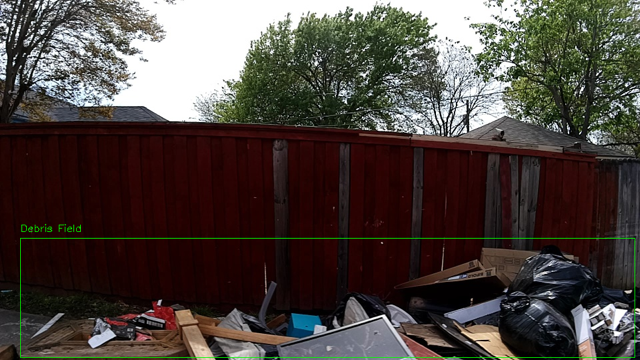
Images captured in 2024 during the pilot program, cameras were installed by City Detect, an Alabama-based company, on code compliance vehicles, which were driven around the city for a couple of days.
courtesy
After months of using AI cameras on bulky trash trucks to flag potential code violations, Dallas is revising its notices to residents and adding safeguards following concerns about privacy and how images lead to city action.

The changes are intended to make notices easier to understand, council members learned during a committee meeting Monday.
Related: Dallas approves $5 million for flood, erosion studies across city
Article continues below this ad
The city started using 50 AI-powered cameras mounted on bulky sanitation trucks in mid-April to scan for possible property and right-of-way concerns, including overgrown lawns, debris, unsafe structures, graffiti and sidewalk issues.
Since the program began, the system has captured millions of images, city officials said. Staff have reviewed 5,318 observations, sent 2,928 courtesy notices and conducted 473 field inspections. The department also reported 374 voluntary corrections and 101 formal enforcement actions.
The numbers reflect different parts of the program, not a step-by-step count of cases moving from camera detection to enforcement. The city is still improving how it tracks what happens after an image is flagged.
The code department plans to soften the language it uses in its courtesy notices, so the notice feels less like an enforcement warning. Officials described them as educational reminders about a potential property concern, not formal warnings or citations. The city says a courtesy notice does not open an enforcement case or set a formal deadline to fix the issue.
The notices will also have a QR code linking residents to the city’s Housing and Community Empowerment resource page and provide additional contacts for residents with questions. Council members also asked that notices be available in Spanish.
Article continues below this ad
Related: The Loop adds a new bridge and gathering spot near American Airlines Center
Residents and council members questioned who can access the camera data, how long images are retained, whether residents’ privacy is protected, how effective the technology is and whether it disproportionately focuses on low-income neighborhoods.
During the presentation, city staff explained how the system works and outlined plans to improve detection accuracy, connect it with city databases, develop performance measures and report on safeguards and outcomes.
How it works
The cameras take still photos as the trucks travel their regular sanitation routes. They don’t record continuous video. The images are sent to a cloud-based system in the U.S., where the company City Detect’s computer vision software scans for potential concerns. The system also assigns images an index to help city staff prioritize which ones to review first.
Article continues below this ad
A flagged image is not automatically treated as a violation. Licensed code officers compare the image with the software’s finding and decide whether the issue warrants a response. They can take no action, monitor the condition, send a courtesy notice, create a service request for an inspection or refer an eligible problem to a city crew for abatement.
If an inspector confirms a violation, the city’s usual enforcement process applies.
Council members also questioned whether the cameras were concentrating on southern Dallas or low-income neighborhoods.
Code Compliance Director Chris Christian said the cameras operate along existing sanitation routes throughout the city and are not intended to target communities based on income or demographics.
He pointed to maps comparing camera observations with code compliance service requests, saying the patterns “correlate almost exactly.”
Article continues below this ad
Privacy
The city says access to images is limited to authorized staff with an operational need. Faces and license plates are blurred, and images are retained for 12 months under city records-retention requirements.
A council member called for an audit of images to verify that privacy protections are working. Christian said staff alert the vendor when they find an image that should have been blurred.
Related: Dallas leaders want to rename Cesar Chavez Boulevard after abuse allegations
City Detect CEO Gavin Baum-Blake told the committee that the company had expanded its blurring technology to cover a person’s full image.
Article continues below this ad
The city plans to improve the system’s accuracy, how staff reviews flagged images and how the data connects with other city systems. It also plans to track how quickly concerns are addressed and report on the program’s safeguards and results.
The city gave no timeline for the steps, and the committee didn’t request another briefing.