
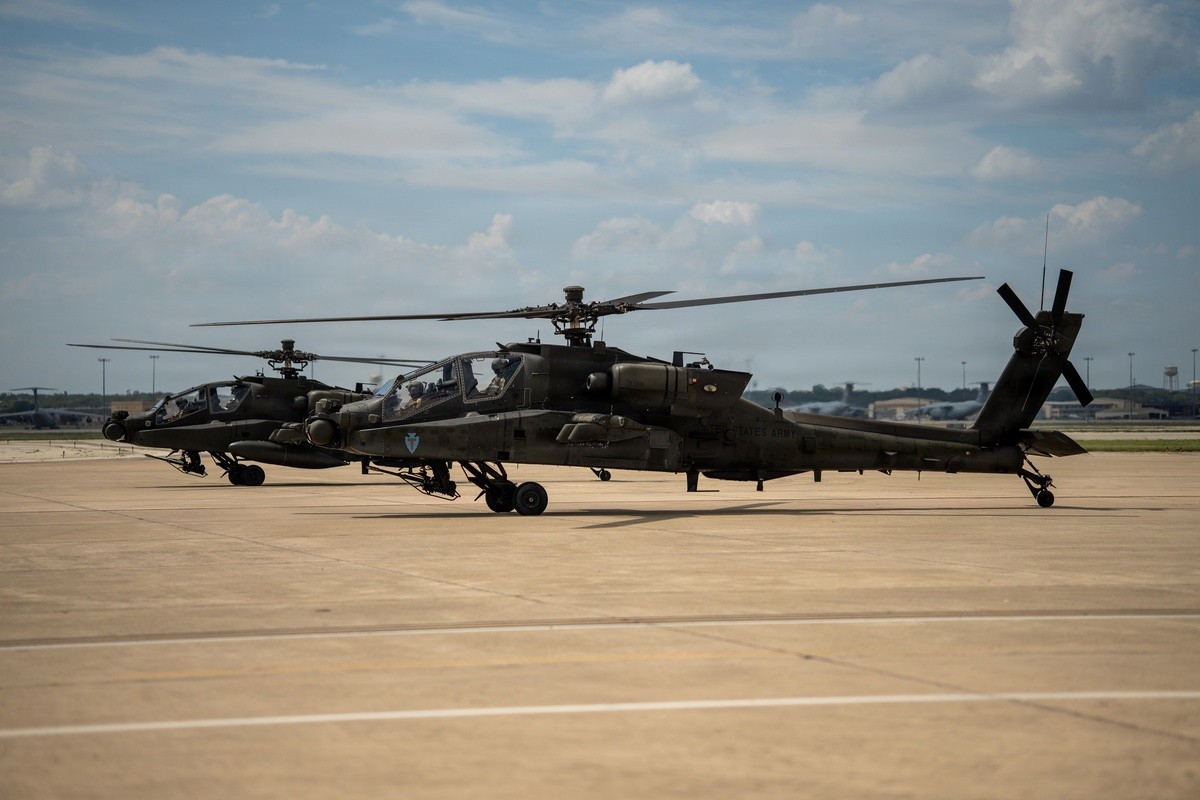

Two Texas Army National Guard AH-64E Apache helicopters idle on the flight line after landing at Kelly Field, Joint Base San Antonio-Lackland, Texas, Sept. 24, 2026.The 1st Battalion, 149th Aviation Regiment, an attack reconnaissance battalion assigned to the 36th Combat Aviation Brigade, 36th Infantry Division, began relocating to JBSA-Lackland as part of a U.S. Army reformatting plan. (U.S. Air Force photo by Jonathan R. Mallard)
(Photo Credit: Jonathan Mallard)
View original
CORPUS CHRISTI ARMY DEPOT, Texas — Corpus Christi Army Depot dispatched integrated teams of artisans specializing in the Apache E-model transmission to Fort Rucker and Fort Drum following the Army’s directive to temporarily suspend flight operations for AH-64E Apache helicopters equipped with Improved Drive System transmissions.
The grounding directive spanned all active-duty and National Guard attack aviation units operating E-model Apaches equipped with this specific component. This action followed an ongoing Army technical and airworthiness assessment of the Improved Drive System transmission. Accelerated inspections were provided across participating units to rapidly restore operational readiness and meet critical movement timelines.
“When the grounding directive was issued, our depot’s integrated team immediately pivoted to support the technical and airworthiness assessment,” said work leader Wesley Bocanegra. “Our top priority has been ensuring every E-model Apache meets the highest safety standards, with focused attention on units preparing for critical movements.”
The combined effort to return Fort Rucker’s training fleet to flight status and support priority missions at Fort Drum positioned CCAD as a critical link between operational units, Original Equipment Manufacturers, and the Army’s enterprise-level logistics network.
During the initial phase of inspections at Fort Drum, which began in mid-September. CCAD served as the sole operational element on-site while Boeing and Aviation Field Maintenance Directorate technicians finalized operations at Fort Rucker. The depot’s integrated team rapidly prepared seven transmissions for inspection, building strong operational momentum ahead of partner’s arrival.
“CCAD’s primary mission in the field is removals,” said depot Sgt. Maj. Jeremy Bucholtz. “We pulled the transmissions out of the aircraft and placed them into the proper configuration, so they are staged and ready for the technical teams to inspect. Once broken down, the OEM stepped in to conduct the actual safety-of-flight checks.”
The depot’s integrated teams prepared numerous transmissions for inspection of the schoolhouse fleet and initial-entry aviators. Eighteen of the transmissions were staged on the ground upon arrival, while another 15 were prepared and processed.
At Fort Drum, the depot team identified significant number of transmissions requiring removal from grounded aircraft. Depot teams executed the required removals, with AFMD assisting on three, reaching 100% removal completion by mid-October.
“CCAD proved to be an indispensable combat multiplier during operations at Fort Drum,” Bucholtz said. “Within 24 hours of boots hitting the ground, the team proved every day that this mission could not succeed without depot-level expertise.”
Inspecting and clearing the Fort Rucker fleet was intended to establish an operational surplus of IDS transmissions. After retaining sufficient assets to reserve flight training requirements, the remaining cleared fleet represented the equivalent of approximately four to five combat battalions, providing the Army with a reserve or serviceable equipment to address potential fleetwide mechanical issues.
CCAD’s rapid deployment and agile field footprint demonstrated the critical importance of mobile technical capacity. By strengthening reach-back support and standardizing multisite deployment protocols, the depot proved its ability to support simultaneous operations across distributed locations without sacrificing tempo or quality.
“Our wholehearted support to the AH-64E main transmission efforts has given our artisans the opportunity to demonstrate their skill, expertise and unwavering dedication,” said Dalexis Cavaness-Flowers, director of propulsion production. “Driven by excellence, the depot’s integrated teams delivered customer satisfaction that keeps the Army flying.”
Convergence and endurance set the conditions for enterprise readiness. As part of the Army’s organic industrial base, the depot remanufactures and resets equipment, generating readiness and operational capability.
“CCAD remains fully committed to enhancing warfighter lethality and ensuring our troops have the equipment they need to dominate on the battlefield, both in the homeland and abroad,” said Rod Benson, deputy and chief operations officer.
“The Army’s Organic Industrial Base is not confined to the walls of our depots,” said COL Kevin Consedine, Corpus Christi Army Depot commander. “Our ability to rapidly deploy skilled artisans and specialized maintenance capabilities to the point of need demonstrates how we bring the depot to the warfighter. This mission is a powerful example of how CCAD directly supports operational units, restores combat readiness, and ensures our Army remains ready to fight and win.”