
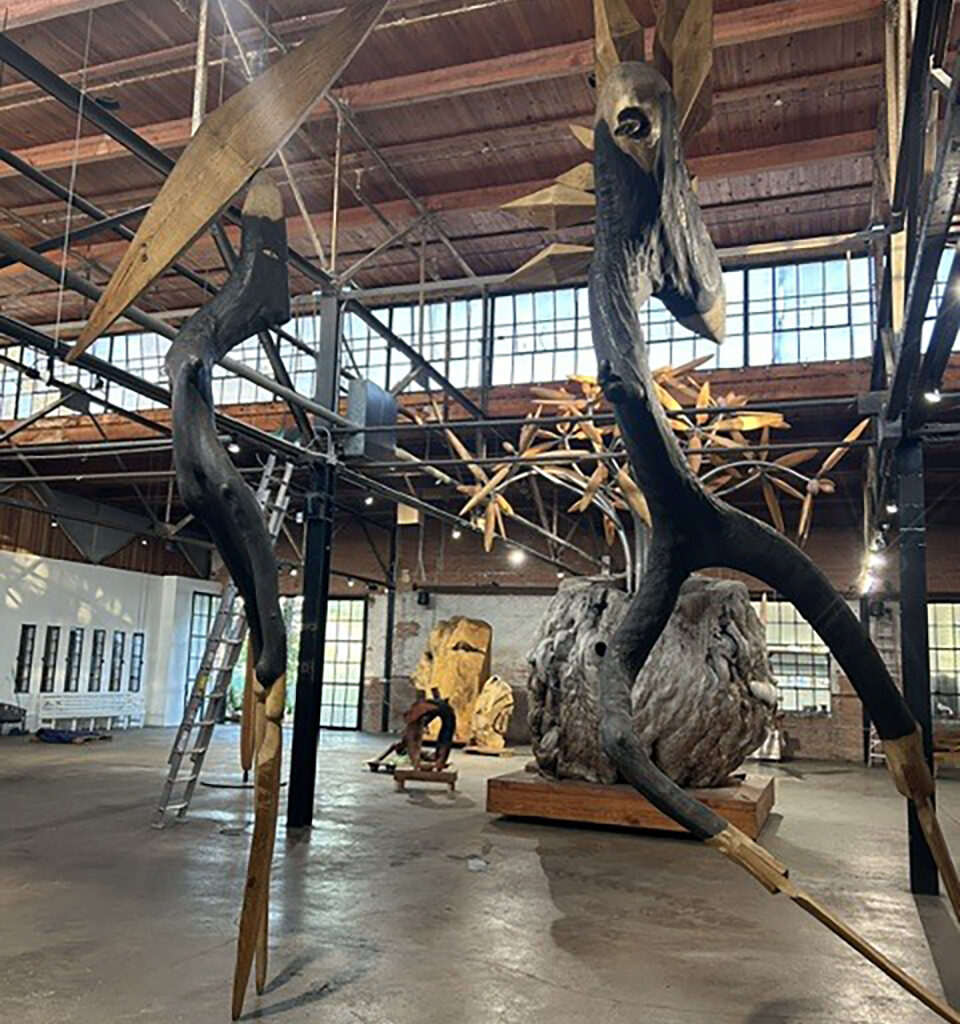
The remarkable sense of calm and awe that envelops a visitor to the new long-term James Surls installation at Passage Arts, a block away from Fair Park, comes from a combination of three elements: the grandeur of the artist’s materials and conceptions; the way the works are set against the walls and ceiling of this gorgeous century-old, restored warehouse as a background; and, perhaps surprisingly, the recorded soundtrack, which functions something like a film score in setting the ambient mood.
Surls’ wood and steel sculptures are majestic in scale (especially the 16,000-pound piece that gives the show its title), but size alone isn’t enough to account for their sense of presence. Rather, his sensitive use of wood is key. As an organic substance, wood creates a very different mood than other sculptural materials such as stone or metal do.
Then, too, Surls’ elemental, simplified sculptural vocabulary, composed of quasi-organic, quasi-abstract forms, creates a balance between timelessness and modernity. (His “flowers,” for example, suggest both flowers and mechanical propellers.) As well as the 25 massive sculptures, there are 18 graphite drawings, from the 1970s, 2010s and 2020s, that help clarify how the artist’s ideas develop.
Passage Arts is a nonprofit space created by the gallerist Kirk Hopper, meant to offer a more adaptable, less constrained form of programming than his former commercial gallery in the Design District, which closed last spring. For its inaugural Surls exhibition, Hopper enlisted the writer Susie Kalil, the doyenne of historians of contemporary Texas art, to co-curate the show with the artist. It is housed in a warehouse across the train tracks from Fair Park, a stone’s throw from where Surls’ career was launched 50 years ago, when Harry S. Parker III, then director of the Dallas Museum of Art, bought one of his works from a loft exhibition in the neighborhood.
The beautifully restored space complements Surls’ work well, with light streaming in from the 28-foot-high clerestory windows, and the unusually intact wood ceiling and upper walls harmonizing with the wood of the sculptures. Equally valuable is the ambient audio accompaniment, combining sounds from nature with music and Surls’ voice reading poetry. The total effect is something like being around a campfire, or in a cabin in the wilderness, experiencing the point at which human nature connects with the natural world.
“James Surls: From the Old Growth” continues through April 17 at Passage Arts, 845 S. Trunk Ave., Dallas. Free. Open Saturday and Sunday, 12-4 p.m. and by appointment. passagearts.org. 214-760-9230.