
AUSTIN, Texas — Austin ISD (AISD) trustees will vote on school boundary changes affecting Linder Elementary School, Marshall Middle School, and other campuses on Oct. 29.
The latest proposed changes focus primarily on Linder Elementary School and Marshall Middle School. AISD said it is looking to prevent future overcrowding at Linder, while Marshall does not currently have a defined attendance boundary.
“We are focusing, really, just on overcrowding needs now and establishing an attendance area for General Marshall Middle School, which didn’t exist,” said Raechel French, AISD’s Executive Director of Planning & Learning Environments, at the board’s Oct. 15 meeting.
“Marshall, what we’re talking about doing, that’s going to require major support that has to happen,” said AISD trustee Candace Hunter. Marshall is located within Trustee Hunter’s service area.
Who could be affected by the proposed boundary changes?
If boundary changes are passed when the Board of Trustees votes Oct. 29, certain households currently zoned to Dobie, Kealing, Lamar and Webb middle schools could be re-zoned to Marshall.
Based on current enrollment of the 5th, 6th, and 7th graders that would be next year’s 6th, 7th, and 8th graders, Austin ISD projects that boundaries realignment would reduce the number of students at Lamar (currently 114% capacity) and Kealing (94% capacity) while increasing the capacities at Dobie, Marshall, and Webb.
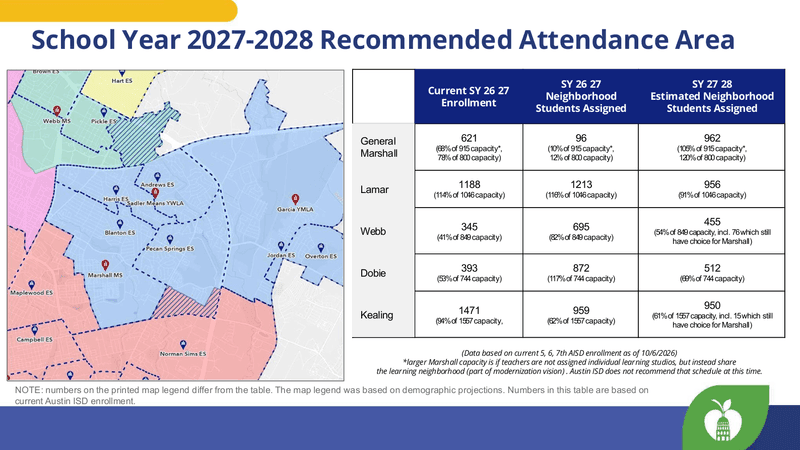
Austin ISD estimates the following numbers of student assignments if Phase I boundary changes are approved (Photo: Austin ISD)
Marshall has a capacity of 915 students, but the campus could see around 962 students assigned under the latest proposal.
“Since it is a modernized building, there is natural flexibility in the number of students which can fit at Marshall MS depending on how the space is utilized (e.g. open collaboration spaces, group rooms, and Professional Learning Centers allow us to schedule teachers and students in spaces differently if needed),” wrote a district spokesperson to CBS Austin. “Leveraging these spaces can fit up to 915 students. We do not anticipate this being a concern in the near future and estimate enrollment to be around 700 students considering current trends.”
ALSO | Teen on electric dirt bike hit by vehicle on way to school in Leander
AISD said the boundary changes are being made, in part, to strengthen feeder patterns and ” to ensure every student has a clear, supported path from kindergarten through graduation.”
David MeMatthews, an education professor at UT Austin, says this consistency is vital for positive student outcomes.
“One of the most important things the school district can do for children and for outcomes, besides having effective instruction, is making sure that a child’s educational experiences have consistency, and that they’re stable and predictable, and that there are no interruptions in learning,” said DeMatthews.
KEYE
AISD plans to redraw boundaries in phases
The district is planning to redraw school boundaries in phases. Boundaries redrawn now would take effect in the 2027-28 school year, with broader changes to be discussed for the 2028-29 school year.
DeMatthews says this phased approach has pros and cons for AISD.
“On one hand, the school doesn’t have a crystal ball. They can’t predict where everyone’s going to move. They can’t predict who’s going to enroll where with complete certainty,” he said.
If needed, the district could redraw the boundaries a second time based on how enrollment actualizes.
However, DeMatthews warns that redrawing boundaries more than once could create more uncertainty for families.
“We’re going to be here again, potentially next year, and then potentially the year after that…” he said. “I think with a lot of families at this point, there is policy and reform fatigue with Austin ISD. It almost feels like every day there’s something new or different that’s happening and that’s creating uncertainty.”
Other considerations in redrawing boundaries
DeMatthews said there are several factors external to student enrollment that districts should consider when redrawing school boundaries.
“You want to make sure that you don’t kind of split communities that have been a part of each other for a long time…those neighborhood boundaries really matter,” he said.
“You also want to try, as much as possible, to have kind natural proportions of students with disabilities, and so you don’t want to see the district become overly segregated where some schools have high proportions of students with disabilities, and some don’t,” he added. “And likewise, you want to try to promote as many schools as possible that are racially and economically diverse. There’s a lot of research that suggests that all students thrive when they’re in environments where they can kind of learn from their peers and experience different cultures and community backgrounds.”
The district’s latest recommendation plan outlines several boundary iterations and lists community concerns that have factored into some plans no longer being recommended. Some of these concerns include the splitting of neighborhoods and transportation access.
Austin ISD also wrote to CBS Austin that feedback on the latest proposal at Oct. 19’s Marshall Middle School information meeting was overall “positive,” although community members sought confirmation that sibling transfers would be prioritized.
“Sibling transfers are prioritized and will be granted unless the superintendent declares a campus is over capacity prior to the opening of Round 2 registration window,” wrote a district spokesperson.
AISD trustees will vote on the proposed changes on Oct. 29. If passed, the new boundaries would take effect starting next school year.