
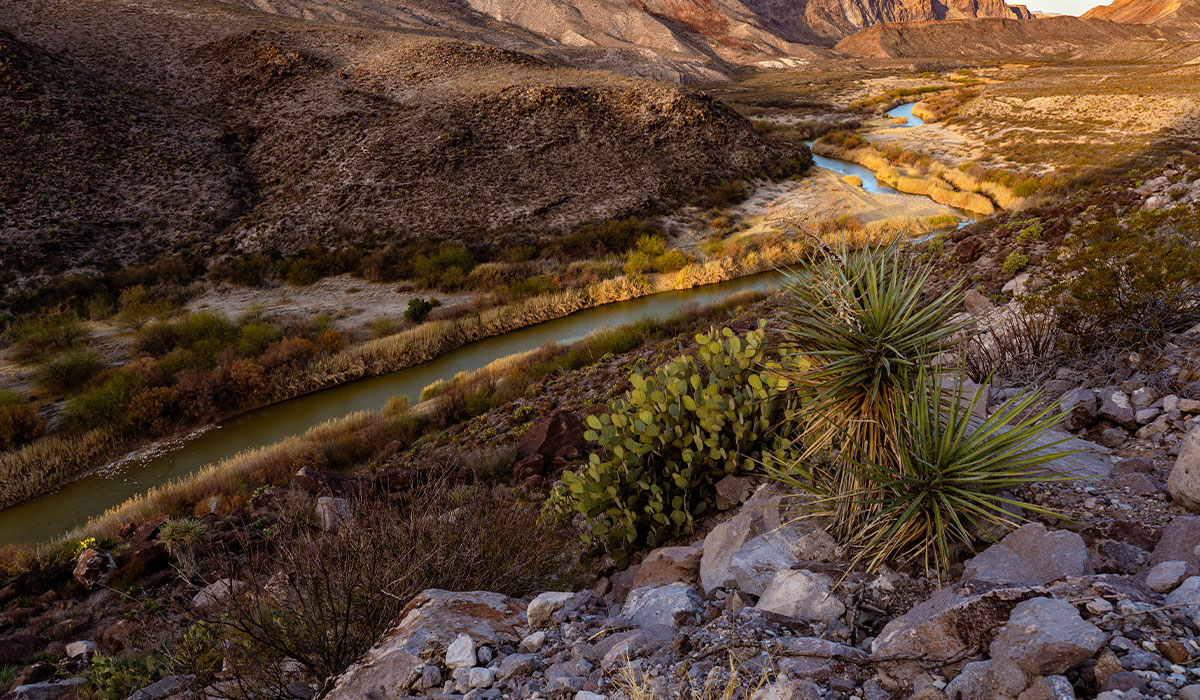
The world has entered an “era of global water bankruptcy,” according to the United Nations, and Texas and Mexico are on the front lines of what could be a catastrophe. For decades, the U.S. and Mexico have actively negotiated the amount of water that flows northward and sustains agriculture — and life itself — in the Rio Grande Valley and elsewhere in Texas. But water scarcity persists on both sides of the border, and Mexico can’t share what it doesn’t have.
To make matters worse, water quality in the region is also deteriorating. Many areas grapple with water that is too saline to use on farms, as well as rising levels of contaminants like arsenic, fluoride, nitrates, fecal bacteria and PFAS (or “forever chemicals”). Contaminants can enter waterways from a range of sources, from excessive pesticides and industrial byproducts to faulty sewage treatment and rock weathering.
The two issues are interconnected and equally pressing, according to Manish Kumar, distinguished professor at Tecnológico de Monterrey (Tec de Monterrey).
“The quality and quantity people have to come together. If there is no quantity, then quality has no meaning,” Kumar said. “At the same time, if you have quantity but no quality, you have a case of ‘water, water everywhere, and not a drop to drink.’”
Kumar describes water as “an interdisciplinary problem,” arising from industry, household use and agriculture. “We have to understand the social aspects and food habits because, at the end of the day, everything gets into the water,” he added.
Only cooperation from both nations can solve a problem that knows no borders. That’s why Kumar and his Tec de Monterrey colleague, Jurgen Mahlknecht, collaborate with UT San Antonio scientists Guadalupe Carmona and Saugata Datta to address the issue. The team is tackling the problem from a number of angles, including using AI and machine learning to measure water levels in transboundary aquifers, which millions of people on both sides of the border rely on.
Mapping hidden threats in groundwater
Pollution in surface water is often visible. A riverbank littered with dead fish or iridescent splashes of oil can spark debate and put pressure on policymakers. Groundwater contamination, on the other hand, is often invisible. It can remain hidden until the damage is already widespread.
Datta and his colleagues are working to close this “lag period” between contamination and detection. The Tec scientists on the team recently led a painstaking review of a decade of groundwater quality data across Mexico (2012–2022) to better predict and restrict future water pollution.
“We want to learn predictive modeling and forecast when water quality will cross safe limits,” Datta said. “By understanding how water has changed in the past and why, we can give forecasts for what can happen in two, five or 10 years.”
A recent publication by alumna Pousali Pathak, co-authored by Datta and Carmona, highlighted these concerns, specifically regarding “colonias” along the border that rely on transboundary groundwater. The study found that certain areas, such as Maverick County, face unusually high salinity due to human activities. The team called for more vigorous monitoring and intervention.
A long-term goal of the project is to map the interconnectedness of transboundary aquifers such as the Edwards, Trinity and Carrizo-Wilcox, using geophysical and geochemical analysis to demonstrate more precisely how actions upstream affect water quality and quantity downstream. The team shares their findings with governance organizations like the Secretaría de Medio Ambiente y Recursos Naturales (SEMARNAT) to help them make informed policy decisions.
“Sometimes they have no idea where some of these problems actually originate from,” Datta explained. “Our mapping helps to answer those questions.”
AI-powered precision for sustainable farming
One cornerstone of the collaboration is a project aimed at reducing the environmental footprint of agriculture by optimizing pesticide use. Pesticide overuse can lead to soil degradation and severe water pollution. To combat this, the team is developing a bilingual app that uses AI and machine learning to provide real-time, site-specific recommendations to farmers.
By analyzing variables like soil type, recent rainfall and crop status, the app will help farmers determine the precise amount and type of pesticide needed.
“Farmers may not know exactly how much pesticide to use,” Kumar explained. “AI can help us because conditions are always variable. This can help human health and also boost ‘one health’ by protecting pollinators.”
A partnership without borders
The team’s research serves as an educational platform. Students from both institutions are actively involved in sample collection, testing and data validation. The team is in the process of seeking external funding, which would support more student involvement and accelerate the research.
The team ultimately plans to recommend policy changes to ensure a more sustainable future for Texas and Mexico alike. For example, the 1944 water treaty, written in an era of more rain and fewer humans, may be due for reevaluation.
“The hydrological climate changes that we’ve been through in the past 20 years have not aligned well with what the policy indicates,” Carmona noted.
The overarching goal is to “support decision-making by identifying priority zones for protection, monitoring and intervention,” Mahlknecht said.
One priority zone Mahlknecht is studying is the Costa de Hermosillo aquifer in Sonora, Mexico, an aquifer plagued by over-extraction and, simultaneously, rising salinity. Mahlknecht hopes to develop the capability to detect salt buildup in groundwater before it becomes undrinkable. If successful, the technique could be applied across the region.
“We want to generate science that is actionable, collaborative and relevant on both sides of the border,” Mahlknecht added.