
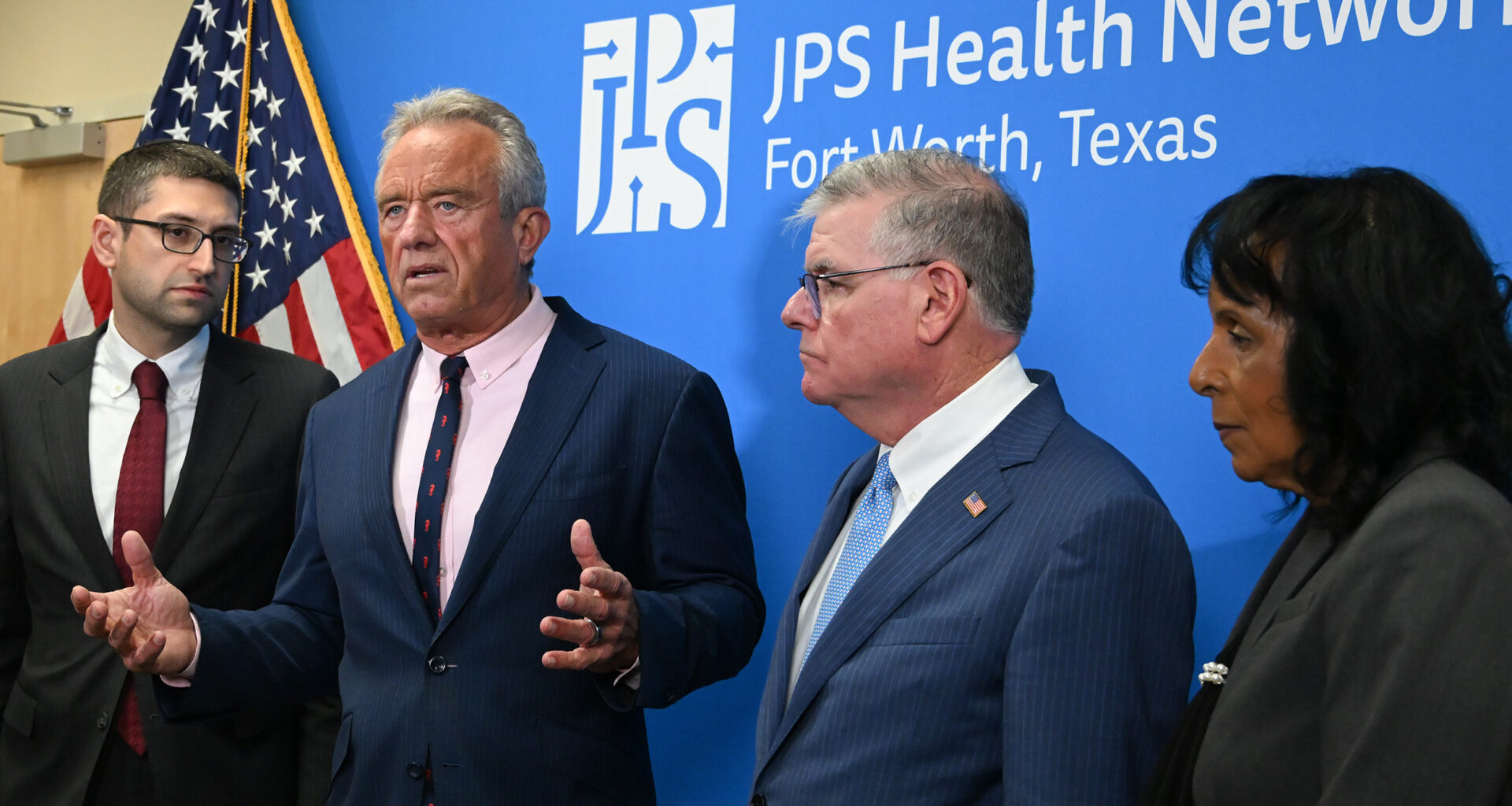
United States Health and Human Services Secretary Robert F. Kennedy Jr. visited John Peter Smith Hospital Tuesday and announced a national plan for kidney health.
The three priorities of the Kidney Care National Plan are to prevent kidney failure, improve dialysis care and patient options, and reform the transplant system.
Goals include earlier disease detection and intervention, expanded home-based options, greater access to kidney transplants, and stronger safety, transparency and accountability measures for the transplant system.
Up to 90% of American adults with kidney disease are not aware they have it, according to the U.S. Centers for Disease Control and Prevention.
The rate of kidney disease mortality in Tarrant County is 15.4 residents per 100,000 people, higher than Texas’ rate of 15.2 and the national rate of 13.1, according to data from Tarrant County Public Health. Non-Hispanic Black residents have the highest mortality rate at 24 deaths per 100,000 people.
A roundtable discussion among Kennedy, other government officials and JPS Health Network leadership was closed to the media. Afterward, the secretary and JPS President and CEO Dr. Karen Duncan took questions.
As Tarrant County’s safety net hospital, JPS’s role in addressing kidney disease includes caring for more than 40% of the county’s uninsured residents, Duncan said.
“The role of JPS is to be available to begin to provide the much needed access and treatment that we talked about here today, and to begin really more on a preventative journey with a number of community sites that we have here,” she said.
Nationally, Kennedy has made chronic disease prevention a key part of his Make America Healthy Again agenda. But his HHS and President Donald Trump’s administration have also drawn criticism for funding cuts, including to grants that support research on chronic health conditions.
At Tuesday’s press conference, Kennedy said the National Institutes of Health’s research budget matches that of 2024, and that “we’re doing more in terms of studying the etiology of chronic disease than has ever been done before.”
“When I came in, it was very difficult,” he said. “In fact, I could say that we weren’t able to find any studies out there looking at the etiology of the most common chronic diseases, and now those are all spread out across the department.”
Although the $47.5 billion NIH budget enacted by Congress for 2026 was on par with the $47.3 billion 2024 budget, the administration had proposed cutting 2.8 billion from the NIH’s institutes that study kidney disease, diabetes, heart disease, arthritis and liver disease — a roughly 40% decline — according to reporting by NPR. Congress ultimately rejected the proposed cuts in approving a budget in line with previous years.
The focus of NIH research has also shifted. Between fiscal years 2024 and 2025, funding for kidney disease and diabetes research were each up 6%. Chronic liver disease and cirrhosis received 3% more funding. But funding for heart disease research is down 7%, and funding for studying social determinants of health — nonmedical factors such as economic status, access to education and nutrition that impact health, including risk of chronic disease — is down 10%.
Grants focusing on how race and ethnicity interact with health have been targeted for cuts under the Trump administration, according to KFF.
Secretary Kennedy was also in Fort Worth Monday evening and attended Texas Attorney General Ken Paxton’s rally as the U.S. Senate candidate pushes through the final stretch of his race against State Rep. James Talarico.
Kennedy stopped short of directly endorsing Paxton, saying he was instructed not to, but did not leave his opinion to the imagination.
“I think that all of you understand what, if I could, what I’d be saying right now,” he told the crowd.
The room erupted in cheers.
McKinnon Rice is the health reporter for the Fort Worth Report. Her position is supported by a grant from Texas Health Resources. Contact her at mckinnon.rice@fortworthreport.org.
At the Fort Worth Report, news decisions are made independently of our board members and financial supporters. Read more about our editorial independence policy here.
This <a target=”_blank” href=”https://fortworthreport.org/2026/10/21/health-secretary-rfk-jr-visited-jps-fort-worth-heres-what-he-said/”>article</a> first appeared on <a target=”_blank” href=”https://fortworthreport.org”>Fort Worth Report</a> and is republished here under a <a target=”_blank” href=”https://creativecommons.org/licenses/by-nd/4.0/”>Creative Commons Attribution-NoDerivatives 4.0 International License</a>.<img src=”https://i0.wp.com/fortworthreport.org/wp-content/uploads/2021/04/cropped-favicon.png?resize=150%2C150&ssl=1″ style=”width:1em;height:1em;margin-left:10px;”>
<img id=”republication-tracker-tool-source” src=”https://fortworthreport.org/?republication-pixel=true&post=841791&ga4=2820184429″ style=”width:1px;height:1px;”><script> PARSELY = { autotrack: false, onload: function() { PARSELY.beacon.trackPageView({ url: “https://fortworthreport.org/2026/10/21/health-secretary-rfk-jr-visited-jps-fort-worth-heres-what-he-said/”, urlref: window.location.href }); } } </script> <script id=”parsely-cfg” src=”//cdn.parsely.com/keys/fortworthreport.org/p.js”></script>