
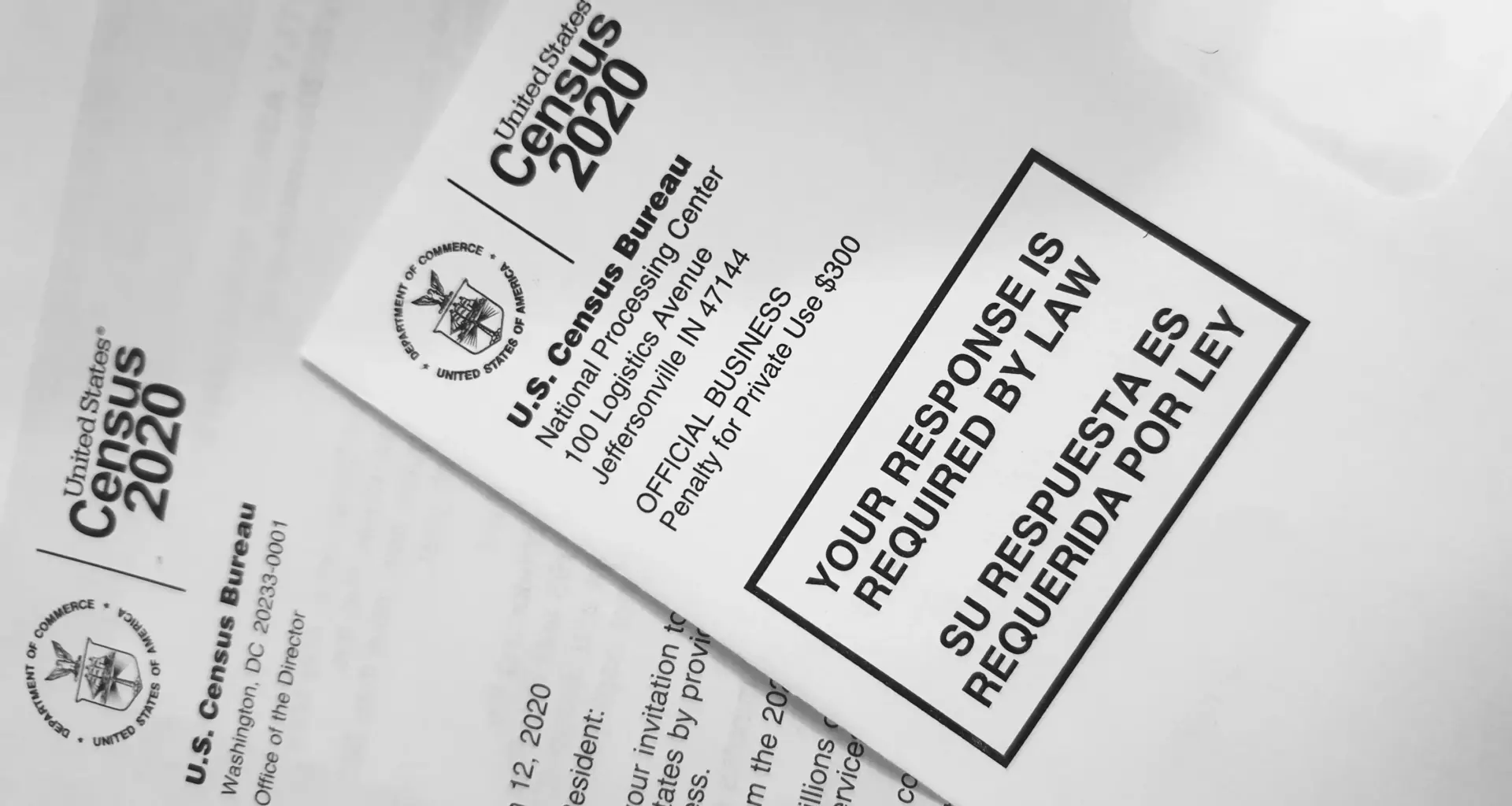
President Donald Trump’s administration is proposing wide-reaching reforms to how the U.S. Census Bureau collects data. While it may appear to be just a dataset on the surface, in reality, it’s a formula that directly impacts elections, healthcare and education in Texas.
On Sept. 9, the Census Bureau announced plans for sweeping changes ahead of the 2030 decennial count. The proposed overhaul would remove race and ethnicity reporting for the first time in the nation’s history, while also barring undocumented citizens, asylum seekers and H-1B visa workers from the count. Permanent residents with green cards would remain in the census.
This also isn’t the first time Trump has targeted the count. Shortly after his second election, the president announced in a 2025 Truth Social post that he would order a “new and highly accurate CENSUS” in which “People who are in our Country illegally WILL NOT BE COUNTED.” But, unlike his unprecedented mid-decade redistricting push, it never came to fruition.
Trump also proposed including a citizenship question during his first term, the addition of which was ultimately blocked by a 5-4 Supreme Court decision in 2019. Under the 14th Amendment of the U.S. Constitution, the final record must count “the whole number of persons in each State,” not just those with citizenship or permanent residency.
Sign up for the This Week’s Top Stories newsletter to get the latest stories delivered to your inbox
THANK YOU!
You’re all set.
CLOSE
“The Constitution is very clear about it,” Ray Serrano, director of research and policy for the League of United Latin American Citizens, told the Observer. “It says that it’s a count that representatives shall be apportioned among the states according to their respective numbers, counting the whole number of persons. Persons in each state. Yeah, I think I suppose we could try to manipulate the Constitution, maybe change it, the 14th Amendment, change the language of Section Two, and make it that we only go and count citizens. But we haven’t done that.”
In a defense published in the Federal Register, the administration argued that its proposal to exclude racial questions and remove many noncitizens from the count seeks to rework the Census to better reflect the amendment’s true intentions.
“The Census Bureau is considering these two additions to better prioritize and fulfill its Constitutional mandate to count for apportionment the ‘whole number of persons in each State’ based on the concept of ‘usual residence’—a process that factors in an element of allegiance but otherwise should be colorblind and should not be distorted in any way by questions about immaterial personal characteristics, such as race,” the article reads.
The fundamental reassessment of how data is collected is likely to face legal battles similar to those seen in 2019. It would also feasibly have to clear scrutiny from a shaken-up U.S. Congress, while additionally surviving a new administration after it takes office in 2029, a year before the census is conducted in 2030. And with early voting for the Midterms starting in Texas, the issue has received minimal local media attention in Dallas-Fort Worth. But if it ultimately succeeds, the unmistakably reshaped count will set the framework for Federal funding, Congressional apportionment, redistricting and research across the region.
“Several members told me months ago: ‘Don’t keep your don’t take your eyes off the census,”That’s more important than these midterms,” Serrano said. “I really do think that they do have a point on that because the census is such an important thing.”
Why it matters for Texas
Under the Constitution, each state elects two senators. The U.S. House of Representatives is a different story altogether. States receive seats based on their population, which — you guessed it — is calculated using census data.
Texas’ population has exploded in the 21st century and appears set to keep growing for some time. The state grew by roughly 4 million people between the 2010 and 2020 counts and gained two congressional seats after the most recent tally. The state is projected to grow by another 11.4% between 2020 and 2030, behind only Utah and Idaho, a jump that would bring its total population to an estimated 32,463,602 people, according to prior reporting by Newsweek.
Preliminary estimates by the Brennan Center for Justice project Texas will gain four seats after the 2030 census, though those totals assume current standards remain in place. Interestingly enough, a New York Times analysis found that two fast-growing Republican strongholds with diverse populations, Texas and Florida, would lose seats if Trump’s goal is achieved. Instead of gaining four seats, the Times found that the state’s congressional delegation would shrink by one member.
“It’s a bit bizarre, I think,” Serrano said. “I’m thinking that it’s going to be hard to decipher who is a non-citizen, who’s a citizen. But I mean, to be honest, I think that I don’t think it matters in terms of whether you are asking, because again, if you’re asking for the question of enumeration and apportionment, and you want persons, you want whole bodies, so there’s really no need to try to ask somebody for this, whether they’re a citizen or not.”
Serrano added that previous census surveys may have included too many questions on trivial topics, leading to respondent fatigue and impacting response rates. However, he said the data points the administration is targeting are “basic questions,” adding that “it’s impossible to not include that in a very basic document.”
Meeta Anand, senior director of Census and Data Equity at The Leadership Conference on Civil and Human Rights, told the Observer that excluding immigrant communities results in an undercount that can fail to determine a community’s needs and, of course, representation.
Texas was already found to have the second-largest undercount (550,000 people) of any U.S. State in 2020, according to the bureau’s post-enumeration survey, but she said the effects would be felt nationwide. Anand added that, as other researchers have said, the rules also don’t seem to have been thought out well enough to accurately account for a person’s “usual residence.”
“I don’t know if people recognize that diversity in the United States is now everywhere,” Anand said. “We find immigrant communities nestled in every community in the United States, and between the exclusion of one citizen plus some wonky details around how they’re going to determine where someone lives, it is not necessarily possible to ascertain who is going to suffer the most from this because it’s just it’s it’s quite frankly a spaghetti full of rules and suggestions”
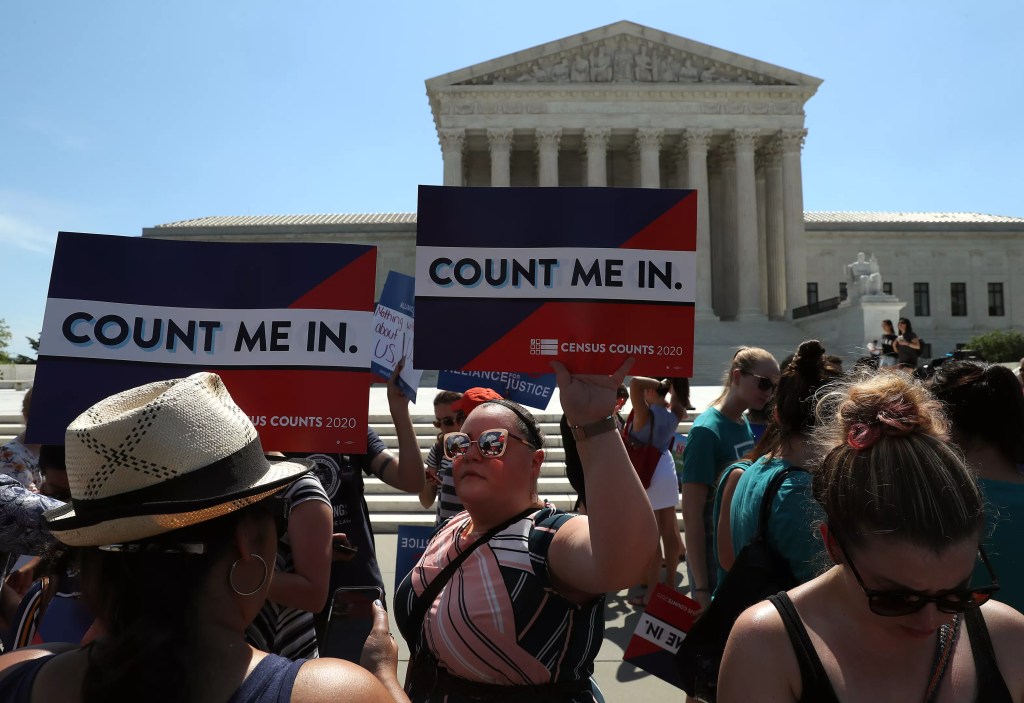 Activists gathered at the U.S. Supreme Court last year ahead of an anticipated decision on using a citizenship question on the 2020 census.
Mark Wilson / Getty Images
Along with deciding congressional apportionment, the data determines how many delegates a state appoints to the Electoral College, directly affecting how much of a say Texas has in presidential elections. The census, especially questions on race and ethnicity, also serves as the basis for fundamental guardrails on redistricting, Anand said, which is typically done in line with the release of new data every decade. Minority voters are, in theory, protected from racial gerrymandering under the Voting Rights Act of 1965, with data serving as the basis for determining district boundaries at the local, state and federal levels.
Texas recently saw a rare mid-decade redistricting push ahead of what is expected to be a difficult midterm season for the incumbent Republican Party. The move was met with fierce opposition from Democrats and community leaders, who argued that the new maps had disproportionately targeted nonwhite voting districts. Supreme Court Justices ultimately upheld the new map in a decision made along partisan lines.
When asked if removing race and ethnicity questions could make diluting communities’ votes even easier, Anand responded, “Yes, I think that’s a distinct possibility.” She added that proposed alternatives to reporting demographic information, such as existing tax records and American Community Survey data, which itself is based on small samples of the population, will become less statistically accurate without census reports to anchor their conclusions.
“Ensuring that we have a data set that is inclusive of the whole population is something that we should all care about and fight for in order to retain our democracy,” she said.
Why it matters for Dallas County
Even beyond electoral representation, Anand said the data has decades-long, day-to-day implications for communities. The impacts linger for a decade or more, she added, and won’t be clear at first.
The census is used to allocate over $2.2 trillion in federal funding to states in direct grant awards, healthcare reimbursements, education subsidies and infrastructure projects tied to population. Regardless of partisan positions on immigrant communities, they remain in communities and still use many of those services. Without them included in the census, long-term planning is muddied and funding is seriously jeopardized, Anand said.
“If you’re looking at a community that is undercounting children, which is not an unusual thing, young children tend to be highly undercounted. When someone is planning for schools, let’s say you’re planning for a school for 100 students because that’s what you counted,” Anand said. “But in reality, your community has 125 students. That means you’ll have overcrowded classrooms… You can picture this analogy carrying through to hospitals, or wastewater systems, or emergency preparedness and disaster planning.”
“If you’re planning an evacuation route, you actually need to know the number of people you need to evacuate.”
In 2018, the Center for Public Policy Priorities in Austin estimated that, for every one percent of the population undercounted, Texas would lose $291 million in federal funding, directly impacting programs like Medicare, Medicaid, Head Start preschool and the Children’s Health Insurance Program, the Observer reported at the time.
Dallas County is set to receive over $139 million in direct federal grant money in its upcoming Fiscal Year 2027 budget, according to county documents. The grants fund initiatives ranging from affordable housing and roads to public safety. And that’s just the county government; municipalities, state-coordinated programs and other entities across the greater Dallas area receive billions of additional federal dollars annually. Each economically disadvantaged child uncounted translates to a per-capita loss of $1,160 in federal funds, according to the Texas Comptroller of Public Accounts, using 2020 data.
County Judge Clay Lewis Jenkins, a Democrat, said removing noncitizens from the county could be “very damaging” to the Dallas area.
“You’ve got to have growth because no matter your police department or any other service that you have, I guarantee you, it’ll cost more to run it five years from now than it costs right now,” Jenkins said. “So when you lock in a false count on your census, the effect of that is you’re going to get shortchanged for 10 years.”
The four-term county judge said he is worried about the impact on North Texas infrastructure, in addition to healthcare. In 2025, the director of the county health department told the commissioners court that about $275 million of its $350 million budget came from federal funding. He also said that eliminating racial and ethnicity questions could hurt the department’s ability to assess the impact of sickle cell anemia and diabetes, both of which disproportionately affect Black and Latino residents, respectively, along with jeopardizing grants to target those issues.
Up for reelection this November, Jenkins said the concerns are bipartisan and will matter to all North Texas voters, especially those worried about tax burdens.
“It is really about funding for roads, public safety, public health, air quality; all the things that we get federal funding for,” he said. “So it’s really important. Doesn’t matter what your politics are, you don’t want to have to be paying local taxes to supplement the amount of federal money you didn’t get.”