
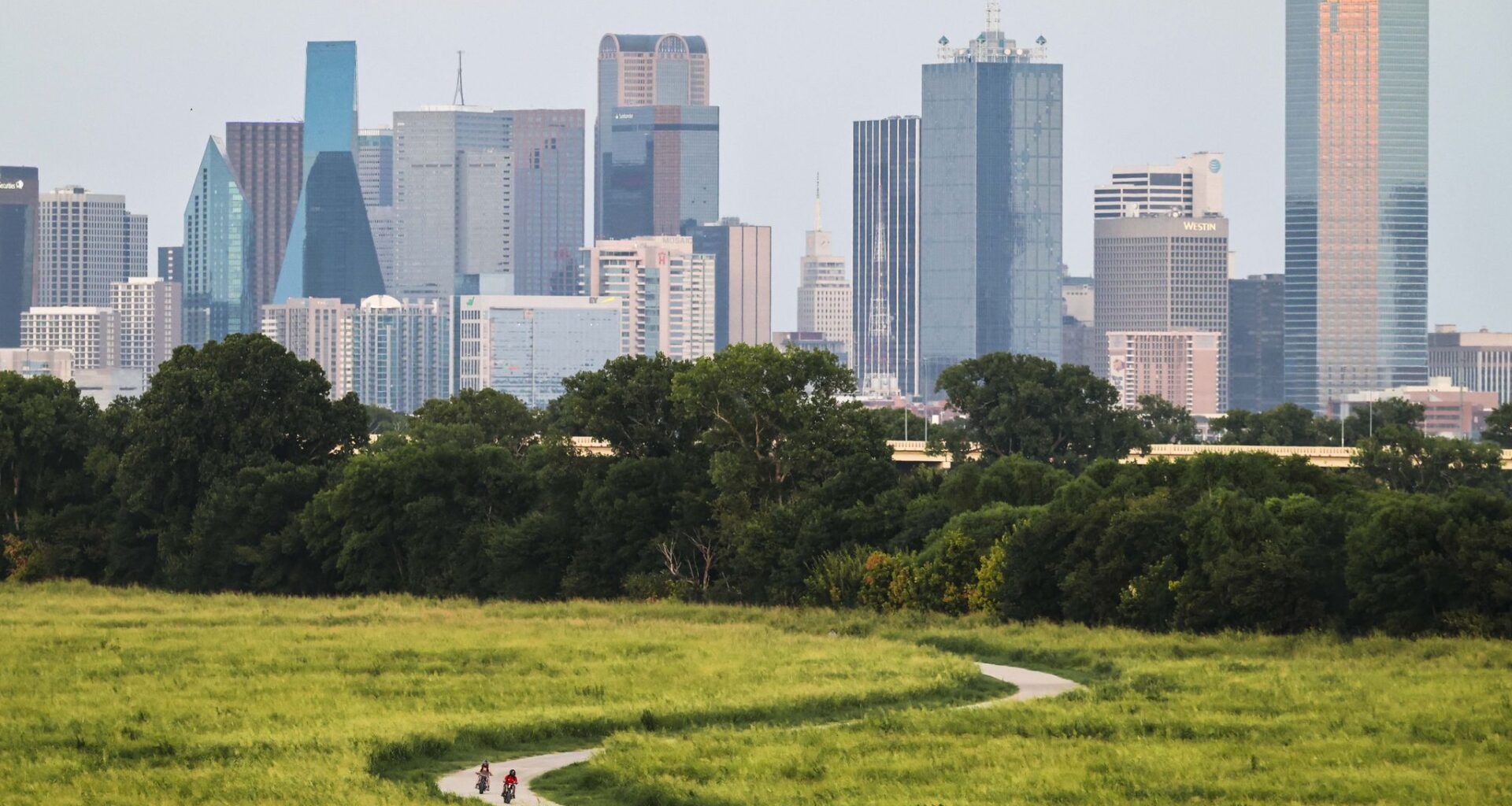
Bicyclists pass along the Trinity Skyline Trail during a warm summer day in Dallas.
Shafkat Anowar/The Dallas Morning News
About three in four North Texans are “somewhat or very satisfied” with where they live, according to new findings from the University of Texas at Dallas.

This was just one of the takeaways from the university’s third annual survey conducted as part of the North Texas Quality of Life Initiative, a project of the School of Economic, Political and Policy Sciences.
The overarching question is: “What does it take to make North Texas a place to call home?” Timothy Bray, director of Institute for Urban Policy Research at UTD, told a small audience Tuesday at an event announcing the latest survey results.
Article continues below this ad
“What is the thing that makes us happy to be where we are, invested enough to change it when things aren’t going well, and wed to it enough that we call it home?” Bray, project co-director, said. “One of the questions we ask in the survey: How often do you use the word ‘we’ when you talk about your neighborhood? That’s what we’re trying to do. If we want to build place we have to create connection between people.”
Each year, the William C. Short Quality of Life Survey asks residents about their lives, communities and the public services and institutions that influence their well-being. Then, a team compiles the results into online dashboards that are publicly available.
“These responses provide information that economic growth measures alone cannot supply, including whether residents feel secure, believe opportunity is accessible, and see a future for themselves and their families in North Texas,” researchers wrote in the report. It also provides community leaders and partners a source of evidence for setting priorities and examining public needs.
The surveys examine the quality of life across five districts: Collin, Denton, and Tarrant counties and northern and southern Dallas County.
Article continues below this ad
This year’s analysis included 1,933 complete responses.
The survey’s theme was “One North Texas, but very different lived experiences,” and it included questions related to economic pressure and food insecurity, perceptions of the American Dream, and how residents view the opportunities and challenges presented by artificial intelligence.
Some key takeaways include:
When asked their feelings on AI, 57% of people said they are “uneasy or afraid,” 32% said they are “hopeful or enthusiastic” and 11% said they no feeling.
Almost half of the respondents (46%) said the American Dream can happen for most people. The results were split evenly between 50% of respondents agreeing that their own opportunities exceed those of their parents and 50% agreeing current and future generations will have worse opportunities than their own generation.
Of people who rent their homes, 62% said they spend at least 30% of their monthly income on rent.
More than half of respondents (53%) reported “sometimes or often” running out of purchased food without money for more.
Article continues below this ad
Looking ahead to next year, initiative leaders said the 2027 survey will launch in May with the findings setting the foundation for a first-ever State of North Texas Forum in September.
The team has other goals for growing the initiative in the future, including making its dashboards more accessible, more focused surveys and deeper regional integration of the information collected.
“By bridging technology and real-world policy, we aim to move research from a one-way pipeline into a continuous loop of learning within our region, and it positions UT Dallas as a neutral convener at the table where North Texas makes its decisions, hopefully with good data,” said Jennifer Holmes, dean of the School of Economic, Political and Policy Sciences.
Article continues below this ad
This reporting is part of the Future of North Texas, a community-funded journalism initiative supported by the Commit Partnership, Communities Foundation of Texas, The Dallas Foundation, the Dallas Mavericks, the Dallas Regional Chamber, Deedie Rose, Lisa and Charles Siegel, the McCune-Losinger Family Fund, The Meadows Foundation, the Perot Foundation, the United Way of Metropolitan Dallas and the University of Texas at Dallas. The News retains full editorial control of this coverage.