

For international students at TCU, coming to college can mean more than adjusting to a new academic environment. Students arriving from different countries are also navigating a new culture, transportation, food and social life while remaining thousands of miles from home.
In fall 2025, 81 of TCU’s 2,754 first-time college students were international students, representing about 3% of the incoming class, according to TCU Institutional Research. That was down from fall 2024, when 98 international students made up about 4% of the incoming class.
The experience of studying in the United States also comes with immigration requirements that can shape how international students experience college. International students typically must maintain their student-visa status throughout their studies, and changes in U.S. immigration policy and visa processing can affect students’ ability to travel, return to the United States and plan for life after graduation.
For some students, those restrictions can make going home during college more difficult.
For Alessandra Perez, a sophomore fashion merchandising major from Panama, coming to TCU meant preparing to spend much of the next four years far from home. Before coming to Fort Worth, Perez wasn’t sure what to expect from the people and the community at TCU.
“What surprised me the most was the way people from the United States are very nice, and they really try to make you feel welcomed at TCU,” Perez said. “I didn’t think it was going to be like that.”
Still, she said being welcomed into a new community has not eliminated the difficulty of being far from family.
“The biggest challenge of living in a new country is not having my family nearby and having to travel six hours or more to see them,” Perez said.
For Mia Fondevila, a junior fashion merchandising and communication studies double major from Panama, adjusting to TCU meant getting used to being surrounded by people she did not already know.
“In Panama, it’s a very small country, so everybody knows each other,” Fondevila said. “I’m very used to knowing my whole school and many people outside of my school, so coming to TCU and not being able to have friends in all my classes was very different for me.”
 Nicole Diaz (left) and Mia Fondevila (right) at a game day tailgate for Nicole’s birthday. (Courtesy of Mia Fondevila)
Since arriving at TCU, Fondevila has built friendships with students from both the United States and countries including Panama, Ecuador, Honduras and Bolivia.
“Having made friends with so many different backgrounds has been an amazing experience,” Fondevila said. “I feel like now I have a much better understanding of how small the world is, and I love that I have so many friends from different parts of the world.”
The distance from home can make ordinary parts of college feel different. Some students have to plan around visa requirements, international travel and the cost of flying home, while also adjusting to life in Fort Worth.
For Monique Chalmers, a junior strategic communication major from Panama, one of those adjustments has been getting around Fort Worth without her own car. At home, Chalmers was used to having a car, but bringing it with her to Fort Worth was not possible because of the distance. Over time, she has found other ways to get around, including using the bikes available around campus.
“The biggest aspect for me in the change of being in another country would be not having my own car, which is something that I have back home,” Chalmers said. “I love riding the bikes that are around campus, which is another way to transport myself.”
International students could also encounter different expectations surrounding class participation, relationships with professors, group projects and assignments.
Adrian Toledo, a senior finance major from Guatemala, said he noticed that classes in the U.S. were more discussion-based and encouraged students to participate more actively.
At first, speaking up in class and adjusting to the more interactive classroom environment was difficult. As the semester continued, Toledo became more comfortable participating in discussions and learned to adjust to the expectations of his classes.
“I feel like here, professors really want you to participate and share your opinion, whereas back home, it was more about listening to the professor and taking notes,” said Toledo.
For students who cannot easily return home, building a community at TCU can become especially important. Valeria Suarez, a junior supply chain major from Honduras, connected with other students through her classes and campus activities.
Through attending campus events and spending time with other students outside of class, Suarez began forming friendships that helped TCU feel more like home.
“Being able to meet people here and have friends to spend time with has made TCU feel like a second home to me, especially since I can’t just go home whenever I want,” said Suarez.
Those connections can also provide a way for international students to maintain parts of their home culture while living in the United States. Andrew Motta, a senior business management major from Panama, said spending time with other Panamanian students and eating familiar foods helps him stay connected to home.
Motta says he tries to stay connected to home through food and has developed a close group of friends at TCU who have become a support system while he is away from his family.
“I have many friends from Panama, which is where I’m from, and I also try to eat some home-cooked meals twice a week that remind me of home and make me feel as if I’m home,” Motta said.
The broader immigration picture
The experience of international students at TCU comes as international enrollment in the United States faces broader changes related to visas and immigration policy.
According to the Institute of International Education’s 2025 Open Doors report, U.S. colleges and universities hosted 1,177,766 international students during the 2024–25 academic year, a 5% increase from the previous year. However, the number of new international students enrolling for the first time fell by 7% to 277,118. More recent data from IIE’s Fall 2025 Snapshot showed the decline continuing, with participating colleges and universities reporting a 17% decrease in new international student enrollment in fall 2025.
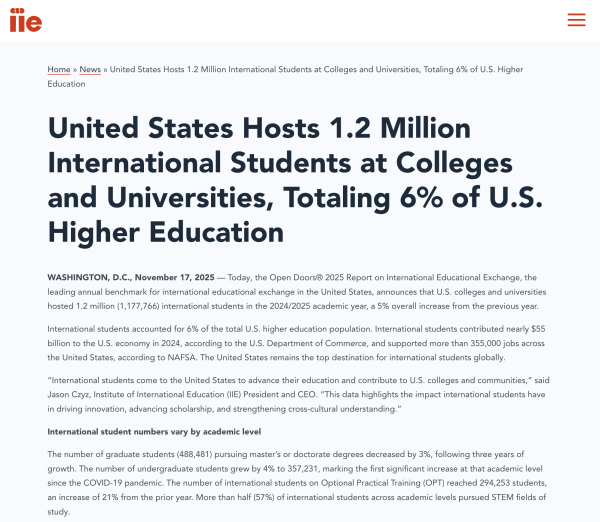 The Institute of International Education’s 2025 Open Doors report found that U.S. colleges and universities hosted 1.2 million international students during the 2024–25 academic year. (Courtesy of the Institute of International Education)
Visa requirements can also affect students’ ability to travel internationally. F-1 students traveling outside the United States generally need a valid passport, a valid visa and a current Form I-20 endorsed for travel to reenter the country. U.S. Immigration and Customs Enforcement advises students to consult their designated school official before traveling. Students whose visas have expired may remain in the United States while maintaining valid F-1 status, but generally must obtain a valid visa before returning from international travel.
Samuel Laguna, a senior engineering major from Honduras, said TCU’s international student center has helped him navigate the documentation required to maintain his student status and travel.
“The best TCU resource, in my opinion, would be the international student center since they help us with everything that has to do with the visa, the F-1 and everything we need to travel,” Laguna said.
How TCU supports international students
TCU provides resources intended to help international students adjust to campus and navigate immigration requirements. The International Services Office (ISO) offers orientation programs for incoming international students and exchange visitors, covering immigration regulations, cultural adjustment and resources for adapting to life in the United States.
The ISO also collaborates with TCU Athletics to host Football 101, an event that introduces international students to American football and the traditions surrounding the sport. The office provides workshops, information sessions, individual appointments and walk-in advising to help students understand immigration requirements, maintain their status and navigate international travel.
“The ISO recognizes that international students need support in many ways. They are not just adjusting to a new campus but a new country, customs and culture,” said Pamela Guerrero, a Coordinator in the International Services Office. “To make the transition easier, students should be made aware of the resources available to them, including student organizations, extracurriculars and knowing the resources every department on campus offers.”
Even with those resources, adjusting to a new country is an ongoing process. Students have to balance academic responsibilities with maintaining relationships at home, following immigration requirements and building new lives in Fort Worth.
For Fondevila, the experience has changed the way she views people and cultures outside of her home country. Since arriving at TCU, she has become more comfortable building friendships with people from different backgrounds.
“I have a much better understanding of how small the world is, and I love that I have so many friends from different parts of the world,” Fondevila said.
After spending two years in Fort Worth, Fondevila has built a community that extends beyond the familiar connections she was accustomed to growing up in Panama. Her friend group now includes students from varying countries.
“Having made friends with many different backgrounds has been an amazing experience,” Fondevila said.
For international students, adapting to TCU is not simply about learning how college works. It can also mean navigating visa requirements, spending extended periods away from family, maintaining connections to home and building a new community in a once unfamiliar place.