
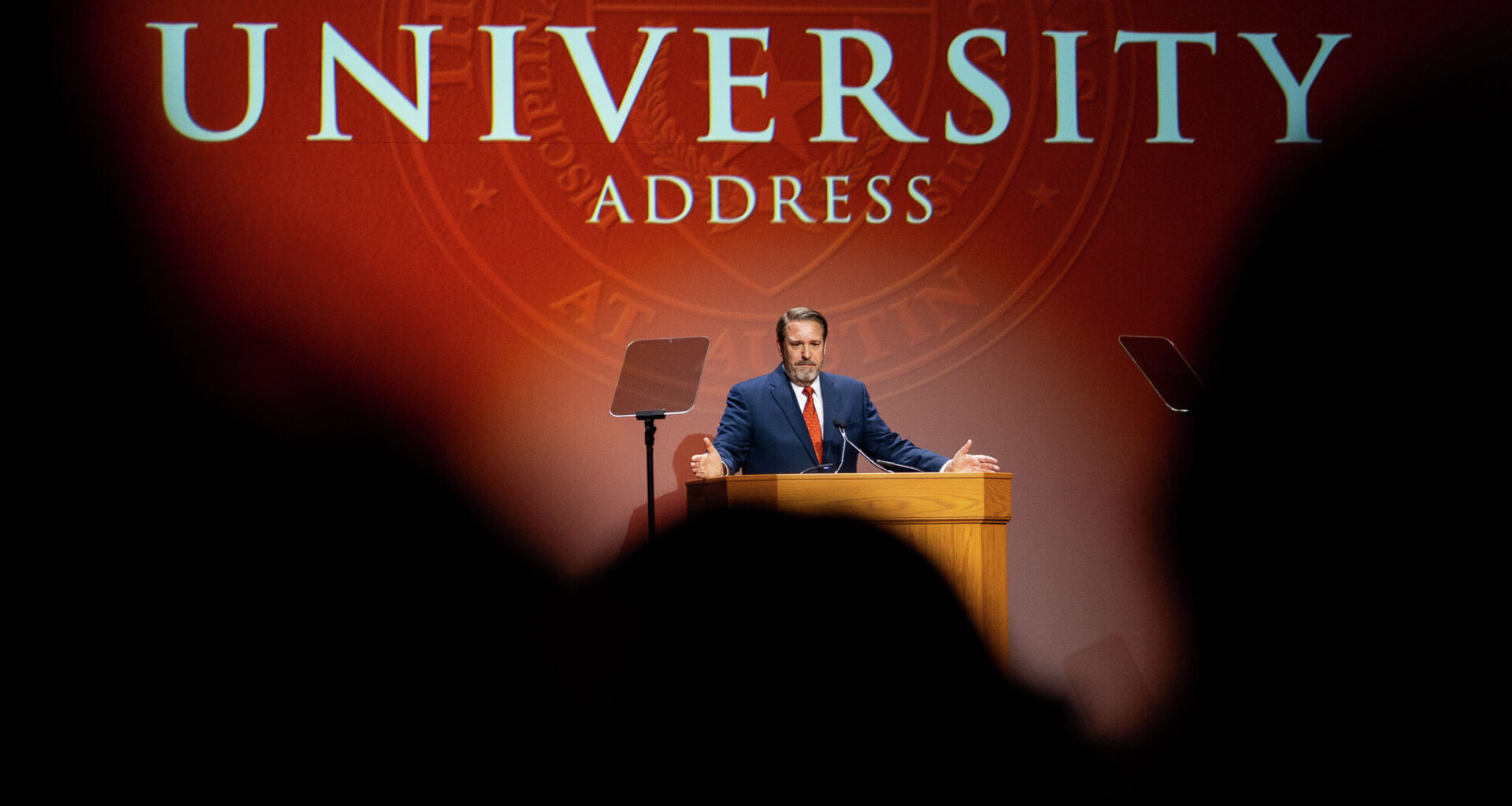
University of Texas President Jim Davis gives the annual State of the University Address to an audience seated in Hogg Auditorium, Oct. 21, 2026.
Sara Diggins/Austin American-Statesman
University of Texas President Jim Davis gives the annual State of the University Address to an audience seated in Hogg Auditorium, Oct. 21, 2026.
Sara Diggins/Austin American-Statesman
University of Texas Student Body President Kiera Dixon speaks before introducing President Jim Davis at the annual State of the University Address to an audience seated in Hogg Auditorium, Oct. 21, 2026.
Sara Diggins/Austin American-Statesman
University of Texas President Jim Davis gives the annual State of the University Address to an audience seated in Hogg Auditorium, Oct. 21, 2026.
Sara Diggins/Austin American-Statesman
Texas Rep. Donna Howard, D-Austin, mingles with other guests ahead of the annual State of the University Address to an audience seated in Hogg Auditorium, Oct. 21, 2026.
Sara Diggins/Austin American-Statesman
University of Texas Student Body President Keira Dixon, right, shakes hands with President Jim Davis after introducing him at the annual State of the University Address to an audience seated in Hogg Auditorium, Oct. 21, 2026.
Sara Diggins/Austin American-Statesman
University of Texas President Jim Davis gives the annual State of the University Address to an audience seated in Hogg Auditorium, Oct. 21, 2026.
Sara Diggins/Austin American-Statesman
Adhia Agostinho, right, and Enow Tanyi protest with the black student coalition Not Our Texas outside the State of the University address, Oct. 21, 2026.
Sara Diggins/Austin American-Statesman
Students with the black student coalition Not Our Texas hold a protest outside the State of the University address, Oct. 21, 2026.
Sara Diggins/Austin American-Statesman
Students with the black student coalition Not Our Texas hold a protest outside the State of the University address, Oct. 21, 2026.
Sara Diggins/Austin American-Statesman
Dean of Moody College of Communication Cary Granat mingles with other guests ahead of the annual State of the University Address to an audience seated in Hogg Auditorium, Oct. 21, 2026.
Sara Diggins/Austin American-Statesman
University of Texas School of Law Dean Bobby Chesney mingles with other guests ahead of the annual State of the University Address to an audience seated in Hogg Auditorium, Oct. 21, 2026.
Sara Diggins/Austin American-Statesman
University of Texas President Jim Davis gives the annual State of the University Address to an audience seated in Hogg Auditorium, Oct. 21, 2026.
Sara Diggins/Austin American-Statesman
Flags are displayed on the stage as University of Texas President Jim Davis gives the annual State of the University Address to an audience seated in Hogg Auditorium, Oct. 21, 2026.
Sara Diggins/Austin American-Statesman
University of Texas President Jim Davis gives the annual State of the University Address to an audience seated in Hogg Auditorium, Oct. 21, 2026.
Sara Diggins/Austin American-Statesman
University of Texas President Jim Davis gives the annual State of the University Address to an audience seated in Hogg Auditorium, Oct. 21, 2026.
Sara Diggins/Austin American-Statesman
Audience members applaud as University of Texas President Jim Davis gives the annual State of the University Address to an audience seated in Hogg Auditorium, Oct. 21, 2026.
Sara Diggins/Austin American-Statesman
University of Texas Student Body President Kiera Dixon speaks before introducing President Jim Davis at the annual State of the University Address to an audience seated in Hogg Auditorium, Oct. 21, 2026.
Sara Diggins/Austin American-Statesman
Nearly two years into his tenure as University of Texas president, Jim Davis walked onto the Hogg Memorial Auditorium stage with three topics in mind: UT’s new academic medical center, research and a core curriculum overhaul.

In Wednesday’s 20-minute state of the university address, Davis announced the launch of a new “University College,” which will be the “guardian” of UT’s reformed set of general education requirements all students will have to take as soon as fall 2028. The announcement builds off the recently created Center for Humanities, which is set up to teach the core and employs 14 faculty specializing in the classics or humanities.
Article continues below this ad
The new college will be led by Devin Stauffer, a Civitas Institute fellow and government professor, and support the refreshed core curriculum. In the early 2000s, UT previously offered a skills-based core curriculum through an undergraduate college but that was folded into the provost’s office in 2025.
Davis announced the launch of the new college before the university has received formal approval for its new core from UT System Regents or the Texas Higher Education Coordinating Board. Regents have already indicated their support, and the state agency is reviewing core requirements statewide.
Stauffer led the task force that formed UT’s new core, which will require all undergraduate students to take 36 credit hours across 12 topics, including humanities, Western civilizations and artificial intelligence literacy. Weeks ago, UT cut dozens of courses from counting toward the core that currently fulfill requirements, including all women’s, gender and sexuality classes and courses on slavery, money and power and African American women.
Article continues below this ad
Adhia Agostinho protests with the Black student coalition Not Our Texas outside the State of the University address, Oct. 21, 2026.
Sara Diggins/Austin American-Statesman
“As the guardian of the core, the University College will work closely with all of our faculty across the colleges and schools to ensure that the core provides a common learning experience for all of our students,” Davis said. He offered few other details in his speech, but said the college will have three committees to oversee each part of the core: Arts & Humanities, Social Sciences and STEM.
The college — led by Stauffer as dean — will launch Jan. 1, 2027, Stauffer said Thursday. He did not provide specifics on how much the college will cost to stand up but said he will fundraise as dean to support teaching the new core.
UT is in talks with the coordinating board, which is also poised to cut requirements statewide, as it sets up the new college, he said. The Center for Humanities will be folded into the college, and the college will not offer its own majors. It will work closely with the College of Liberal Arts and other units across campus that want to offer core courses.
Article continues below this ad
“This new college is really just part of the process of trying to get the new core up and running, secure its place at UT, and then make sure it goes well over the years,” Stauffer said. “This new college is really instrumental to the success of the core.”
Under Davis, the university has instituted several significant changes at the college level — from folding UT’s Graduate School, which was established in 1910, into the provost’s office to consolidating the School of Information into a new computing school in the College of Natural Sciences. Leaders also eliminated gender and ethnic studies departments in the College of Liberal Arts and established a new Department of Social and Cultural Analysis in their place. But unlike in the past, these changes have not been reviewed by an elected faculty governing body. Davis is advised by a committee of faculty that he appoints.
The University of Texas chapter of the American Association for University Professors sharply criticized the core curriculum college after the speech, calling it “yet another example of a decision of enormous consequence for students’ education being made quickly, from the top, and without meaningful faculty governance or student consultation.”
Audience members listen as University of Texas President Jim Davis speaks at the annual State of the University Address to an audience seated in Hogg Auditorium, Oct. 21, 2026.
Sara Diggins/Austin American-Statesman
Building on past reform
In his first public address to the university made last year, Davis pitched himself as a curious former UT student with life experience beyond that of the academics who preceded him. In reforming core curriculum and degree offerings, he promised to tackle concerns over indoctrination and restore public trust.
Article continues below this ad
Over the past year, he and his second-in-command, Provost William Inboden, have overseen tremendous leadership turnover, bringing in new hires from outside the university to lead colleges, including one dean with limited academic experience and another who served as secretary of education in Oklahoma.
This semester, UT has also weathered speech controversies over who should be invited to campus to address students. Davis recently promised to review the university’s policy for guest speakers after a far-right podcaster in October directed racist and homophobic slurs toward students during an on-campus event.
University of Texas President Jim Davis gives the annual State of the University Address to an audience seated in Hogg Auditorium, Oct. 21, 2026.
Sara Diggins/Austin American-Statesman
Despite pleas from students of color, Davis did not condemn a racist social media post from a Republican candidate for statewide office, who said South Asian UT students were a “problem… far worse than I imagined.”
Article continues below this ad
On Wednesday, he looked back at his time leading UT and said he’s been a leader who acts — leading when other universities don’t. He did not address the cuts to programs, the core overhaul, the guest speaker review or the elimination of ethnic and gender studies majors but said that UT is “building a culture focused on mission, decision, and action.”
“We all knew last year that there was work to do to be a model of public trust at a time when trust in higher education in general was at an all-time low,” Davis said. “I’ve noticed that other universities are beginning to talk about this. They’re about where did higher ed go wrong, talking about what is self-indulgence, the political drift, divisive factors, things like that.”
As audience members left Davis’ address, a few dozen students from Not Our Texas — a Black student organization — circled an area near Hogg Auditorium in protest of his leadership and its impact on the Black student experience. The organization’s members demanded the university address the racist rhetoric at recent campus events that made Black students feel unsafe and unwelcome on campus.
Students with the black student coalition Not Our Texas hold a protest outside the State of the University address, Oct. 21, 2026.
Sara Diggins/Austin American-Statesman
Gorgeous Monroe, a UT senior protesting the event, held a sign that said, “We deserve a statement.”
Article continues below this ad
“The current state of our university is one where minority students are not welcome,” Monroe said. “If we are really the change makers we claim to be, we should be setting that precedent.”
UT’s strength in research, demand
In the face of recent criticism, Davis boasted that there has never been more demand for the university — in philanthropy, the number of aspiring students and the level of faculty interest in working at UT. More than 1,200 people applied to teach core curriculum alone, Davis said.
Davis also spoke about UT’s new $5 billion artificial intelligence hospital, which he described as patient-centered and a training destination for future doctors. AI will be woven into the hospital, with a focus on making care more preventative.
Article continues below this ad
“(We’re) not just building a hospital. It’s more than that,” Davis said. “Fundamentally, we’re building a technology platform to improve individual health and treat disease.”
He also announced that UT’s research portfolio is expected to hit $1.5 billion in expenditures this year — a dramatic increase from eight years ago, when UT spent $617.6 million in research, according to the Texas Higher Education Coordinating Board.
A teleprompter displays University of Texas President Jim Davis’ speech at the annual State of the University Address to an audience seated in Hogg Auditorium, Oct. 21, 2026.
Sara Diggins/Austin American-Statesman
UT receives more funding from the National Science Foundation than any other university in the country and ranks in the top 10 higher education institutions for federally funded energy and defense research.
Article continues below this ad
Davis said the university plans to open a new Frontiers of Science Building for interdisciplinary research in areas such as AI and quantum science.
The building will not be owned by any college or school, allowing any academic units to collaborate there, he said.
Davis did not answer questions nor agree to interviews after the talk.
Article continues below this ad