
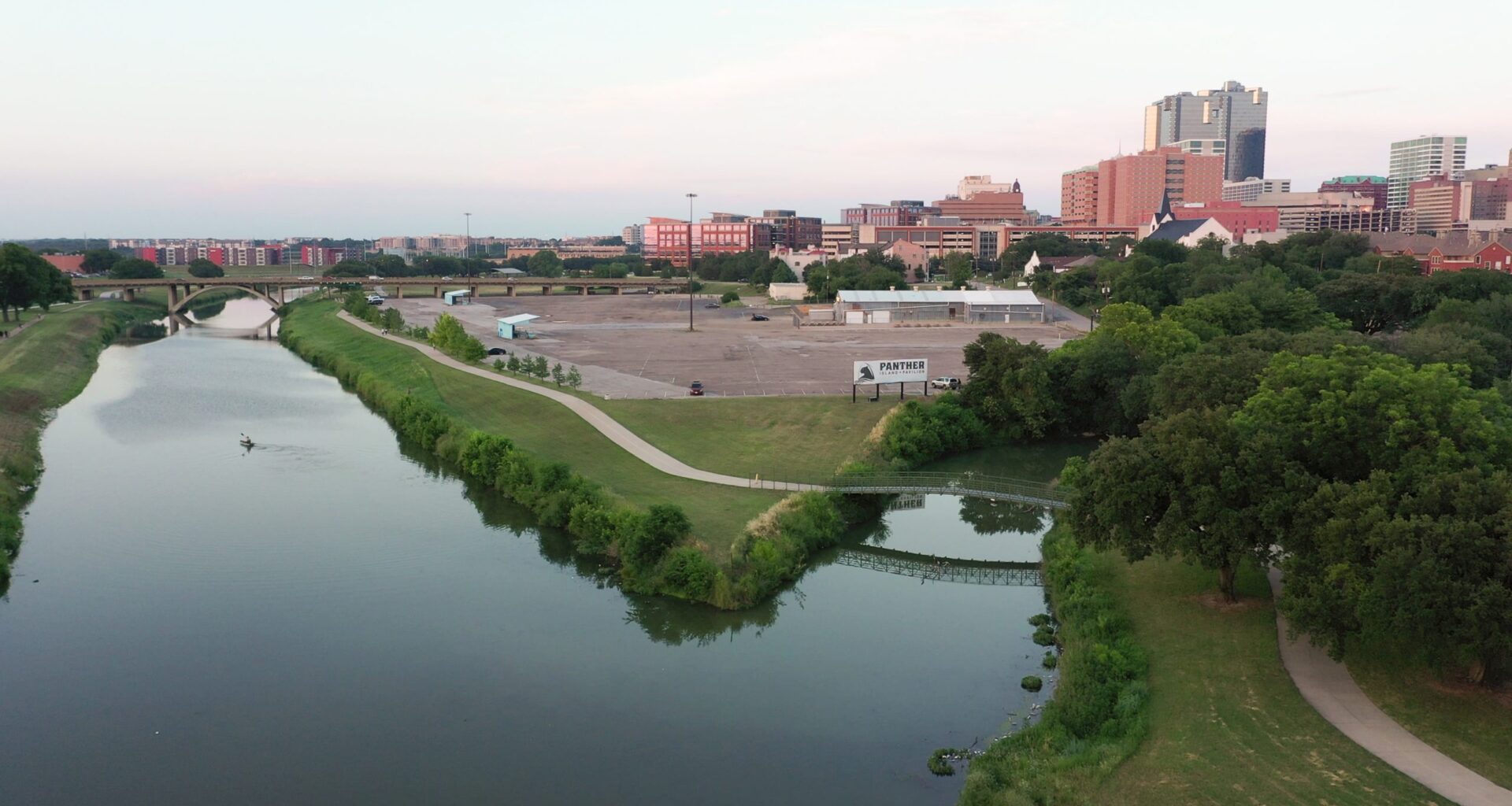
Construction on the first portion of the long-delayed Central City/Panther Island federal flood control project is due to start in February 2027, the Tarrant Regional Water District board was told on Tuesday.
Contractors are to begin work on the much-anticipated north channel of the Trinity River bypass, a key feature of the $1.6 billion flood control project.
A $169 million contract on the first half of the channel was awarded by the U.S. Army Corps of Engineers last month to Chicago-based construction company The Walsh Group. When completed, the north bypass will be 3,900 feet long and 300 feet wide at the bottom of the channel.
An earthen levee and concrete floodwalls will contain the water in the bypass channel. Streets, walkways and trails that are part of the project will connect to the Trinity Trails system.
Tarrant Regional Water District program manager Kate Beck told board directors that the whole project will take about three years.
 A rendering shows a concrete wall and an earthen levee around the future Panther Island that will mitigate Trinity River floodwaters by channeling overflow away from downtown and north Fort Worth. (Courtesy | Tarrant Regional Water District)
The project, which has, at some level, been in discussion for the past two decades, will steer the river’s floodwaters away from 2,400 acres of homes and businesses in downtown Fort Worth and the Historic Northside neighborhood.
The bypass will be broken up into north and south channels, creating a man-made island which has been dubbed Panther Island.
The Corps of Engineers expects to request bids from developers by summer 2027 for construction on the south channel, if the water district has sufficient funds by then, Beck said.
“We’re also pursuing and thinking about other funding opportunities so we could advance as soon as possible,” Beck told the board.
The city and the water district have already begun work on smaller initiatives associated with the Central City project, such as the Ham Branch project. Restoration of natural habitat on the Ham Branch of Marine Creek is intended to mitigate effects on that waterway from the Central City construction work.
The forward momentum on the flood control project comes after funding disputes last year over federal defense contracts prompted delays, stalling the north bypass channel’s original groundbreaking date of spring 2026, according to previous Fort Worth Report coverage.
Central City’s channels will expand flood mitigation along the Trinity River floodway and its levee system. The 27-mile Trinity levee system was built by the Corps of Engineers beginning in the 1950s following decades of disastrous and deadly flooding. However, the levee infrastructure was designed for a city with a population of about 350,000 — the existing flood control system would not be able to sustain floodwaters of a similar magnitude, Beck explained.
 A graphic of the Central City flood control project shows the bypass broken up into two channels, north and south, to reroute Trinity River floodwaters. (Courtesy | Tarrant Regional Water District)
Beck reminded board directors that the flood control project will also provide amenities such as parks and river accessibility, in addition to housing, business development and other economic opportunities.
Fort Worth and water district officials have introduced Panther Island-specific development and zoning standards as developers eye the area. That includes new form-based codes — a code that addresses a district’s design standards — and business proposals from Austin-based Seco Ventures that include bringing multifamily housing to the island.
How some Panther Island responsibilities will be allocated
The water district board also voted to enter an agreement with the city to define which improvements to open space, flood infrastructure and other Panther Island public features for which the district and Fort Worth officials will be responsible.
For example, under the agreement, Fort Worth is responsible for construction of city-owned stormwater systems, bridges and streets, whereas the water district will govern construction on Panther Island canals, walkways and related improvements, board documents show.
The first phase of Panther Island’s development “has been a really good test of understanding what each of us will own and maintain over time,” Susan Alanis, the water district’s Panther Island program manager, told board directors Tuesday.
The deal also recognizes the goal outlined in the Panther Island master plan of preserving 15% of the area’s land as open space. Negotiations between Fort Worth and water district officials will also be required to determine who will lead parkland developments.
The Panther Island public improvement district adopted by the city council in the summer will relieve the water district of the cost of upgrades, renovations and other changes to public infrastructure, Alanis said. Under the PID, property owners in the district will be charged an assessment, proceeds of which will help pay for such improvements.
To celebrate the north bypass channel’s kickoff, officials are planning a groundbreaking event, Beck said.
Meanwhile, an open house will be held 6 p.m. Thursday by project officials at Northside Community Center, where members of the public are invited to learn more about Central City’s progress.
Nicole Lopez is the environment reporter for the Fort Worth Report. Contact her at nicole.lopez@fortworthreport.org.
The Report’s environment coverage is supported by the Marilyn Brachman Hoffman Foundation.
At the Fort Worth Report, news decisions are made independently of our board members and financial supporters. Read more about our editorial independence policy here.
This <a target=”_blank” href=”https://fortworthreport.org/2026/10/22/central-city-flood-control-flows-ahead-with-2027-construction-date-development-agreements/”>article</a> first appeared on <a target=”_blank” href=”https://fortworthreport.org”>Fort Worth Report</a> and is republished here under a <a target=”_blank” href=”https://creativecommons.org/licenses/by-nd/4.0/”>Creative Commons Attribution-NoDerivatives 4.0 International License</a>.<img src=”https://i0.wp.com/fortworthreport.org/wp-content/uploads/2021/04/cropped-favicon.png?resize=150%2C150&ssl=1″ style=”width:1em;height:1em;margin-left:10px;”>
<img id=”republication-tracker-tool-source” src=”https://fortworthreport.org/?republication-pixel=true&post=843014&ga4=2820184429″ style=”width:1px;height:1px;”><script> PARSELY = { autotrack: false, onload: function() { PARSELY.beacon.trackPageView({ url: “https://fortworthreport.org/2026/10/22/central-city-flood-control-flows-ahead-with-2027-construction-date-development-agreements/”, urlref: window.location.href }); } } </script> <script id=”parsely-cfg” src=”//cdn.parsely.com/keys/fortworthreport.org/p.js”></script>