
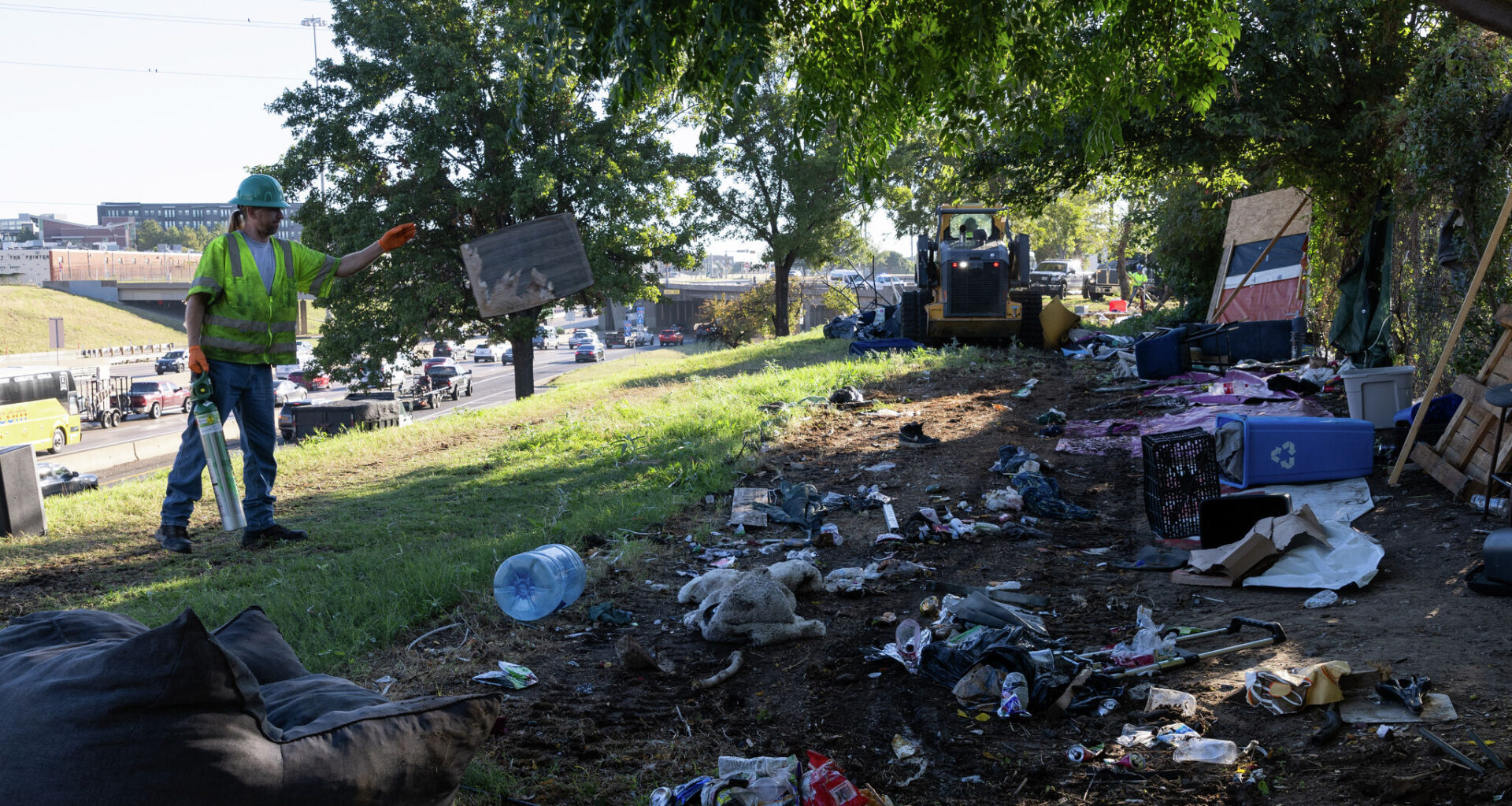
A Dallas code compliance worker clears the remnants of a homeless camp near downtown Dallas on Sept. 26, 2024. Contributing columnist Dallas Cothrum opposes a Dallas County bond proposition that would raise taxes to address homelessness.
Juan Figueroa/Dallas Morning News
The Dallas County Commissioners Court often goes unnoticed. Maybe that’s because Dallas City Hall is always stealing the headlines. But now it looks like the county is jumping into the drama with a proposed homeless tax, termed Proposition A on the November ballot.
Voters will decide whether to raise taxes to 2.4 cents per $100 of value, which would generate almost $103 million annually to fight homelessness. The county’s official legal notice termed the measure a 22.02% increase, making the nominal tax rate for the county $0.2486 per $100 valuation — up from $0.2155.
The measure brought by Commissioner Andy Sommerman barely passed as County Judge Clay Lewis Jenkins and Commissioner Theresa Daniel squeaked out a narrow majority. Commissioners Elba Garcia and John Wiley Price voted against it. When these two leaders are opposed to court business, voters should take heed.
Article continues below this ad
Sommerman faces a stiff election challenge in District 2, which includes the Park Cities and North Dallas, from Republican Barry Wernick. Wernick may have a real chance to be the lone Republican on the court because of rising taxes. And if he is elected, Wernick might be able to form a commonsense coalition with Garcia and Price.
Price, the budget hawk at the county, made an impassioned plea against the measure, saying it will raise housing costs for renters during a crisis of housing affordability. Both Price and Garcia raised serious questions about why this level of financial responsibility should fall to Dallas County taxpayers. Most importantly, they expressed concerns about how the program will be distributed across 31 municipalities in the county.
A lot of coffee
Separately, the county is also issuing $350 million in debt via certificates of obligation rather than general obligation bonds, which would have required voter approval. The total cost with interest for these bonds will be $688 million. To be fair, this was necessary to deal with jail problems, but it’s still a lot of new government revenue at a time when homeowners are feeling the crunch.
You may not be noticing it, but the county is getting into your pocket pretty good.
Article continues below this ad
Meanwhile, school districts and some cities are calling for bond issues or tax increases. In a time of great inflation and a struggling economy, how much can taxpayers carry?
Further exacerbating the situation is rising home values that created larger annual outlays for homeowners.
Proponents love to tell you it is only a cup of coffee or two, but really what they mean is it’s just another cup in addition to the extra cup the taxman asked for last year, and the extra cup he asked for the year before that, and the extra cup – you get the idea. Eventually, just an extra cup adds up to a lot of coffee.
“It’s one more tax on well-to-do folks who are getting nickeled and dimed to death,” complained Farmers Branch Mayor Terry Lynne. “Retired people are getting squeezed out of their homes.”
A magnet, not a solution
The other way to sell this is to insinuate that it’s a temporary experiment — something the county can try for five years and adjust as needed. But make no mistake this is a permanent tax. Once elected officials create new revenues, it’s very hard to roll them back.
Article continues below this ad
There’s no doubt homelessness is a problem. But I doubt this plan will fix it; I suspect it will lead to mission creep. When asked on WFAA’s Inside Texas Politics if the tax increase will end homelessness, Sommerman said, “Absolutely not.”
California has spent billions on various programs to address the issue. What has it gotten them? More homeless people. If you build it, people will come — in this case from other nearby jurisdictions.
I recall the late Dallas Police Chief David Kunkle telling me that when he was Arlington’s top cop, the city’s police officers told the homeless, “Go to Dallas. They will take care of you.”
Another DART
I fear that this will be little different than DART. There will be 31 municipalities paying in, but most of the money will be spent in the city of Dallas. Why? It’s where the most acute problems are and much of the infrastructure. It’s also the area where the county’s vendor, Housing Forward, has experience. If you live in a suburb, you’ll be subsidizing Dallas’ homelessness program.
Article continues below this ad
Richardson’s point-in-time homeless count reported by Housing Forward to HUD noted there were 15 homeless individuals in that city. Even if none of them are in the Collin County part of Richardson, that’s just 0.5% of the 2,872 homeless in Dallas County.
But according to 2026 Dallas Central Appraisal District numbers, there are 26,031 parcels of land in Richardson with a taxable value of $15.8 billion, which is about 3.5% of the $456.23 billion certified taxable value in the county. Richardson taxpayers will contribute more to the homeless solution than its share of the homeless problem.
Other suburbs will have the same gripe. A source at City Hall in Irving has provided me a homeless count of 61 there, or 2.1% of the county’s homeless population. In Garland, an official gave me the number 33, which is 1.1% of the total.
Don’t tell me the suburbs are not paying more than their share.
Where’s my 22% raise?
My biggest question is this: Why am I to believe the county will be better at solving homelessness than the city of Dallas has been? The city opened an Office of Housing Solutions in 2017 under former City Manager T.C. Broadnax. At the time, he boasted, “I am confident that we can create a stronger city that cares for the most vulnerable.” Confidence was one of the few things Broadnax didn’t lack, but homelessness didn’t improve.
Article continues below this ad
In 2023, Broadnax proclaimed, “The City of Dallas will continue to invest and support solutions that are proven to reduce homelessness in our city.” Now, we have the county making similar promises.
No doubt, there has been improvement in downtown Dallas, but the problem seems to have only migrated to Deep Ellum, the Cedars and the Stemmons Corridor.
I am also concerned that adding another agency to the mix will only muddle things. Last summer, a city audit found that OHS and Housing Forward were misaligned in their approaches to homelessness.
“Documentation provided by Housing Forward and OHS does not support that the two strategies were initially assessed or continually reassessed for needed coordination to ensure focus areas are aligned and complementary of each other,” the audit found. Translation: Everyone isn’t pulling in the same direction. Adding the county to that tug of war will only exacerbate the problem.
Article continues below this ad
Fool me once, shame on me. Fool me a twice, I’ll write a passive-aggressive column about it, and vote against the measure when I go to the polls. I hope others do too.
I would have supported a pilot program that had a reasonable proposal. This is not a pilot, nor is it reasonable. A 22% ask is too much on top of the other asks. As Wernick has said, “Did you receive a 22% pay increase this year? I didn’t. I will not vote as if you did.”