
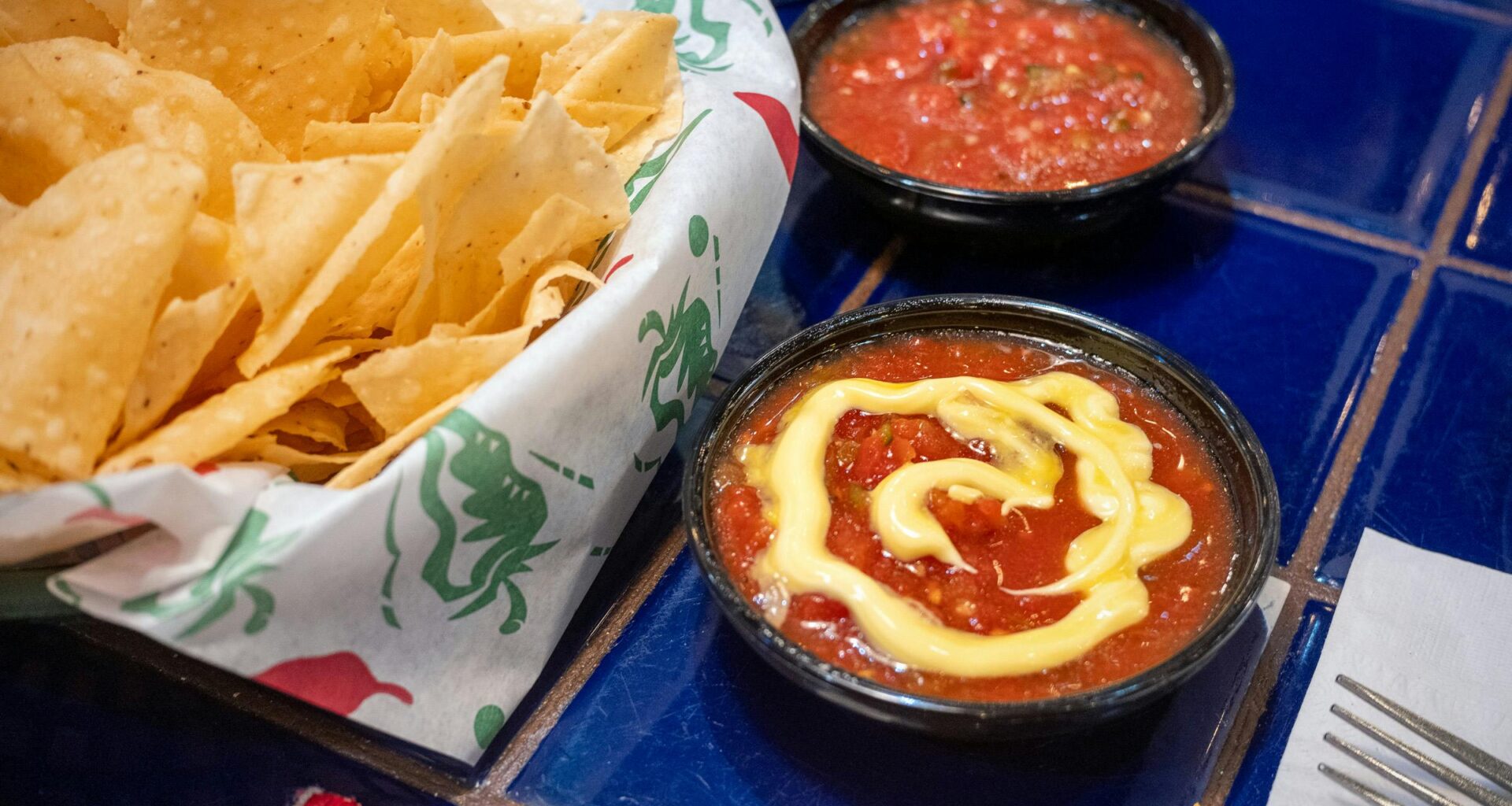
During a recent lunch at Mercado’s Cafe, in Tyler, I noticed an elderly woman with her white hair in braids eating lunch with her mustachioed husband, who was wearing a T-shirt tucked into jeans with black suspenders. They were sitting at the table next to mine. The woman grabbed a tortilla chip to dip into a cup of red salsa with a swirl of Parkay floating on top. “It makes the salsa,” she told me, referring to the margarine spread masquerading as butter.
I was dining with chef Lance McWhorter, a seventh-generation East Texan, and fellow journalist Greg Castillo. I scanned the dining room, which was decorated like a party store that specialized in old-timey Americana and Cinco de Mayo decorations. We craned our necks to see around the flower-filled fountain in the center of the main dining room. I stood up to peek into booths. Every table, like ours, had a squeeze bottle of Parkay and a monkey dish (a small, flat-bottomed bowl) of red salsa. Each dish contained an identical buoyant dollop of the butter substitute.
I’ve heard tales of this northeast Texas food tradition from friends who grew up in the area, as well as from people across the state who are surprised folks haven’t heard of the practice. Most explain it like Christi Schambach does. The Tyler native, who now lives in Houston, first tried butter in salsa as a five-year-old. “I remember our parents told [my siblings and I] to put the butter in our salsa because we thought it was too hot,” she says. “It kind of helped take the heat down.” When she moved to Houston, she was taken aback by the absence of Parkay on Mexican-restaurant tables. Friends teased her. “It is the weirdest thing, but I crave it,” she says.
The origin stories for this tradition skew fuzzy, but one legend has it that the custom began in the very same building I was sitting in, according to Jeff Bonner, the nephew of Mercado’s Cafe founder Andy Gugar, who also started the restaurant’s sister chain, Posados Cafe. Shortly after Mercado’s Cafe opened, in 1987, Gugar’s diaper-clad son, Rickey, was sitting in a high chair at a table in a comfortable side dining room. The tot was crying from the spiciness of the salsa that came alongside the chips. “But if you took it away from him, it was a literal fight,” says Bonner, the restaurant group’s director of operations. Neither he nor other family members remember whether baby Rickey grabbed the butter first (it was on the table to be eaten with the fluffy sopaipillas) or it was Rickey’s mom who squirted the butter into the salsa to reduce the heat. Regardless, “from then on, he was able to eat it, and that’s where the thing started,” Bonner says.
McWhorter grew up with butter in salsa and says it’s a generational habit that stuck. “It’s definitely a boomer thing, but I honestly think it serves no purpose,” says the 54-year-old owner of Heritage East at Culture ETX, a restaurant on Tyler’s main square. He remembers his grandparents loving it. “It’s just boomers trying to get their money’s worth. It is literally like, ‘I’m getting everything that I can for my eight-dollar enchiladas. If it’s on the table, I’m going to use it,’ ” he quips. But he refuses to call Parkay butter. “It’s butter-adjacent lubricant,” he says.
Over lunch, we joked about the proper Parkay-pouring technique: Does one swirl it in from the edge or start at the center and go outward? It has to look pretty, after all. McWhorter, Castillo, and I took turns attempting to apply the correct amount of pressure and movement to the bottle to create the signature swirl. We ended up with blobs instead—unattractive yellow archipelagos of food science.
The liquid never fully integrated into the salsa. At best, it created narrow stripes of Parkay that sloughed off the chips. If any part of the Parkay clung to the salsa on the chips, the mixture did not taste like butter, as the late-twentieth-century TV advertisements claimed.
If the salsa is thicker, though, the Parkay blends better, as Castillo and I realized at the Tyler location of the Jalapeño Tree, an East Texas chain also famous for the butter-in-salsa tradition. The Parkay there created a creamier, richer salsa—if vegetable oil is capable of such alchemy—but only when small amounts were used. Our server, a Tyler native named Rachel, reiterated the tradition while admitting confusion. “It’s a thing we do here,” she told us. “I don’t know why, but everyone does it. I don’t get it.” She shared that Parkay is also smeared on tortillas, evoking the once ubiquitous statewide practice at Tex-Mex restaurants. But the East Texas tradition of putting Parkay in salsa—as strange and insular as it may be—seemingly shows no sign of decline.
Read Next