
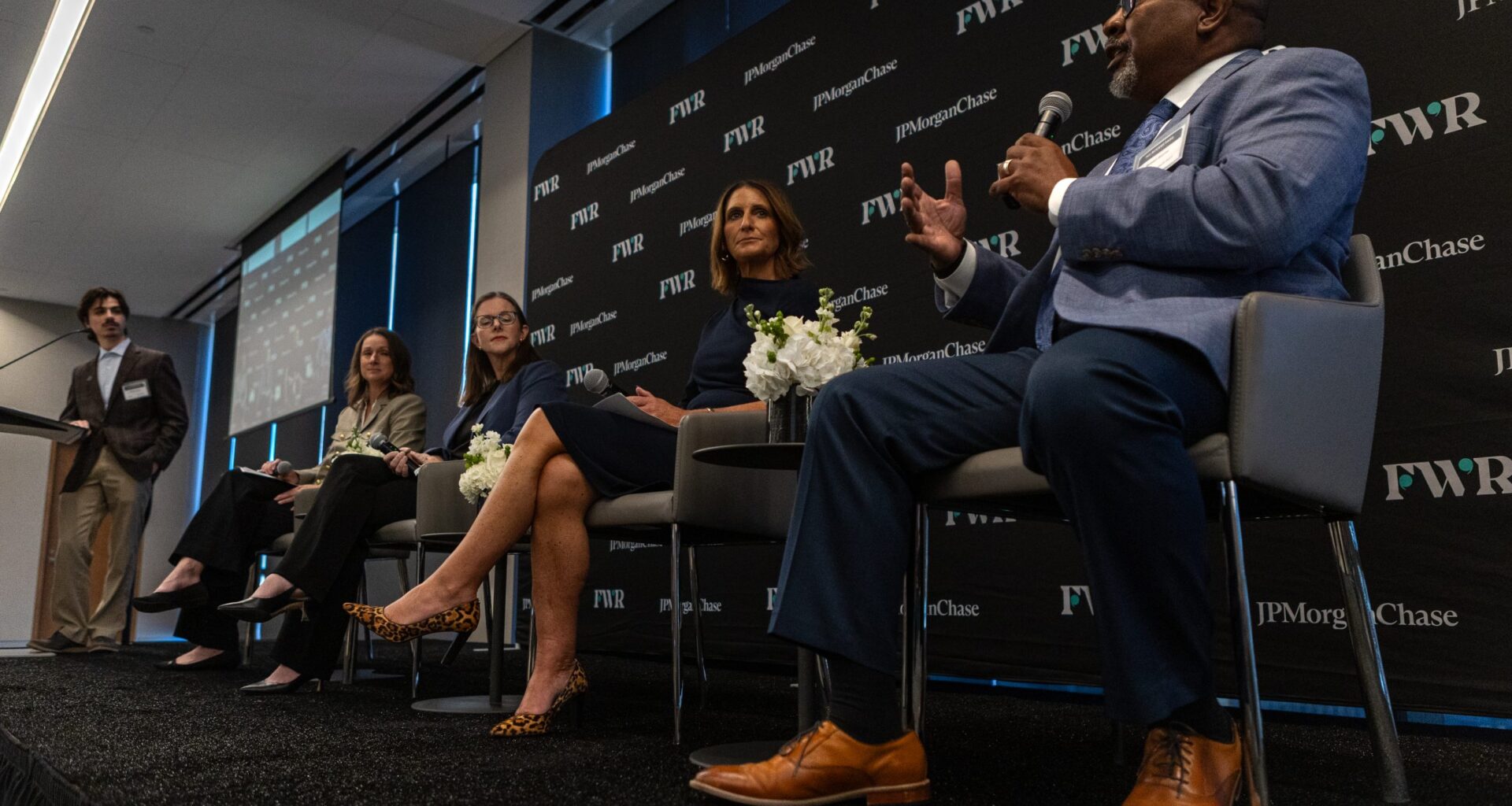
Rev Partnership CEO Karen Molinar noted a recurring theme in the past two weeks as she listened to students across Tarrant County.
They’re interested in careers. They want a variety of pathways. But a key piece is often missing.
“They want exposure to the different career paths that are available to them,” Molinar said.
Meeting student demand will take collaboration from Tarrant County’s K-12 school systems, higher education institutions and businesses, regional workforce leaders said at the Fort Worth Report 2026 Growth Summit on Thursday at Frost Tower. The outcome will be a stronger, homegrown workforce that can support the area’s growth and transform the lives of students.
A simple action adults must take with students will kick it off.
“We have to start listening,” Molinar said.
Tarrant County is heading in the right direction, panelists said.
Industry and schools are working together at a level that Kirsten Jakowitsch, interim president of Tarrant County College’s Northeast Campus, has not seen in her three decades in higher education.
K-12 schools have more than 1,300 career-and-technical education teachers, more than 80% of high school students are enrolled in career-readiness class and close to 8,000 students earn an industry credential by graduation, Molinar said.
But too many barriers exist for students from low-income families, said Lindsey Garner, president and CEO of Communities In Schools of Greater Tarrant County. Her nonprofit places licensed social workers in schools to work with students most at risk of dropping out and ensure their needs are seen and met.
“If the pipeline isn’t working for everyone, it’s not working,” Garner said.
Garner used a student at Fort Worth ISD’s Amon Carter-Riverside High School as an example. The student wants to cross the graduation stage. He’s also a young father and must support his family. He visited his social worker and said that he was leaving school because he could not afford his next car payment.
Communities In Schools stepped in and assisted the student with his car payment so he can remain in school. State data shows more than 4 in 5 FWISD students come from low-income families.
“We are providing the interventions, prioritizing that so they are on track to not only graduate on time, but that they have every opportunity to create a vision and a practice plan for what lies beyond the graduation stage,” Garner said.
Robert Sturns, Workforce Solutions for Tarrant County’s executive director, knows employers want workers with technical skills, credentials and who know how to navigate a digital world. But they also tell Sturns they need something else: soft skills.
“To show up at work on time, to be able to communicate with their co-workers, to be adaptable and flexible and to take some criticism,” Sturns said.
The skills can’t entirely be taught in credentialing programs, he said. They start at home. But schools need to bake it into their programs alongside technical skills.
K-12 schools are seeing students use their soft skills more after Texas banned cell phones, Molinar said. After the law went into effect last year, Molinar, then FWISD superintendent, walked around high schools to see how students were reacting to the ban.
“It was amazing to see them conversing at lunchtime, sitting outside having conversations and even playing board games at lunch instead of on their cell phones,” said Molinar, a former FWISD superintendent. “We needed a technical solution to make that start.”
Students also want work-based learning opportunities. TCC has state-of-the-art labs for advanced manufacturing and aviation, but they are not at the level of those found in an employer’s facility, Jakowitsch said.
TCC leans on nearly 700 different work-based learning partnerships with employers across the county, she said. Some are even paid apprenticeships.
“That gives our students the opportunity to either get clinical, practical or applied work experience in an employer’s facility,” Jakowitsch said.
Areas of improvement exist.
Molinar noted the need for better communication between businesses and K-12 schools. Both employers and school districts need to each designate one person as a point of contact who can nurture relationships that blossom into meaningful programs, lessons and opportunities for students.
“We always talk about persistence for our students to get through school, get through college, get through the next steps,” Molinar said. “We need persistence to even establish those partnerships.”
Businesses and schools also must show students pathways they never considered, Sturns and Jakowitsch said. Manufacturing and logistics aren’t as cool as aerospace, but both industries need workers. The challenge is breaking students’ preconceived notions and showing them that these are modern, technologically advanced careers.
“The jobs are there,” Jakowitsch said. “There’s more we can do with employers to talk about the career paths.”
Molinar wants Tarrant County’s K-12 schools, colleges and businesses to create a public-facing dashboard that tracks the success of students, their college persistence and their eventual careers. That level of transparency allows leaders to tout success, find gaps and help students.
“We can do this together,” Molinar said.
Jacob Sanchez is education editor for the Fort Worth Report. Contact him at jacob.sanchez@fortworthreport.org or @_jacob_sanchez.
Disclosure: FWISD manager Pete Geren leads the Sid W. Richardson Foundation, a financial supporter of the Fort Worth Report. FWISD manager Laurie George is a member of the Report’s reader advisory council. At the Fort Worth Report, news decisions are made independently of our board members and financial supporters. Read more about our editorial independence policy here.
This <a target=”_blank” href=”https://fortworthreport.org/2026/10/22/homegrown-workforce-depends-on-tarrant-county-schools-employers-working-together/”>article</a> first appeared on <a target=”_blank” href=”https://fortworthreport.org”>Fort Worth Report</a> and is republished here under a <a target=”_blank” href=”https://creativecommons.org/licenses/by-nd/4.0/”>Creative Commons Attribution-NoDerivatives 4.0 International License</a>.<img src=”https://i0.wp.com/fortworthreport.org/wp-content/uploads/2021/04/cropped-favicon.png?resize=150%2C150&ssl=1″ style=”width:1em;height:1em;margin-left:10px;”>
<img id=”republication-tracker-tool-source” src=”https://fortworthreport.org/?republication-pixel=true&post=843303&ga4=2820184429″ style=”width:1px;height:1px;”><script> PARSELY = { autotrack: false, onload: function() { PARSELY.beacon.trackPageView({ url: “https://fortworthreport.org/2026/10/22/homegrown-workforce-depends-on-tarrant-county-schools-employers-working-together/”, urlref: window.location.href }); } } </script> <script id=”parsely-cfg” src=”//cdn.parsely.com/keys/fortworthreport.org/p.js”></script>