
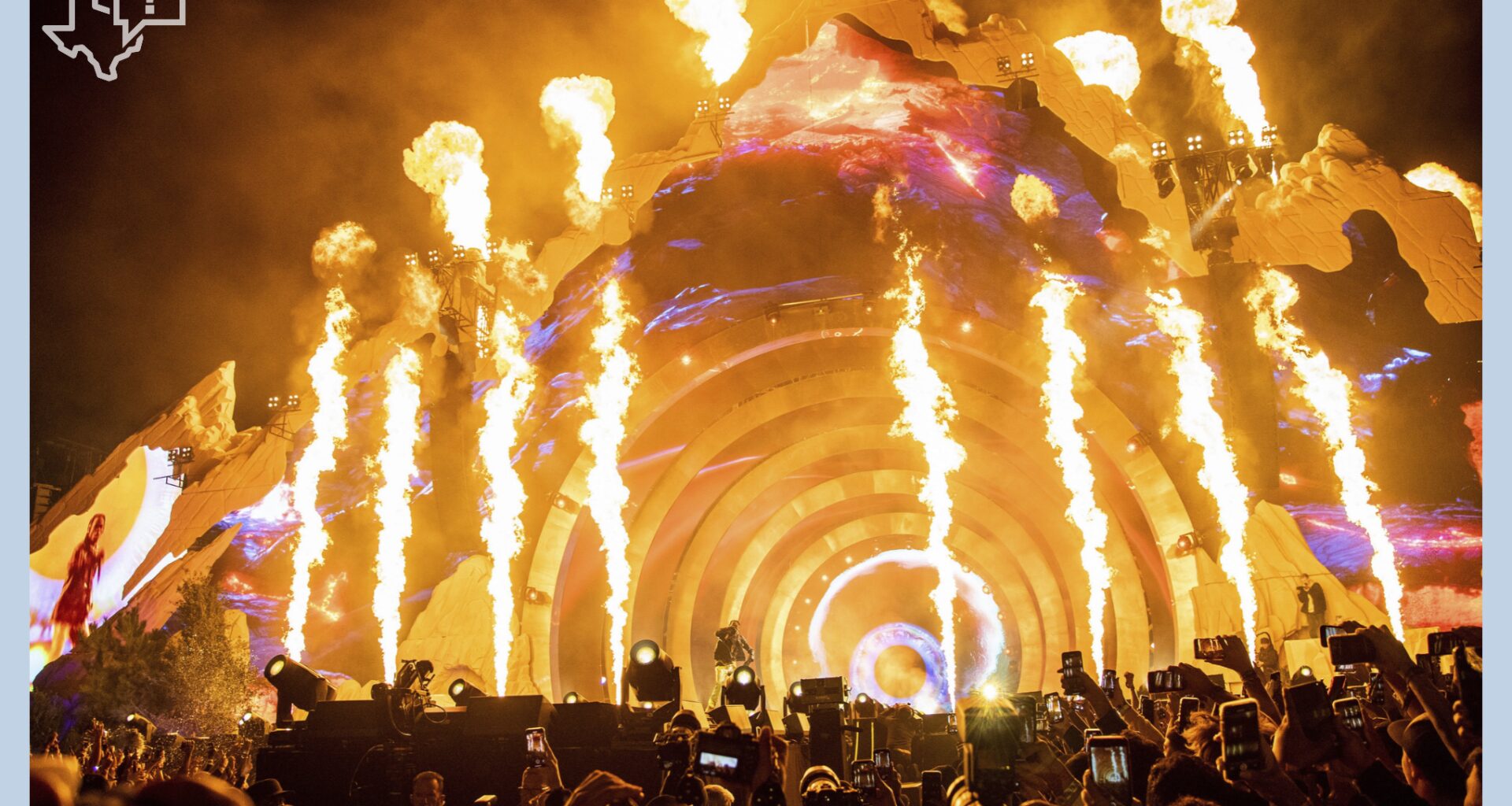
Travis Scott performs at Day 1 of the Astroworld Music Festival at NRG Park, Nov. 5, 2021, in Houston. A nearly 1,300-page police report released on Friday, July 28, 2023, shows some of the safety concerns people had before rap superstar Travis Scott took the stage at the deadly 2021 Astroworld festival in Houston.
Amy Harris/Invision/AP
Join us on a journey to better understand Houston, one question at a time. Sign up to get the Houston Explained newsletter in your inbox every Tuesday and Friday.
The only time in my life I truly believed I was going to die was on a Friday night almost five years ago.
It was Nov. 5, 2021, the first night of the Astroworld Festival, Houston-born rapper Travis Scott’s celebration of music and the city that raised him, at NRG Park. Ten people did die, aged 9 to 27: John Hilgert, Brianna Rodriguez, Jacob Jurinek, Franco Patiño, Danish Baig, Axel Acosta, Rudy Peña, Madison Dubiski, Bharti Shahani and Ezra Blount.
Article continues below this ad
They were crushed in a crowd I was standing in and wrestled my way out of.
I was supposed to write about the festival’s triumphant return to Houston after the pandemic, with a lineup stacked with SZA, Young Thug, Bad Bunny, and, of course, Travis Scott himself. I had an assignment, one that I begged for, for the University of Houston’s life and arts magazine.
But I never wrote that story, and this is the first time I have tried.
Before the sun went down
So much hype had built around the festival, back for the first time since before the pandemic, that I felt a thrill at just seeing the entrance, marked by a giant inflatable of Scott’s head with its mouth agape. I was there with a team of UH student journalists and photographers, all my friends.
Article continues below this ad
For most of the afternoon, the festival was what Scott intended: a celebration of his Houston. Carnival games and rides paid homage to the real Astroworld, the amusement park that closed in 2005, and I ate Frenchy’s for the first time in my life standing on that lot.
But the trouble was brewing right under our noses. Unaware of the danger, we watched people hop the fences, skirt sheriff’s deputies on horseback and overrun the merchandise stands.
Houston knows how to get rowdy, I remember thinking.
On the walk to the main stage after SZA’s set, I understood how packed the place was.
All the day’s acts so far had performed on the Thrills stage on the west end of the grounds, and Scott’s set would be on the massive Chills stage on the east. So the crowd moved from one side of the festival to the other all at once. And by the time we stopped moving, we were penned in on every side either by barricades or by masses of people.
Article continues below this ad
The fateful set
My friends and I ended up close enough to the stage that when Scott finally came out, in an eruption of sound and pyrotechnics that sent columns of fire into the night sky, we could see the sweat dripping off him.
The crowd surged as soon as the set began, and I was lifted off my feet as we were blasted with waves of heat. For stretches of 30 seconds or more, I was being thrown 10 feet one way and 10 feet back without touching the ground. The whole mass of people churned like a hurricane, and without any of us meaning to, we trampled people who had fallen and struggled to get up.
What I will never forget is realizing I could not breathe. Between the pyrotechnics and the sweating bodies pressed together, the air was hot, thick and useless. No matter how hard I tried, nothing filled my lungs.
Article continues below this ad
I understood I was in danger when I started to feel faint. My friends were nowhere in sight, and all I could think about was finding a way out of the crowd. I remember bracing my elbows against the current, and I am ashamed of what that meant, because I was adding to what was hurting people.
Pushing out, I saw how bad it was. People fell like dominoes around me. I stumbled over mounds of bodies, and I still wonder whether they were alive or not.
There was a woman whose dazed, pale face I can still see. People screamed for help, for security, for anyone who was watching the crowd instead of the stage.
As I got to the edge of the crowd, a security guard hauled me over a barricade. I watched as he kept going, pulling people out two at a time. Behind the barricade, it felt like a field hospital in a war zone. Some people lay flat on their backs; others cried while trying to find their own lost friends.
Article continues below this ad
I climbed a second set of barricades before I could breathe again.
Drake was onstage by now, and the crowd was getting louder. But nobody on the outskirts of the crowd knew about the disaster unfolding 50 yards ahead.
I looked for my friends for about an hour after escaping the tumult. When I finally found them, they were as wrecked as I was. One of them lost her shoes and was walking around barefoot. We passed dozens of ambulances lined up outside the fences on our way back to the media tent.
We were like zombies walking back to the car, and I could barely sleep that night. I woke up around 6 a.m. to a call from my mother.
Are you OK? Yeah, why? They’re saying some people died there last night. Oh.
I reassured her that I was fine, hung up and went back to sleep without registering what I had lived through the night prior.
There wouldn’t be a day two. The festival was over.
What I still carry
Three weeks after Astroworld, I went to another concert at Toyota Center, and in its crowded corridors, I was hit by a rush of anxiety. Gritting my teeth and searching for the exits, I realized I would carry the Astroworld tragedy with me for a long time.
It has happened since at the rodeo, held on the same grounds as the disaster, at music festivals and nightclubs, at the Astros’ 2022 World Series parade and even while covering World Cup festivities this summer.
I hate it. I love people, and I have always basked in the collective effervescence of a massive crowd excited to be together in the same place. But I have seen up close what it means to be trapped in a sea of people, and my nerves cannot forget that feeling.
Five years later, it’s still a frequent topic of conversation among the friends I was with that night. And I know we’re not the only ones.
If you were at Astroworld, or if you lost someone there, I would like to hear how you have carried that night with you since. Email me.
Has Astroworld changed how you experience concerts, festivals or other large events in Houston?
Why or why not?

What is your Houston question?