
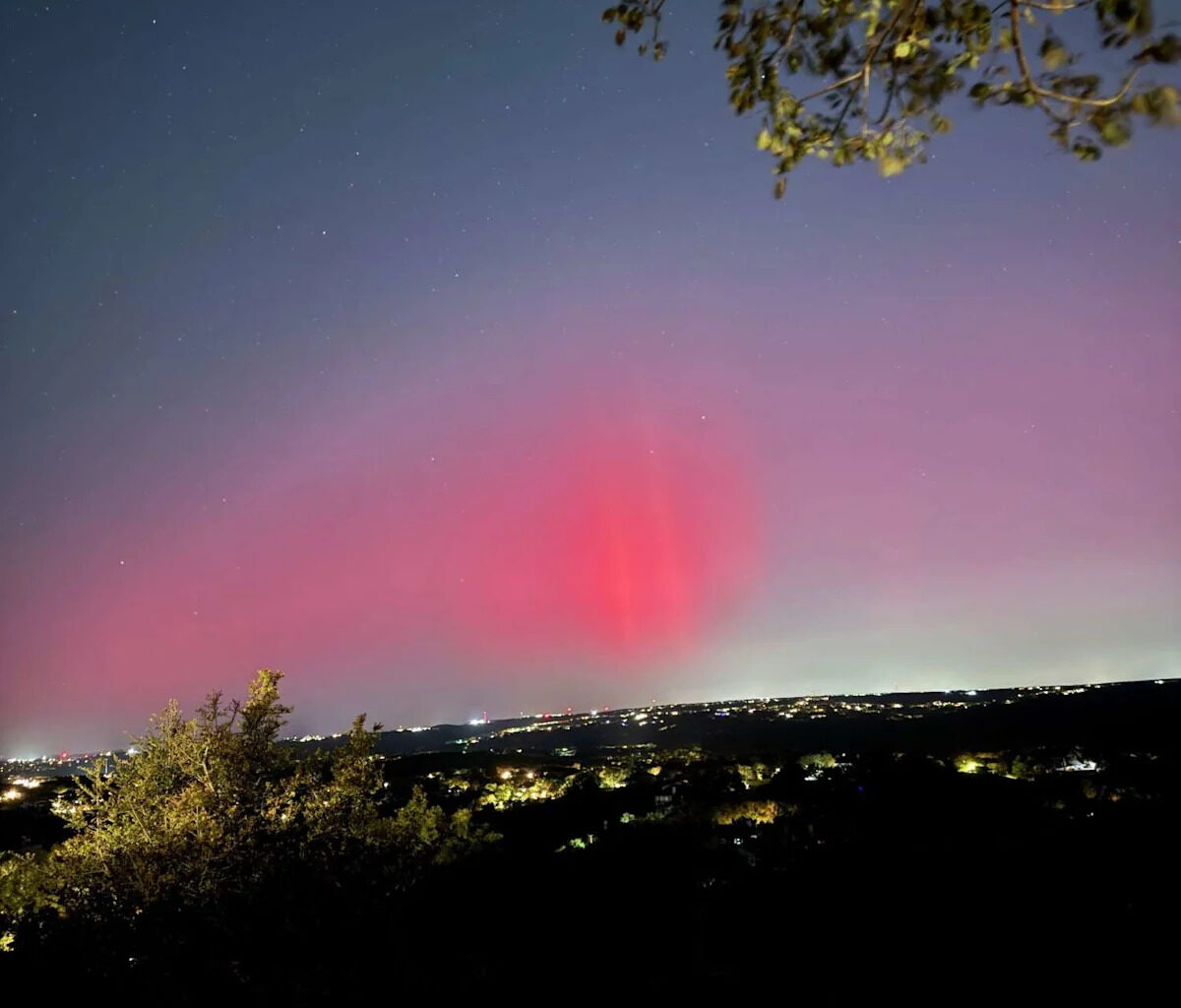
If you happened to step outside on Tuesday night between 8:00 and midnight, you might have caught a glimpse of something truly rare in the Lone Star State: a soft red, green and pink glow lighting up the sky. To everyone’s surprise, the aurora borealis, or northern lights, made a stunning appearance in the southern tier of the United States as a powerful geomagnetic storm swept across the atmosphere.
TUESDAY’S SHOW: Did you see the northern lights in Austin?
Luckily, we’re not done yet with the potential for stunning celestial views in Texas. In fact, this current geomagnetic storm is the result of a series of intense coronal mass ejections (CMEs) that have occurred since Sunday.
According to the National Oceanic and Atmospheric Administration, we’ve already experienced two out of three CMEs, with the final one expected to reach Earth on Wednesday. This will set the stage for another night of gorgeous hues in the sky, possibly even stronger and more vibrant, according to NOAA’s Space Weather Prediction Center.
What’s the Austin weather forecast?
Set the timer on your phone to remind you to step outside and look up Wednesday night in Austin. The best time to view the northern lights will be from 10 p.m. to 2 a.m., but keep an eye out any time after sunset at 5:36 p.m.
• Be sure to step away from streetlights, give your eyes a few minutes to adjust to the darkness and look toward the north.
• At times, you may be able to see the aurora with the naked eye, but if not, try using your phone’s camera in long-exposure mode, it can often capture colors and movement that aren’t immediately visible.
• Be patient because the auroras can dance and suddenly spike, so stay alert.
Luckily, the forecast will cooperate with clear skies expected throughout the evening and until after midnight. Then clouds will develop around 2 a.m. and become widespread along the I-35 corridor by sunrise. Temperatures will be mild but dip into the 60s around 8 p.m. and then the low 60s from midnight through sunrise on Thursday.
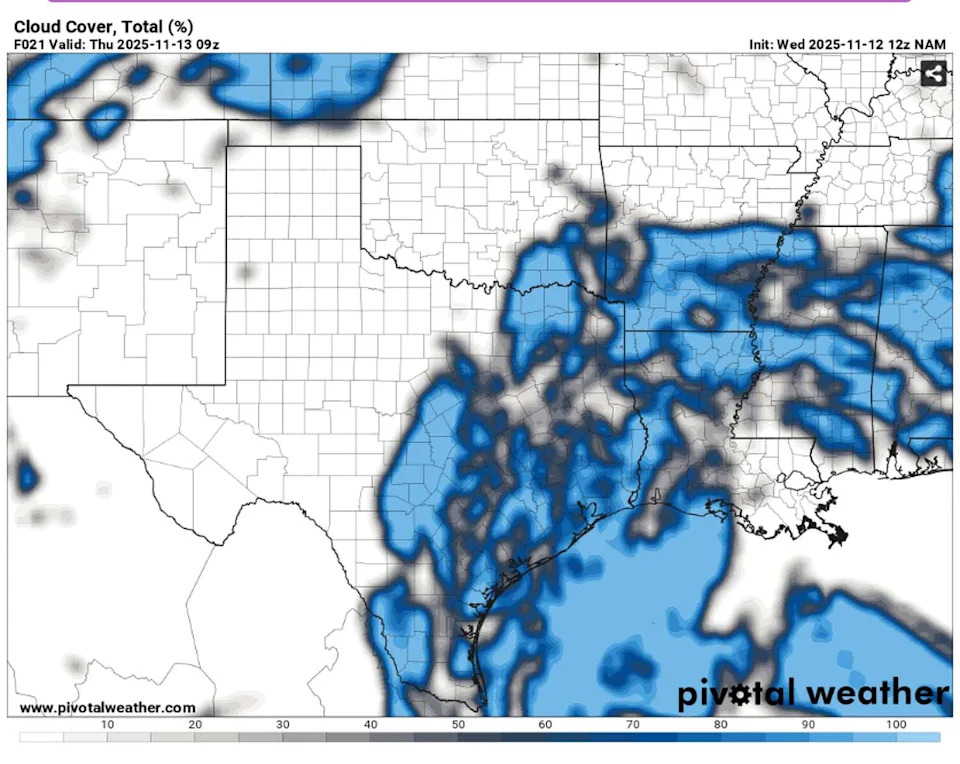
Clouds will begin to develop over Central and South Texas after 2 a.m. with a mostly cloudy sky by sunrise on Thursday. (Pivotal)
What are Coronal Mass Ejections?
CMEs are blasts of solar material consisting of charged particles with strong, localized magnetic fields, and they extend into space from the Sun. The current series of CMEs originated from sunspot AR4274, and they are the strongest recorded since October 2024.
“This batch of CME’s that have already come in were profoundly stronger than anticipated,” Shawn Dahl, service coordinator at NOAA’s Space Weather Prediction Center, in a video posted on X.
He explained that Tuesday’s geomagnetic storm was initially ranked at a G2 to G3 (moderate to strong) level, but during the event, it briefly reached G4, which is considered severe on a scale of 1 to 5. Wednesday’s event is forecast to reach G4 as well, but could potentially climb to G5, with viewing expected as far south as the Texas coast.
“The third CME will be the most energetic activity out there in space, and it’s traveling faster than the other two,” Dahl said. “We believe it’s going to pack an even stronger punch than what we’ve already experienced.”
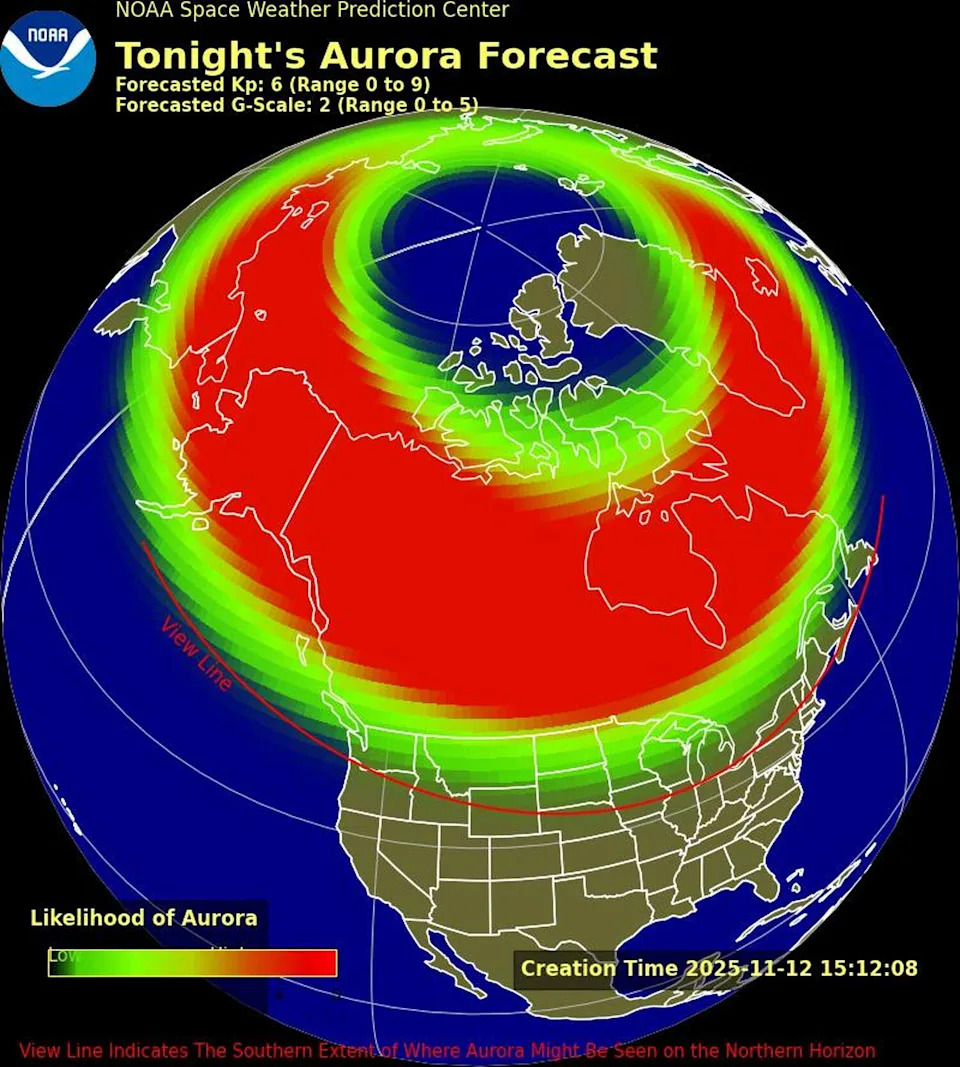
The brightness and location of the aurora is typically shown as a green oval centered on Earth’s magnetic pole. The green ovals turn red when the aurora is forecast to be more intense. Aurora can often be observed somewhere on Earth from just after sunset or just before sunrise. (NOAA)
The aurora does not need to be directly overhead but can be observed from as much as 600 miles away when the aurora is bright and if conditions are right.
How do the auroras get their vibrant colors?
The stunning green, pink, and red colors are caused by the interactions between charged particles from the Sun and gases in Earth’s atmosphere.