
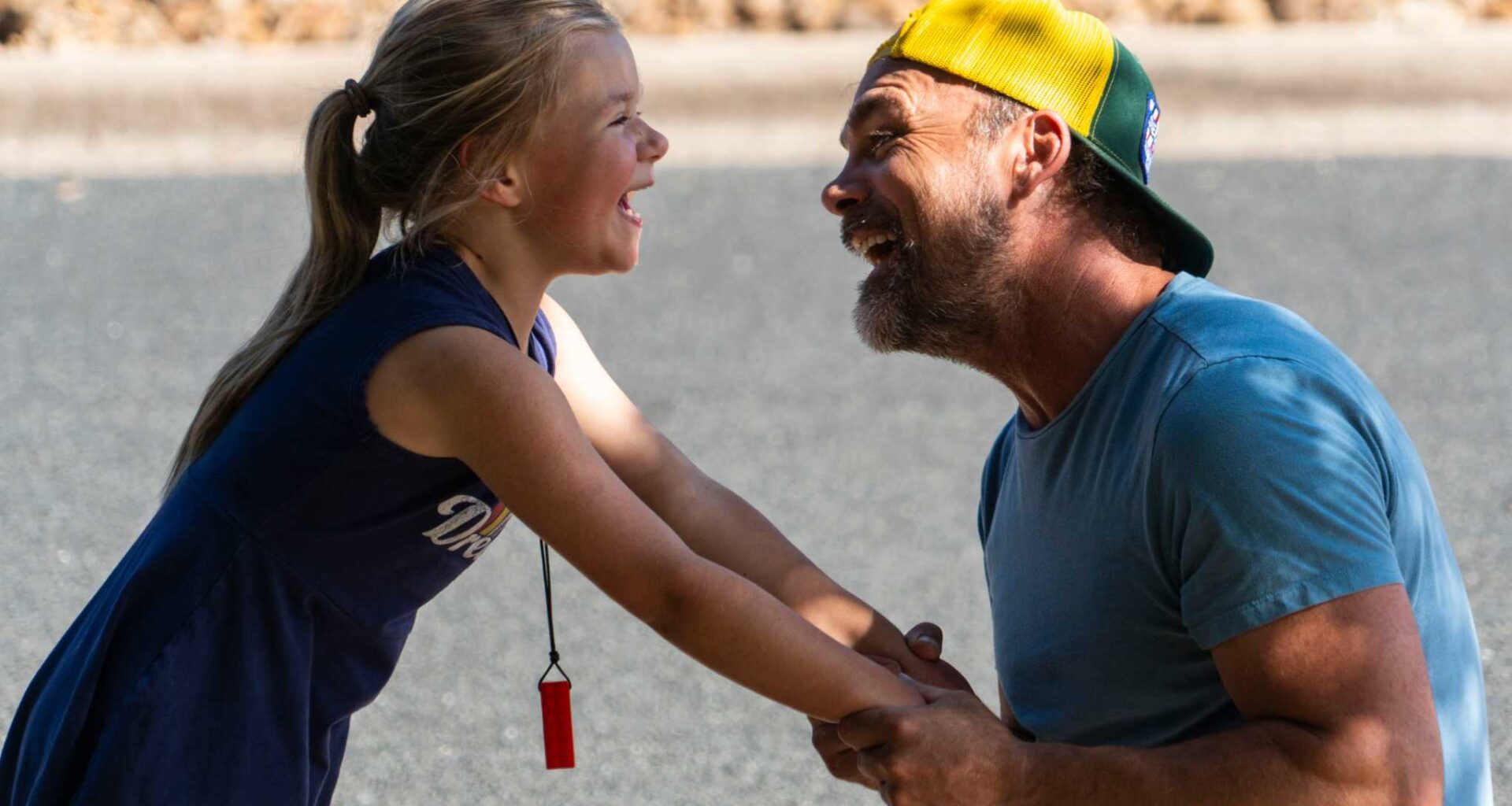
Casey McPherson plays with his daughter Rose, when she was 7. Now 10, Rose is one step closer to getting a treatment for her rare disease her father’s lab discovered. Rats will soon be given her condition and her treatment.
Kara Hawley / American-Statesman
Austin musician Casey McPherson is one step closer to manufacturing a genetic treatment for his daughter, Rose.

McPherson, who made his name as the leader of the band Alpha Rev, founded Alpha Rose Therapeutics and its RareLabs to help parents like himself find a therapy or create one for their child with a rare disease. So far, the lab, at Austin Community College’s bioscience incubator, has found treatments for 10 children. More fundraising needs to be done to conduct the clinical trials for those treatments.
Article continues below this ad
This month, McPherson secured a $2.3 million grant from the National Institutes of Health to do more testing on the treatment RareLabs has found for Rose’s genetic mutation, HNRNPH2. The mutation causes children to slowly lose functions, including the ability to speak.
The mutation is known to occur in 1 in 130,000 children, but many others might be diagnosed with autism or epilepsy without the genetic testing needed to give a more specific diagnosis.
The grant will allow the treatment to be tested in rats for safety and to make sure the treatment gets to the parts of the brain where it needs to reach.
“Those are the most expensive rats in the world,” McPherson said.
Article continues below this ad
Rose’s treatment, which will eventually be an infusion in the spine, already has been shown to be effective in brain cells that were created based on Rose’s genetics.
RareLabs Chief Science Officer Rodney Bowling stands in RareLabs at Austin Community College’s incubator lab. Since starting the lab with Casey McPherson, they have found treatments for 10 rare diseases.
Kara Hawley / American-Statesman
He is hoping that based on the rat study, he will not need to try the treatment in primates and can begin doing clinical trials in humans. Another $5 million will have to be raised to reach the first human trial, and $20 million to $25 million to get through U.S. Food & Drug Administration approval.
“It’s been incredibly frustrating,” McPherson said. “It’s just money that stands in the way between a treatment that can help my child, and its the regulatory process that stands in the way. How many years do children like Rose need to suffer in silence, trapped in their bodies?”
Article continues below this ad
The University of Texas is now part of the overhaul of the clinical trial system that aims to accelerate the process by using artificial intelligence, replication of prior approved studies, using organoids instead of animals in studies, creating digital twins, implementing existing data as patient controls, and other efficiencies.
Eventually, McPherson is hoping that RareLabs can get approval for the process of creating these genetic mutation treatments and be able to create individualized treatments for a genetic mutation without having to go through the FDA process for each one.
This would be like a stem cell transplant or CAR T treatment in cancer, which is the same process for each patient, but each patient is given a personalized transplant.
If he had been able to give Rose, now 10, the treatment before she first started showing signs of loss, he believes his daughter would not have experienced cognitive decline.
Article continues below this ad
He hopes the treatment will stop the continued decline and even restore some things she has lost.
“I can’t wait to treat Rose,” he said. “And maybe hear her say her first word since she was months old.”