
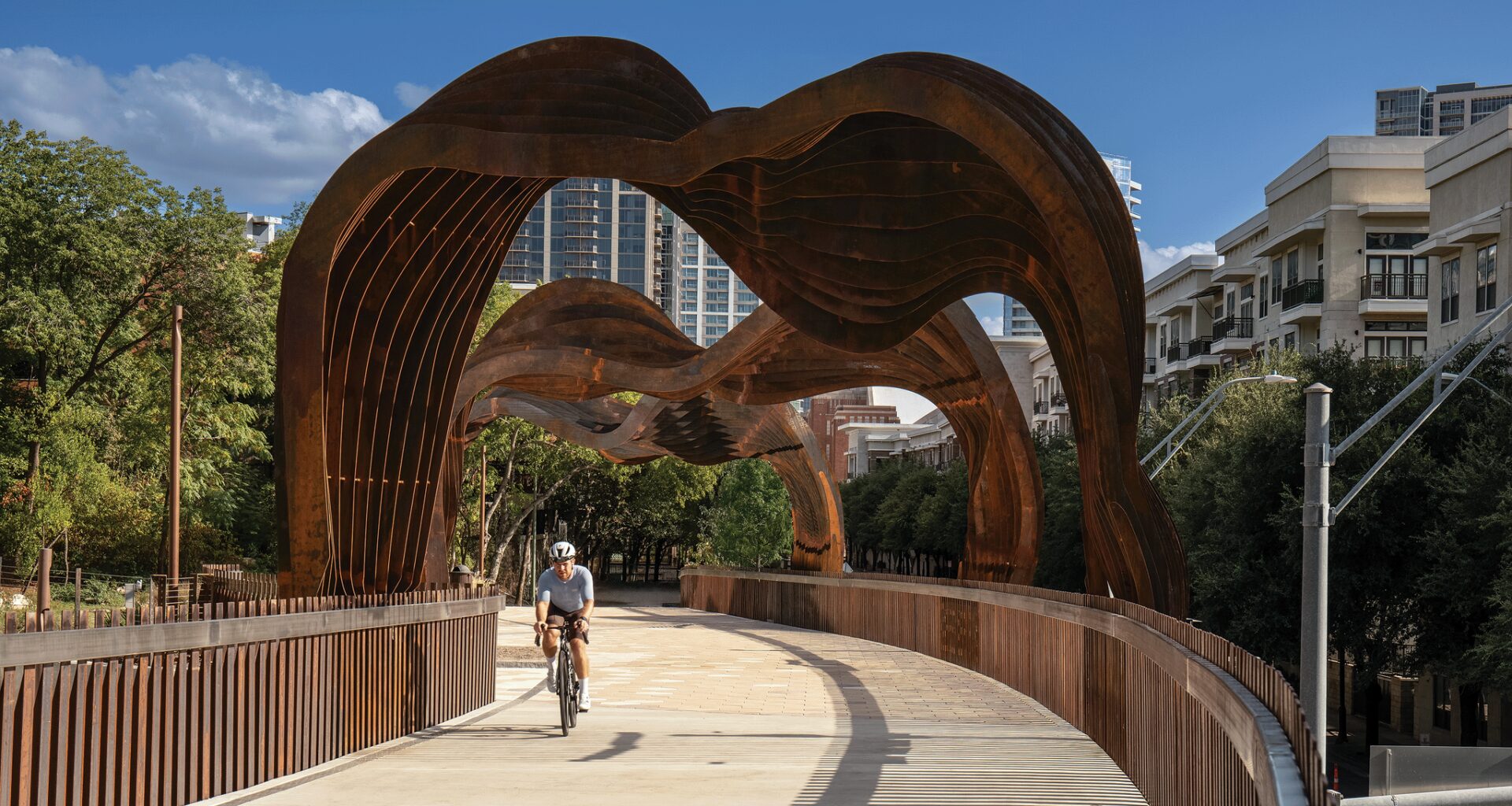
Runners, walkers, bikers and roller skaters are already blending the newest addition to the Katy Trail into their daily routines.
This week, The Loop — the organization working to connect 50 miles of Dallas’ trail system — unveiled an elevated pedestrian and bike bridge at the south end of the trail near the American Airlines Center.
The plaza is a focal point of the work to connect Dallas’ trails. At a time when there has been so much negativity about the future of downtown Dallas as sports teams and employers consider retreating to the suburbs, The Loops’ work to tie together and improve our trails is a win.
The new pedestrian and bike bridge connects the Katy Trail to the AAC and the Arts District, allowing trail users to move seamlessly from the trail to street level. From there, pedestrians can use the Hi Line Connector to reach the Trinity Strand Trail and the Skyline Trail along the Trinity River.
And while the Katy Trail is one of the most popular and highly traveled trails, and it’s easy to celebrate this opening because it’s so visible, it’s just one piece of a much larger network.
“It’s connecting Dallas to Dallas,” The Loop chairman Jeff Ellerman said.
Trails are popular amenities and can provide a return on investment for Dallas. People want to live and work in places that are walkable and where there are spaces to enjoy the outdoors.
Making Dallas’ neighborhoods more connected aids in fostering a stronger sense of community and place. Outdoor space also draws employers and people to Dallas.
“The identity of Dallas is going to include access to The Loop, to trails, to green space, to public space … that’s becoming more and more important as our city continues to grow,” executive director Philip Haigh told us.
The Loop also stands out because it represents one of the more effective public-private partnerships in Dallas. This work is funded both through private donations and money from the city and federal government.
Dallas has spent plenty of time worrying about what it might lose. The Loop is a reminder of what Dallas can build to become the type of city we want to be.