
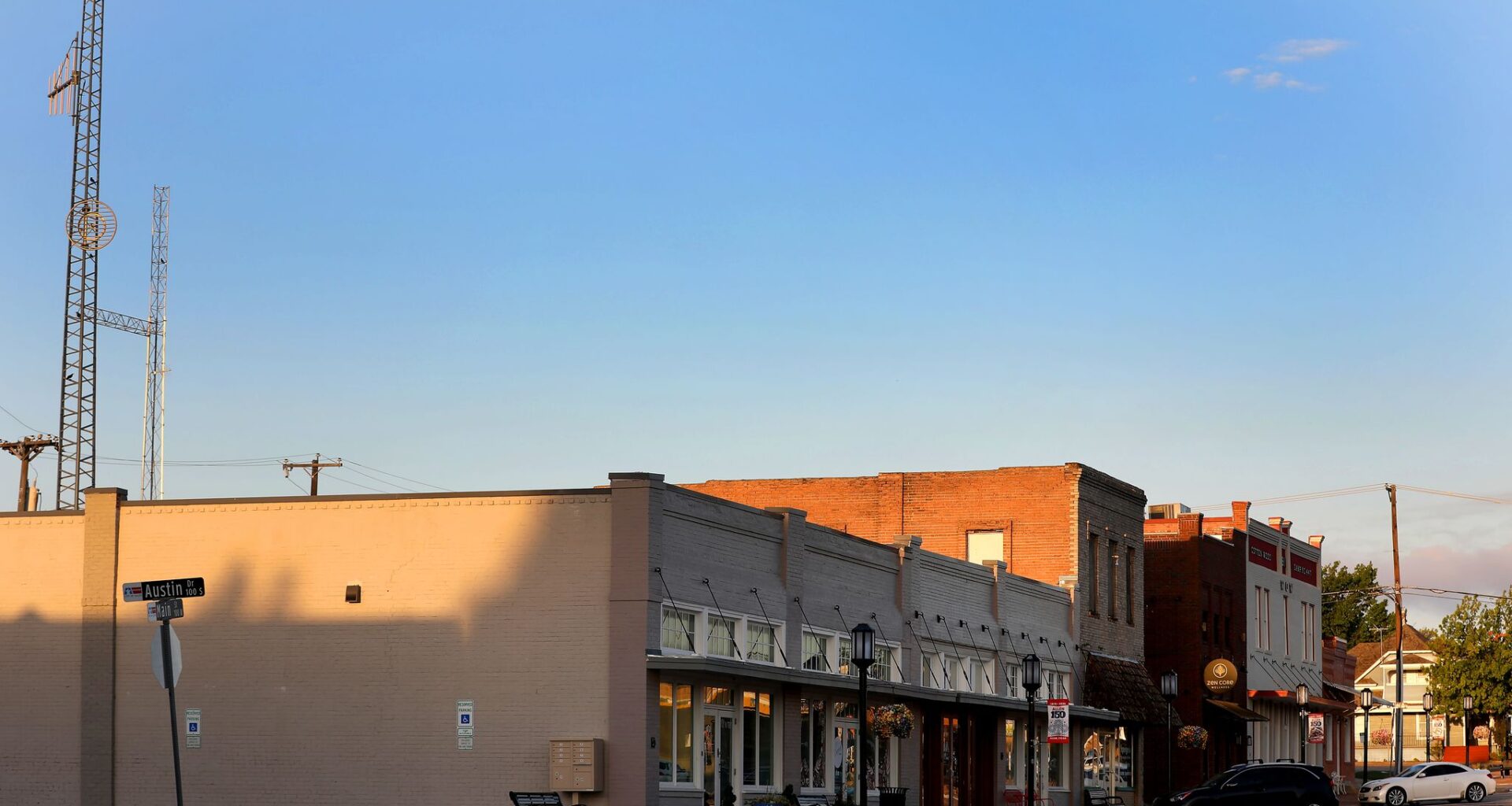
When Leah Holden moved to a loft apartment in Frisco’s historic downtown two months ago, she felt like she had stepped into an episode of “Gilmore Girls.”
Characters in the idyllic early 2000s television show regularly pass musicians busking in the town square as they walk to the diner where they know all their fellow patrons.
In downtown Frisco, Holden and her boyfriend run into neighbors on walks to get pistachio lattes and pints at Rollertown Beerworks.
Article continues below this ad
A band takes the stage during the official opening of the redeveloped downtown area, The Rail District, In Frisco, Texas, Tuesday, October 13, 2026.
Anja Schlein/The Dallas Morning News
Her new apartment is just four miles from her old neighborhood near The Star, which boasts The Dallas Cowboys’ training facility and ritzy shops, restaurants and offices. The area was walkable, but its proximity to the Dallas North Tollway limited how far she could go.
“We didn’t get the small town in a big town feel we were looking for,” Holden, 25, said.
As population explodes north of Dallas and shiny, modern developments crop up along major highways, Collin County cities are trying to recapture their small-town charm.
Collin County was the second-fastest growing county in the nation between 2024 and 2025, according to the U.S. Census. For residents, that means worse evening rush hour traffic northbound on Highway 75 as pictured in McKinney, Texas, Thursday evening, October 16, 2026.
Anja Schlein/The Dallas Morning News
Frisco inaugurated its revamped downtown earlier this month after more than two years of construction and Celina, Anna and Allen are all in the process of remaking their downtowns into walkable neighborhoods. They follow trendsetters Plano and McKinney that undertook downtown revitalization projects years ago.
Article continues below this ad
For all four cities, redeveloping downtown is a study in contradictions — creating walkability while providing ample parking in a car-centric region, embracing gentle density where strip malls and sprawl are the norm and preserving history as cities race to meet the future.
Something ‘Austin-y’
Much of Frisco’s original downtown burned down in a 1920s fire, but the city chose a railroad theme for the redeveloped downtown as a nod to its history as an outpost of the St. Louis — San Francisco Railway.
In the 4th Street Plaza, you can sit on black benches modeled after the wheels of railroad cars. A curved, red structure resembling a train track floats above, providing shade. The city used clay brick pavers as opposed to concrete.
Article continues below this ad
“The clay brick never fades,” said Stan Cowan, a landscape architect with the firm MESA that worked on the project. “It will be a legacy project.”
In addition to the plaza, the city also removed angled parking from Main Street, widened sidewalks and built a five-story parking garage.
During more than two years of construction, several downtown businesses lost customers while others closed their doors. The city offered grants and gift cards to help support downtown stores. Now that the project is complete, city officials and business owners are hoping the revitalization draws residents back downtown.
Developer Donny Churchman, who bought commercial property in the Rail District eight years ago, believes walkable downtowns fulfill a need for community that suburbanites crave. But he acknowledged the need to provide parking downtown while maintaining the coveted “small-town feel.”
Article continues below this ad
Chad Patton, co-founder of CAP Realty, which owns the building Holden lives in and three others downtown, wants to contribute to that small-town feel.
“Frisco’s kind of a corporate place, and now they’ve got this thing that’s a little quirky, a little Austin-y,” Patton said. “There’s so much desire to be a part of something like that, rather than to live at the corner of the highway with 400 other units.”
Building around the square
Downtown Celina is steeped in history, Anthony Satarino, president of the city’s economic development corporation, said in his office overlooking the town square. The office still has a tin roof circa the early 1900s, and used to be a bank – one that Bonnie and Clyde planned to rob in the 1930s, rumor has it.
Back then, the square was a commercial hub in Collin County, with grocers, feed stores, car showrooms and more. It’s one of the only cities in Texas that has a square, though it is not home to a historic county courthouse like Denton or McKinney.
Article continues below this ad
The town has since rocketed to become the nation’s fastest-growing city as per 2025 Census numbers. Currently home to about 64,000 residents, Celina will eventually be bigger than Frisco; its population at buildout is expected to be 350,000.
As Celina booms, the city is working to attract big-box retail along Preston Road and offices along the Dallas North Tollway expansion, modern developments that will keep residential taxes low. But city leaders wanted to make sure downtown was not left behind.
The city has spent more than $93 million to enlarge the town square, build a parking garage and a new facility with city offices and a library. The garage is complete and the city buildings are expected to open early next year. Satarino said those projects will help the downtown economy thrive, beyond existing restaurants and stores that are busier on evenings and weekends.
“That keeps daytime population here,” Satarino said, “which is critical for us.”
Article continues below this ad
Donny Churchman, a developer who is building a mixed-use project poses in downtown Celina, Texas, Thursday, October 8, 2026.
Anja Schlein/The Dallas Morning News
The city’s economic development corporation has provided incentives to developers to bring more offices and shops to the area.
Churchman is also developing an area at the edge of downtown Celina, by the train tracks. His $15 million project includes a building with commercial space on the first floor and residential above it. He hopes it will give small business owners “an opportunity to live where they work.”
“We know it’s going to be a big city,” Churchman said of Celina. “But think of the Fourth of July parades … That’s a real nostalgic feeling and I believe when downtowns are done right in large suburbs, they’ll always feel like that.”
Recreating history in Allen and Anna
In Allen and Anna, city leaders are in the early stages of revitalizing downtowns that currently don’t see a lot of foot traffic.
Allen is investing downtown later in its growth trajectory, like Frisco. Its original downtown also suffered a fire, which destroyed several historic structures in 1915.
In Allen, city leaders are in the early stages of $17 million project to revitalize downtown.
Anja Schlein/The Dallas Morning News
In Allen, city leaders are in the early stages of $17 million project to revitalize downtown.
Anja Schlein/The Dallas Morning News
A $17 million project will turn the city’s old fire station into a space for restaurants, revitalize an old public library and create a pocket park with a performance stage. Construction on the 18,000-square-foot project will begin later this year, according to city officials. Allen is partnering with a developer who previously worked on Assembly Park, a mixed-use project in Plano.
About 20 miles north of Allen, Anna’s economic development corporation inked a $10 million deal to bring restaurants and a beer garden with space for live music performances downtown. A new City Hall and library were built where a granary once stood and there are plans to turn nearby Interurban Street into a pedestrian-only corridor.
Anna was recently named the nation’s fifth fastest-growing city, per the U.S. Census. Preserving Anna’s history while preparing for explosive growth has been a challenge while redeveloping downtown, Anna’s director of economic development Natasha Roach said.
“We have a group of residents who have been here for generations … they have very vivid memories of what downtown used to be,” Roach said. “But then you have 34,000 other people who don’t know that story.”
Marquin Hunn, 61, is one of those long-time residents. She owns the Sherley Brothers store, a historic hardware store that has been downtown since 1894 and has been in her family for four generations. Over the years, the store has housed farm equipment, antiques and even hearses when morticians worked there. She plans to restore the building and open it to the public as a museum with a small shop attached.
Hunn hopes her store and downtown will evoke the nostalgia of when Anna was a town of 800 people and visitors from up and down Highway 5 would come to the store not just to buy tools, but to visit with her grandmother.
“I think about my family when they came from Kentucky and Virginia, and … settled in Collin County when it was nothing,” Hunn said. “I’m just trying to re-establish that simple lifestyle.”