
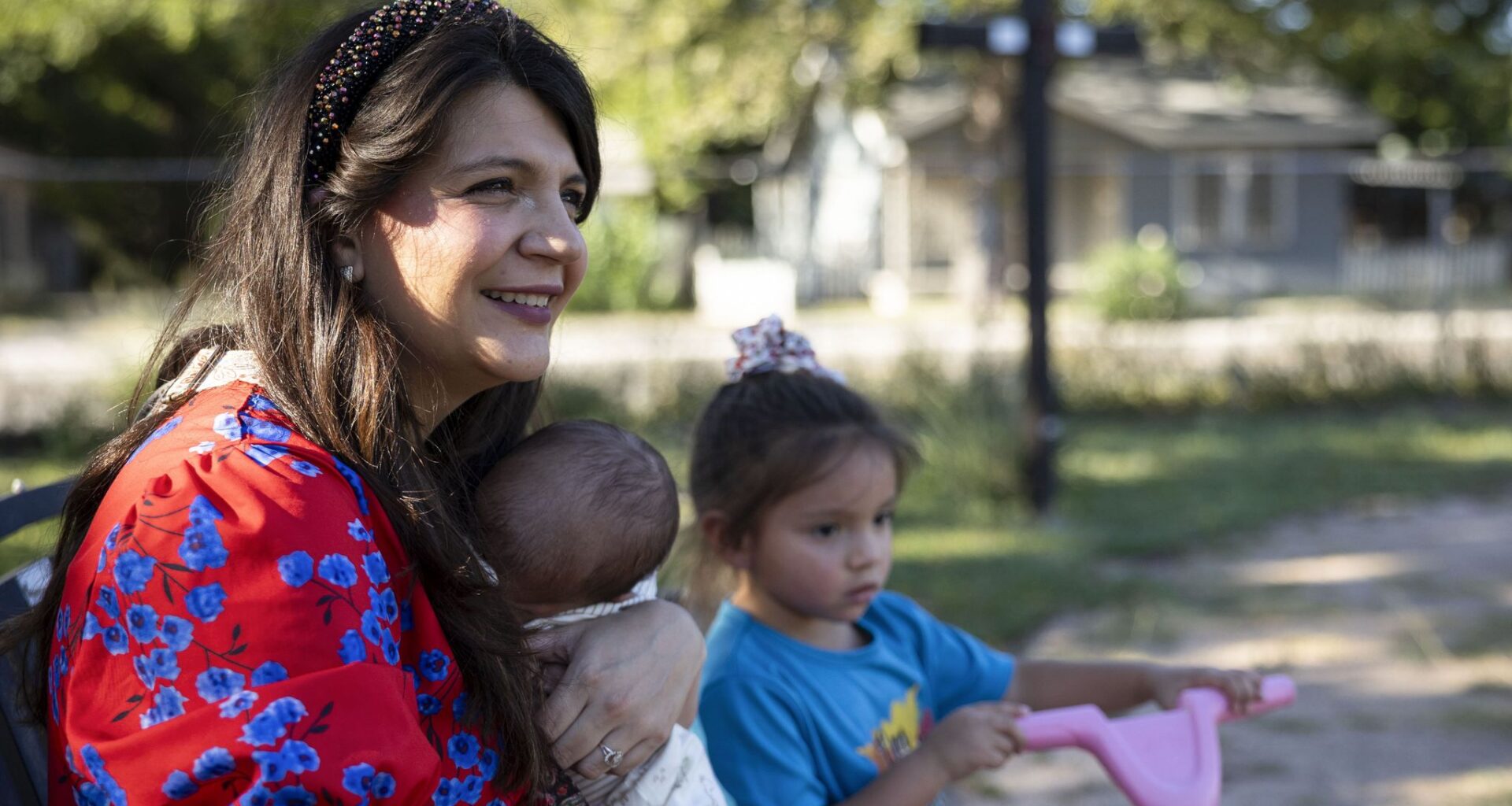
Judith Rendon holds her infant son, Jesus IV, while spending time with her daughter Ellie, 2. The South Side native has traveled to the North Side for maternal care since having her first child, who is now 8.
Katina Zentz/San Antonio Express-News
Judith Rendon, a South Side mother of four, has traveled to the North Side for maternal care and doctor’s appointments since having her first child, who is now 8.

“Access in the North Side is so much better, it’s all clustered together,” she said. “Here, it’s truly, to me, a desert.”
Article continues below this ad
Healthcare access has been an issue for decades on the South Side — a situation that was exacerbated by the 2023 closure of Texas Vista Medical Center, leaving just one hospital for the whole area. The loss of that facility will soon be partly offset: University Health is building Palo Alto Hospital on a 68-acre campus next to Texas A&M-San Antonio.
RELATED: ‘New strategies’: University Health looks beyond medicine on South Side
But even with Palo Alto, the South Side still will not have the same level of access to maternity care as is available on the North Side, which has nearly a half dozen facilities offering the services.
Rendon, 34, gave birth for the fourth time in mid-July. She said she traveled at least 30 minutes for each prenatal medical appointment — during rush hour, the drive could “easily” take almost double the time.
Article continues below this ad
San Antonio Express News Logo
Make us a Preferred Source on Google to see more of us when you search.
Add Preferred Source
Because her pregnancy was considered high risk, that meant multiple trips: Every two weeks, she had an appointment with an obstetrician-gynecologist and another with a high-risk pregnancy specialist; every four weeks, she had a cardiologist appointment.
Judith Rendon holds her infant son, Jesus IV, and her daughter Ellie, 2, while daughters Sol, 4, and Autumn, 8, sit with their father, Jesus. Her husband drove her to all her appointments on the North Side during her pregnancy with their son.
Katina Zentz/San Antonio Express-News
Her husband, Jesus, drove her to all appointments, and her mother-in-law has provided a helping hand — support that not all San Antonio moms have.
Article continues below this ad
RELATED: ‘It’s heartbreaking’: Former Southwest General hospital closes after 40 years
“I’m aware I’m privileged, and it’s so much harder for the moms who don’t have a car or family to rely on or can’t get off work,” she said. “Being in the healthcare field makes me even more aware that working as a community can help us move further.”
The South Side native — who attended South San Antonio Independent School District and met her husband there — worked at Texas Vista for years before its closure. There, she saw members of her community coming in for help, but it’s “gone now.”
Judith Rendon spends time with her children in August at the prayer garden by St. Joseph South San Catholic Church in San Antonio. “Access in the North Side is so much better, it’s all clustered together,” she says. “Here, it’s truly, to me, a desert.”
Katina Zentz/San Antonio Express-News
Judith Rendon holds son Jesus while spending time with her children at the prayer garden by St. Joseph South San Catholic Church.
Katina Zentz/San Antonio Express-News
Judith Rendon watches as 8-year-old Autumn holds her brother, Jesus, at their South Side home.
Katina Zentz/San Antonio Express-News
Judith Rendon holds her son, Jesus, while daughters Sol, Autumn and Ellie play at their South Side home.
Katina Zentz/San Antonio Express-News
Maternal care in San Antonio
The now-closed Texas Vista, originally Southwest General, was best known for its maternity ward. In 1994, it devoted a full ward and nursery to teenage mothers in an area with many young mothers. It also was the first in the city to offer free pregnancy tests. It ranked in the top 10% nationally for its maternity care in the 2000s.
Article continues below this ad
“That hospital was truly generational and something special for the community,” said Adriana Rocha Garcia, president and CEO of Center for Health Empowerment in South Texas, known as CHEST. “For kids to be able to say they were born in their neighborhood, born in the same hospital as their mom, it was truly special.”
READ MORE: History of Southwest General reveals much-needed hospital: ‘A hidden gem on the South Side’
Mothers like Rendon — who have to travel for prenatal care, including the training and recommendations that come from frequent doctor visits — are at a disadvantage, Rocha Garcia said. “If we don’t get the moms on the right path, something drastic can happen, like infant mortality,” she said.
Judith Rendon holds son Jesus while spending time with her children at the prayer garden by St. Joseph South San Catholic Church. “It’s so much harder for the moms who don’t have a car or family to rely on or can’t get off work,” she says.
Katina Zentz/San Antonio Express-News
San Antonio’s South Side is “officially designated as medically underserved,” according to CHEST. Only 70 acute care and 30 maternity beds are located in the South Side, out of the city’s 5,000 hospital beds.
Article continues below this ad
The 2022 Bexar County Community Health Needs Assessment report found that residents of ZIP code 78207 and other neighborhoods south of U.S. 90 have lifespans up to 20 years shorter than their neighbors in North Bexar County.
A survey respondent in the 2025 version of the report cited the area’s having only one emergency room (attached to a full-service hospital) as a reason for the difference in life expectancy and other negative health outcomes.
Transportation challenges
Community members often pointed out that having to cross town for medical care, especially specialty care, is more difficult for those without reliable transportation, the health needs report said.
Article continues below this ad
SA INC.: Get the week’s top local business stories in your inbox
“Where can we get or how can we get someone to listen to us and maybe set up transportation for those of us who don’t have a car, so we can get to San Antonio?’ Because it’s really hard, if you don’t have a car,” said a survey respondent from Von Ormy, on the Southwest Side.
Judith Rendon walks while holding son Jesus in August at the prayer garden by St. Joseph South San Catholic Church.
Katina Zentz/San Antonio Express-News
“Think about a mother who is having a kid in the summer: If they can’t find a ride, what if they miss their appointment? Some providers cancel if they don’t make it,” Rocha Garcia said. “Many things are stacked against moms to get the care that they need — and many of them can’t miss work hours because that will be a pay cut.”
Article continues below this ad
An option for those who don’t have a car is taking the bus. The VIA Metropolitan System operates 75 routes in a service area of over 1,200 miles.
But during the summer days with triple-digit temperatures and UV indexes over 10, it’s not safe for pregnant mothers to wait for the bus — especially at bus stops with no shelter, Rocha Garcia said.
Most bus stops in San Antonio are unsheltered and have metal benches, said Bill Barker, former director of planning at VIA and former executive director of Solar San Antonio. In mid-August, he measured the temperature at the San Pedro and Rector bus stop using an infrared thermometer. The bench’s surface temperature was nearly 143 degrees Fahrenheit.
The National Weather Service warns that heat index values of 130 degrees or higher can lead to heatstroke, which is a severe medical emergency. Symptoms include a core body temperature of 104 degrees or higher; hot, dry skin; rapid pulse; slurred speech; confusion; and seizures.
Article continues below this ad
RELATED: Here’s what you need to know about heat cramps, heat exhaustion and heatstroke
“If someone’s body temperature is 106°F, they are lucky to be alive,” Barker said.
The VIA Link, a van ride service that costs the same as the bus, is an alternative that allows San Antonians to book their rides in advance, which can come in handy for appointments. However, it only operates in six designated areas, according to a map on its website. One area is on the South Side, around Palo Alto College, TAMU-SA and the Toyota campus; a second is on the Southeast Side, around Brooks. But large swaths of the region don’t have coverage.
Sol Rendon embraces her baby brother, Jesus, while mother Judith supports the infant at their South Side home.
Katina Zentz/San Antonio Express-News
Road to solutions
University Health’s Palo Alto Hospital is set to open in February 2027 with six labor rooms; 11 neonatal intensive care unit beds plus a family room where parents can sleep overnight; and 10 postpartum rooms with a couplet-care design, where the baby can room in with a parent, according to University Health spokesperson Elizabeth Allen.
Article continues below this ad
RELATED: Meet the CEO guiding University Health’s expansion
“It’s an exciting time for the South Side to have this hospital coming in,” said Irma Sanchez, director of women’s health services/neonatology at Palo Alto.
In addition to Palo Alto Hospital, the health system is building a multispecialty center, University Health Vida, which will offer comprehensive medical care, including women’s health and pediatric services.
The labor and delivery facilities at Palo Alto Hospital will open as Level I, or the lowest on a scale that goes up to IV. Upon opening, the plan is to bring it to Level III status. University Health’s Women’s & Children’s Hospital, located on Medical Drive, is a Level IV NICU and a Level IV maternity center.
Article continues below this ad
Baptist’s Mission Trail Hospital, currently the only labor and delivery hospital south of U.S. 90, is a Level II center. If an infant is born there and needs more advanced care, transport is available to one of the system’s Level IV NICUs, said Natalie Gutierrez, Baptist Health System’s spokesperson. Those facilities are on the North Side.
Methodist Hospital has several OB-GYN and midwifery clinics, but they are all additions to their existing hospitals, none of which is on the South Side.
Despite the difficulties tied to healthcare access, Rendon wants to stay on the South Side, “where home is,” she said.
Article continues below this ad
“So many people leave here, but this is where my family is, where we were raised, where the people who really matter are,” she said. “I want to pass on the kindness I have received from my neighbors — I wouldn’t have it any other way.”
Judith Rendon talks to her daughter Sol, 4, while holding her infant son, Jesus. “So many people leave here, but this is where my family is, where we were raised, where the people who really matter are,” Rendon says of the South Side.
Katina Zentz/San Antonio Express-News